






Sunday, February 15, 2026
ISSN 2765-8767
  • Survey
  • Podcast
  • Write for Us
  • My Account
  • Log In
Daily Remedy
  • Home
  • Articles
  • Podcasts
    The Future of LLMs in Healthcare

    The Future of LLMs in Healthcare

    January 26, 2026
    The Future of Healthcare Consumerism

    The Future of Healthcare Consumerism

    January 22, 2026
    Your Body, Your Health Care: A Conversation with Dr. Jeffrey Singer

    Your Body, Your Health Care: A Conversation with Dr. Jeffrey Singer

    July 1, 2025

    The cost structure of hospitals nearly doubles

    July 1, 2025
    Navigating the Medical Licensing Maze

    The Fight Against Healthcare Fraud: Dr. Rafai’s Story

    April 8, 2025
    Navigating the Medical Licensing Maze

    Navigating the Medical Licensing Maze

    April 4, 2025
  • Surveys

    Surveys

    AI in Healthcare Decision-Making

    AI in Healthcare Decision-Making

    February 1, 2026
    Patient Survey: Understanding Healthcare Consumerism

    Patient Survey: Understanding Healthcare Consumerism

    January 18, 2026

    Survey Results

    Can you tell when your provider does not trust you?

    Can you tell when your provider does not trust you?

    January 18, 2026
    Do you believe national polls on health issues are accurate

    National health polls: trust in healthcare system accuracy?

    May 8, 2024
    Which health policy issues matter the most to Republican voters in the primaries?

    Which health policy issues matter the most to Republican voters in the primaries?

    May 14, 2024
    How strongly do you believe that you can tell when your provider does not trust you?

    How strongly do you believe that you can tell when your provider does not trust you?

    May 7, 2024
  • Courses
  • About Us
  • Contact us
  • Support Us
  • Official Learner
No Result
View All Result
  • Home
  • Articles
  • Podcasts
    The Future of LLMs in Healthcare

    The Future of LLMs in Healthcare

    January 26, 2026
    The Future of Healthcare Consumerism

    The Future of Healthcare Consumerism

    January 22, 2026
    Your Body, Your Health Care: A Conversation with Dr. Jeffrey Singer

    Your Body, Your Health Care: A Conversation with Dr. Jeffrey Singer

    July 1, 2025

    The cost structure of hospitals nearly doubles

    July 1, 2025
    Navigating the Medical Licensing Maze

    The Fight Against Healthcare Fraud: Dr. Rafai’s Story

    April 8, 2025
    Navigating the Medical Licensing Maze

    Navigating the Medical Licensing Maze

    April 4, 2025
  • Surveys

    Surveys

    AI in Healthcare Decision-Making

    AI in Healthcare Decision-Making

    February 1, 2026
    Patient Survey: Understanding Healthcare Consumerism

    Patient Survey: Understanding Healthcare Consumerism

    January 18, 2026

    Survey Results

    Can you tell when your provider does not trust you?

    Can you tell when your provider does not trust you?

    January 18, 2026
    Do you believe national polls on health issues are accurate

    National health polls: trust in healthcare system accuracy?

    May 8, 2024
    Which health policy issues matter the most to Republican voters in the primaries?

    Which health policy issues matter the most to Republican voters in the primaries?

    May 14, 2024
    How strongly do you believe that you can tell when your provider does not trust you?

    How strongly do you believe that you can tell when your provider does not trust you?

    May 7, 2024
  • Courses
  • About Us
  • Contact us
  • Support Us
  • Official Learner
No Result
View All Result
Daily Remedy
No Result
View All Result
Home Politics & Law

The Perception of COVID-19 Can Impact The Presidential Election

Daily Remedy by Daily Remedy
August 8, 2021
in Politics & Law
0

“Let them eat cake”, is quite possibly the most famous misattributed quotation given to any person in modern times. The person to whom the quotation is falsely attributed, Marie Antoinette, was already a reviled figure in pre-revolutionary France, and the perception that she was an out-of-touch elitist who did not understand the plight of the common person made this rumor seem all the more true, and all the more tantalizing not to share.

Eventually perception became reality, and the quotation became firmly entrenched to Marie Antoinette, and soon the quotation became a symbol of the gross inequity in French society – which led to a violent revolution leading many to lose their lives through of the most gruesome tools of execution, the guillotine. A revolution waiting for its initial igniting spark – that it found in an off-kilter remark, that came to symbolize much more than its words would have intended.

That is the power of perception. And while the aphorism, perception is greater than reality, has been used to the point of cliché, it nevertheless remains absolutely true.

And for this election cycle, perhaps the perception of voter safety will be the absolute deciding factor in determining who our next president will be.

It will determine who goes out to vote, and consequently, the total number of votes each candidate receives. If people feel the risk of contracting COVID-19 or the risk of suffering personal harm due to civic unrest or outright riots is too great, then voter turnout will be disproportionately affected. Of the two, I believe the former, the perception of public safety due to COVID-19 will be the bigger factor in influencing voter turnout.

Though a Rasmussen poll early in the Summer of 2020 found that nearly half of Americans believe that community violence is a risk in their communities – a statistic quite appalling – it is one that is not likely to change in the remaining weeks prior to the election.

What is likely to change, and change in a significant way, is the impact of COVID-19 on the everyday lives of Americans. A change that will have serious bearing on the voter turnout, far more than any risk of communal violence – because such a change will come in just weeks, if not days, before the election itself. Relatively recent – which makes it far more impactful.

Recency bias has been studied extensively by behavioral economists in nearly all facets of life, repeatedly proving that recent events hold greater sway than older, more historic events. A phenomenon that has come to shape much of our society, from closing arguments in legal courts to sales pitches targeting customers.

Recency bias creates predictable responses among the people affected – which, for voters, can be used to predict or in the very least, approximate, voter turnout based upon the progression of COVID-19.

The graph displayed is the Serial Position Effect, a term coined by Hermann Ebbinghaus and shows a wide, U-shaped curve. The graph was developed based upon numerous studies showing we tend to remember the first and last things more easily. Which for most seems obvious enough.
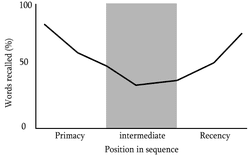
But what is not obvious are the factors that have shown to adjust the angle of the curve. Factors that can impact the effect of the recency bias on voters. The first is the overall intensity of the recency bias.

Is it far more severe or significant than other news we heard before?

If COVID-19 becomes far more virulent in the coming days than it has been before, then the impact of recency bias will become more pronounced. But that is not predictable, and the numerous revisions recurring among predictive models show just how unpredictable it is.

But what is predictable, and an equally signficant factor, is the duration of the recency bias. Studies have shown that recency bias depends upon both the intensity and the duration. And the impact of the duration is related to the ratio of the recency bias period relative to the entire period of exposure.

Translated into COVID-19 terms, the impact of the recency bias depends upon when COVID-19 gets worse. While estimates vary, most believe that COVID-19 really became a national issue sometime in March, with many economic shut-down periods beginning in April. So if we assume March to be the beginning, admittedly that is a challengeable assumption, then the pandemic has been going on for seven months. If the pandemic worsens in early October, then the recency bias ratio would be one month to seven months, or 1:7. If the pandemic worsens in late October, then the ratio would be less.

How less does it need to be to be negligible? That is the critical question.

We will never be able to predict true intensity and duration with such a short time interval, but the statistics can provide a proxy. And with these two points we can create parameters around understanding the impact of COVID-19 on voter perception.

Politics is rife with precedent, and October during presidential election years has been fertile ground for scandals and news. In fact, the term “October Surprise” was coined by political strategist, William Casey, to reflect the frequency of this phenomenon in modern politics. Indeed, nearly every election since the 1980’s has had some deliberately placed scandal designed to affect the election.

What makes 2020 unique is that the COVID-19 is not inherently political, but has become political through an entanglement of public policy, inter-department rivalries, and a wide array of public opinions and conspiracies. And the direction COVID-19 takes this October will likely be the October Surprise that determines the election.

To validate our assumptions, we will host a series of survey polls, administered through our own news outlet, to glean public feedback verifying our core assumptions.

To quantify the impact of voter safety we focus on two key metrics: daily death rates and daily cases of COVID-19. We use the metrics defined historically by the Institute for Health Metrics and Evaluation.

The survey below assesses voters’ perception of safety based upon different daily death rates and incidence reports. And the goal is to determine the relative impact of COVID-19 on voter turnout based upon the severity of the pandemic and when it begins to worsen. Survey results will be updated on a weekly basis until the election.

And hopefully by understanding voter perceptions and behaviors, we can ensure a safe and fair election for everybody.




ShareTweet
Daily Remedy

Daily Remedy

Dr. Jay K Joshi serves as the editor-in-chief of Daily Remedy. He is a serial entrepreneur and sought after thought-leader for matters related to healthcare innovation and medical jurisprudence. He has published articles on a variety of healthcare topics in both peer-reviewed journals and trade publications. His legal writings include amicus curiae briefs prepared for prominent federal healthcare cases.

Leave a Reply Cancel reply

Your email address will not be published. Required fields are marked *

Videos

In this episode, the host discusses the significance of large language models (LLMs) in healthcare, their applications, and the challenges they face. The conversation highlights the importance of simplicity in model design and the necessity of integrating patient feedback to enhance the effectiveness of LLMs in clinical settings.

Takeaways
LLMs are becoming integral in healthcare.
They can help determine costs and service options.
Hallucination in LLMs can lead to misinformation.
LLMs can produce inconsistent answers based on input.
Simplicity in LLMs is often more effective than complexity.
Patient behavior should guide LLM development.
Integrating patient feedback is crucial for accuracy.
Pre-training models with patient input enhances relevance.
Healthcare providers must understand LLM limitations.
The best LLMs will focus on patient-centered care.

Chapters

00:00 Introduction to LLMs in Healthcare
05:16 The Importance of Simplicity in LLMs
The Future of LLMs in HealthcareDaily Remedy
YouTube Video U1u-IYdpeEk
Subscribe

AI Regulation and Deployment Is Now a Core Healthcare Issue

Clinical Reads

Ambient Artificial Intelligence Clinical Documentation: Workflow Support with Emerging Governance Risk

Ambient Artificial Intelligence Clinical Documentation: Workflow Support with Emerging Governance Risk

by Daily Remedy
February 1, 2026
0

Health systems are increasingly deploying ambient artificial intelligence tools that listen to clinical encounters and automatically generate draft visit notes. These systems are intended to reduce documentation burden and allow clinicians to focus more directly on patient interaction. At the same time, they raise unresolved questions about patient consent, data handling, factual accuracy, and legal responsibility for machine‑generated records. Recent policy discussions and legal actions suggest that adoption is moving faster than formal oversight frameworks. The practical clinical question is...

Read more

Join Our Newsletter!

Twitter Updates

Tweets by TheDailyRemedy

Popular

  • The Information Epidemic: How Digital Health Misinformation Is Rewiring Clinical Risk

    The Information Epidemic: How Digital Health Misinformation Is Rewiring Clinical Risk

    0 shares
    Share 0 Tweet 0
  • Child Health Is Now a Platform Issue

    0 shares
    Share 0 Tweet 0
  • Prevention Is Having a Moment and a Measurement Problem

    0 shares
    Share 0 Tweet 0
  • Behavioral Health Is Now a Network Phenomenon

    0 shares
    Share 0 Tweet 0
  • The Breach Is the Diagnosis: Cybersecurity Has Become a Clinical Risk Variable

    0 shares
    Share 0 Tweet 0
  • 628 Followers

Daily Remedy

Daily Remedy offers the best in healthcare information and healthcare editorial content. We take pride in consistently delivering only the highest quality of insight and analysis to ensure our audience is well-informed about current healthcare topics - beyond the traditional headlines.

Daily Remedy website services, content, and products are for informational purposes only. We do not provide medical advice, diagnosis, or treatment. All rights reserved.

Important Links

  • Support Us
  • About Us
  • Contact us
  • Privacy Policy
  • Terms and Conditions

Join Our Newsletter!

  • Survey
  • Podcast
  • About Us
  • Contact us

© 2026 Daily Remedy

No Result
View All Result
  • Home
  • Articles
  • Podcasts
  • Surveys
  • Courses
  • About Us
  • Contact us
  • Support Us
  • Official Learner

© 2026 Daily Remedy