













Monday, March 30, 2026
ISSN 2765-8767
  • Survey
  • Podcast
  • Write for Us
  • My Account
  • Log In
Daily Remedy
  • Home
  • Articles
  • Podcasts
    The Hidden Costs Employers Don’t See in Traditional Health Plans

    The Hidden Costs Employers Don’t See in Traditional Health Plans

    March 22, 2026
    The Impact of COVID-19 on Patient Trust

    The Impact of COVID-19 on Patient Trust

    March 3, 2026
    Debunking Myths About GLP-1 Medications

    Debunking Myths About GLP-1 Medications

    February 16, 2026
    The Future of LLMs in Healthcare

    The Future of LLMs in Healthcare

    January 26, 2026
    The Future of Healthcare Consumerism

    The Future of Healthcare Consumerism

    January 22, 2026
    Your Body, Your Health Care: A Conversation with Dr. Jeffrey Singer

    Your Body, Your Health Care: A Conversation with Dr. Jeffrey Singer

    July 1, 2025
  • Surveys

    Surveys

    Understanding of Clinical Evidence in Peptide and Hormone Use

    Understanding of Clinical Evidence in Peptide and Hormone Use

    March 30, 2026
    Public Sentiment on the Future of Peptides and Hormone Therapies in U.S. Medicine

    Public Sentiment on the Future of Peptides and Hormone Therapies in U.S. Medicine

    March 17, 2026

    Survey Results

    Can you tell when your provider does not trust you?

    Can you tell when your provider does not trust you?

    January 18, 2026
    Do you believe national polls on health issues are accurate

    National health polls: trust in healthcare system accuracy?

    May 8, 2024
    Which health policy issues matter the most to Republican voters in the primaries?

    Which health policy issues matter the most to Republican voters in the primaries?

    May 14, 2024
    How strongly do you believe that you can tell when your provider does not trust you?

    How strongly do you believe that you can tell when your provider does not trust you?

    May 7, 2024
  • Courses
  • About Us
  • Contact us
  • Support Us
  • Official Learner
No Result
View All Result
  • Home
  • Articles
  • Podcasts
    The Hidden Costs Employers Don’t See in Traditional Health Plans

    The Hidden Costs Employers Don’t See in Traditional Health Plans

    March 22, 2026
    The Impact of COVID-19 on Patient Trust

    The Impact of COVID-19 on Patient Trust

    March 3, 2026
    Debunking Myths About GLP-1 Medications

    Debunking Myths About GLP-1 Medications

    February 16, 2026
    The Future of LLMs in Healthcare

    The Future of LLMs in Healthcare

    January 26, 2026
    The Future of Healthcare Consumerism

    The Future of Healthcare Consumerism

    January 22, 2026
    Your Body, Your Health Care: A Conversation with Dr. Jeffrey Singer

    Your Body, Your Health Care: A Conversation with Dr. Jeffrey Singer

    July 1, 2025
  • Surveys

    Surveys

    Understanding of Clinical Evidence in Peptide and Hormone Use

    Understanding of Clinical Evidence in Peptide and Hormone Use

    March 30, 2026
    Public Sentiment on the Future of Peptides and Hormone Therapies in U.S. Medicine

    Public Sentiment on the Future of Peptides and Hormone Therapies in U.S. Medicine

    March 17, 2026

    Survey Results

    Can you tell when your provider does not trust you?

    Can you tell when your provider does not trust you?

    January 18, 2026
    Do you believe national polls on health issues are accurate

    National health polls: trust in healthcare system accuracy?

    May 8, 2024
    Which health policy issues matter the most to Republican voters in the primaries?

    Which health policy issues matter the most to Republican voters in the primaries?

    May 14, 2024
    How strongly do you believe that you can tell when your provider does not trust you?

    How strongly do you believe that you can tell when your provider does not trust you?

    May 7, 2024
  • Courses
  • About Us
  • Contact us
  • Support Us
  • Official Learner
No Result
View All Result
Daily Remedy
No Result
View All Result
Home Perspectives

Infinite Clinical Games

We contextualize the clinical encounter as a game to see how trust affects the rules and payoffs.

Daily Remedy by Daily Remedy
November 27, 2022
in Perspectives
0
Infinite Clinical Games

Luemen Rutkowski

We all know healthcare’s a game. But few know the rules. We think the game’s defined over a clinical encounter, starting and then finishing, when it’s actually never-ending.

It’s an infinite game. It continues in perpetuity, with the rules changing after every decision. In game theory, we call it a changing payoff, which means the likelihood of a subsequent decision taking place changes after a round of decisions have been made. Sometimes we can see starkly different outcomes after just a few rounds, even for similar clinical circumstances.

Take a female patient going in for her mammogram screening. After the first screening, she gets an email saying the results were inconclusive, so she needs to get another test. Her initial instinct is to panic, to assume the worst case scenario and rush for a repeat test. Once the second study comes back normal, her fears assuage. After a few years of this, whenever she presents with inconclusive results on her mammogram, she chalks it up to her body type and leaves things at that.

Her response to the initially inconclusive test result changed after the second study because she saw the second study came back normal. Going forward, her response to similarly inconclusive studies changed because she knew what to expect the next time around. Her payoffs changed after every test result, so her decisions changed as well. In healthcare, every decision is a game, defined by payoffs that influence the outcome. And every round is a response to a previous decision, with the payoffs adjusting in reaction.

Since the payoffs determine the rules of the game, and consequently, the likely outcome, each clinical decision made before modifies subsequent decisions that will be made. If the rules are harsh and warrant a stiff penalty, then the difference in payoffs will be more skewed and the results of the game will reflect a more extreme, one-sided outcome. But if the rules are more balanced, then the payoffs will reflect a more even outcome.

Games are funny like that. It’s less about the player and more about the rules. In healthcare, it’s less about the individual decision-maker and more about the rules that affect the decisions. Sometimes the rules are so extreme that the outcome is a direct response to a rule itself.

The best of example of this would be the legal influence in healthcare. When the legal penalty for a clinical decision is severe, the rules reflect a more extreme difference in payoffs between that decision and its opposite.

Suppose an elderly patient appears in the emergency department with altered mental status. Regardless of what may be the underlying cause of the symptoms, the patient will receive a stroke workup. Providers will order blood tests, a carotid Doppler, and a head CT, regardless of whether it’s necessary. Maybe the patient’s dehydrated, maybe there’s an electrolyte imbalance; it doesn’t matter. The downside payoff for not ordering those tests is too risky because of the legal liability that comes with failing to perform a stroke workup. So clinical judgment be damned, those tests will get ordered.

But something gets lost in all of this. If the purpose of healthcare is to optimize patient outcomes, then the rules should reflect this, and only this. The payoff of any clinical decision made by a provider should balance the likelihood of diagnosing or treating a disease based on the presenting symptoms or available information. Instead, we see rules that lead to sub-optimal clinical outcomes because the payoffs have little medical basis. The rules are defined by avoiding legal liability instead of optimizing clinical decision-making. In certain instances, the payoffs are so extreme that they effectively determine the most legally safe outcome instead of guiding toward the best-case clinical scenario.

There are consequences to this. In any game where the results can be predicted by the rules, the rules overtake the outcome in importance. In healthcare, this is what happens when the risk of legal liability overtakes the clinical benefits of a decision.

Sure, state and federal regulatory bodies are quick to say they don’t influence the practice of medicine. But if they set the rules with payoffs that are extreme to the point of predetermining outcomes, then they are defining the practice of medicine.

We like to ignore this in healthcare. And we have yet to fully appreciate how extreme payoffs affect healthcare by swaying clinical decisions. It’s time we study how patient outcomes are affected by the decisions made. We can start by applying basic decision frameworks from behavioral economics.

When we construct decision matrices to compare the payoffs of different clinical decisions side by side, we see how influential the rules are to any outcome in medicine, particularly the rules defined by legal liabilities.

Take the following vignette: A 57 year old female patient with rheumatoid arthritis presents to her primary care office complaining of worsening pain. She’s already on opioids for pain, as well as a low dose disease modifying anti-rheumatic drug (DMARD). And now, she’s asking for a bump in her pain medications. The primary care physician is presented with a series of decisions: to trust or not to trust the patient when she says she’s in pain, and to temporarily increase or not to increase the pain medications.

When displayed in a two-by-two matrix, we see the decisions side by side. On the left is the decision to trust and on the top is the decision to increase the medication. The payoff to the physician is the first number and the payoff to the patient is the second number, with the two being separated by a comma. It may appear odd that we separated the decision to trust with the decision to adjust the opioid dose, but that’s the point.
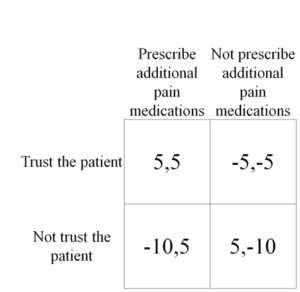
Infinite Clinical Games Figure

Clinical decisions made with a degree of skepticism have different payoffs because the results from those decisions are different. When you trust someone, you act implicitly, without too much guarding – like letting your friend borrow your car. But absent trust, the barriers come up. Now that same situation, letting someone borrow your car, but somebody you distrust, is met with a litany of paperwork detailing who assumes liability and how the car will be driven. In your mind, the lack of trust poses a risk, so the perceived risk of letting that person borrow your car becomes greater. So the payoffs grow farther apart.

In this clinical scenario, the payoffs reflect how trust alters a clinical decision. When a physician trusts a patient, his downside risk is perceived to be lower so the outcome is more balance, often tilting toward what’s best for the patient.

But trust does something else beyond altering the likely outcome. It not only changes the payoffs, it changes the game fundamentally by changing how the players view it. Each patient encounter is no longer seen as a single game, repeated and reenacted over and over again at each visit. It’s seen as an infinite game, ongoing and changing per clinical visit.

In such a game, the physician is more likely to provide additional pain medications because he is more trusting of her. Not just that she truly has worsening pain, but that she will use the medications appropriately and agree to decrease the medications back to its original dose later on. Both the physician and the patient make decisions in the moment based on trust, knowing that the engendered trust in the current decision will positively affect payoffs in subsequent decisions.

In contrast, absent any meaningful trust, the clinical encounter breaks down into a single decision with the full weight of legal liability squarely felt in the payoffs. There is no subsequent round because neither the physician nor the patient can see much beyond this current decision. The physician is distrustful, afraid of the legal consequences that may come from increasing her pain medication. So he makes a decision based on a payoff that is defined less by the patient’s clinical need and more on the potential legal liability. As a result, the patient suffers.

Trust turns the clinical encounter from a game with fixed payoffs restarted at each encounter into an ongoing game with changing payoffs modifying over time. It aligns the payoffs of any clinical decision with what’s best for the patient and increases the likelihood of an optimal clinical outcome.


ShareTweet
Daily Remedy

Daily Remedy

Dr. Jay K Joshi serves as the editor-in-chief of Daily Remedy. He is a serial entrepreneur and sought after thought-leader for matters related to healthcare innovation and medical jurisprudence. He has published articles on a variety of healthcare topics in both peer-reviewed journals and trade publications. His legal writings include amicus curiae briefs prepared for prominent federal healthcare cases.

Leave a Reply Cancel reply

Your email address will not be published. Required fields are marked *

Videos

Most employers are unknowingly steering their health plans toward higher costs and reduced control — until they understand how fiduciary missteps and anti-competitive contracts bleed their budgets dry. Katie Talento, a recognized health policy leader, reveals how shifting the network paradigm can save millions by emphasizing independent providers, direct contracting, and innovative tiering models.

Grounded in real-world case studies like Harris Rosen’s community-driven initiative, this episode dives deep into practical strategies to realign incentives—focusing on primary care, specialty care, and transparent vendor relationships. You'll discover how traditional carrier networks are often Trojan horses, locking employers into costly, opaque arrangements that undermine fiduciary duties. Katie breaks down simple yet powerful reforms: owning your data, eliminating conflicts of interest, and outlawing anti-competitive contract clauses.

We explore how a post-network framework—where patients are free to choose providers without restrictive network barriers—can massively reduce costs and improve health outcomes. You'll learn why independent, locally owned providers are vital to rebuilding trust, reducing unnecessary procedures, and reinvesting savings into the community. This conversation offers clarity on the unseen legal landmines employers face and actionable ways to craft health plans built on transparency, independence, and aligned incentives.

Perfect for HR pros, benefits advisors, physicians, and employer leaders committed to transforming healthcare from the ground up. If you’re tired of broken healthcare models draining your budget and frustrating your staff, this episode will empower you to take control by understanding and reshaping the very foundations of employer-sponsored health. Discover the blueprint for smarter, fairer, and more sustainable benefits.

Visit katytalento.com or allbetter.health to connect directly and explore how these innovations can work for your organization. Your path toward a healthier, more cost-effective future starts here.

Chapters

00:00 Introduction to Employer-Sponsored Health Plans
02:50 Understanding ERISA and Fiduciary Responsibilities
06:08 The Misalignment of Clinical and Financial Interests
08:54 Enforcement and Legal Implications for Employers
11:49 Redefining Networks: The Post-Network Framework
25:34 Navigating Healthcare Contracts and Cash Payments
27:31 Understanding Employer Health Plan Structures
28:04 The Role of Benefits Advisors in Health Plans
30:45 Governance and Data Ownership in Health Plans
37:05 Case Study: The Rosen Hotels' Health Model
41:33 Incentivizing Healthy Choices in Healthcare
47:22 Empowering Primary Care and Independent Providers
The Hidden Costs Employers Don’t See in Traditional Health Plans
YouTube Video xhks7YbmBoY
Subscribe

Policy Shift in Peptide Regulation

Clinical Reads

Semaglutide and the Expansion Problem: When One Trial Becomes a Platform

Semaglutide and the Expansion Problem: When One Trial Becomes a Platform

by Daily Remedy
March 30, 2026
0

Semaglutide has moved beyond its original indication and now sits at the center of a widening set of clinical questions: cardiovascular risk, kidney disease progression, and even neurodegeneration. The question is no longer whether the drug lowers glucose or reduces weight—it does—but how far those effects extend across systems, and whether evidence from one population can be translated into another without distortion. Large, well-powered trials have produced consistent signals, yet those signals are now being applied in contexts that were...

Read more

Join Our Newsletter!

Twitter Updates

Tweets by TheDailyRemedy

Popular

  • Neuralink's Healthcare Ambitions

    Neuralink’s Healthcare Ambitions

    1 shares
    Share 0 Tweet 0
  • Innocent Physician Still Punished

    0 shares
    Share 0 Tweet 0
  • Substantive Due Process in Healthcare

    0 shares
    Share 0 Tweet 0
  • The Performance of Rest

    0 shares
    Share 0 Tweet 0
  • What’s Next for the Obesity Industrial Complex

    0 shares
    Share 0 Tweet 0
  • 628 Followers

Daily Remedy

Daily Remedy offers the best in healthcare information and healthcare editorial content. We take pride in consistently delivering only the highest quality of insight and analysis to ensure our audience is well-informed about current healthcare topics - beyond the traditional headlines.

Daily Remedy website services, content, and products are for informational purposes only. We do not provide medical advice, diagnosis, or treatment. All rights reserved.

Important Links

  • Support Us
  • About Us
  • Contact us
  • Privacy Policy
  • Terms and Conditions

Join Our Newsletter!

  • Survey
  • Podcast
  • About Us
  • Contact us

© 2026 Daily Remedy

No Result
View All Result
  • Home
  • Articles
  • Podcasts
  • Surveys
  • Courses
  • About Us
  • Contact us
  • Support Us
  • Official Learner

© 2026 Daily Remedy