













Friday, February 13, 2026
ISSN 2765-8767
  • Survey
  • Podcast
  • Write for Us
  • My Account
  • Log In
Daily Remedy
  • Home
  • Articles
  • Podcasts
    The Future of LLMs in Healthcare

    The Future of LLMs in Healthcare

    January 26, 2026
    The Future of Healthcare Consumerism

    The Future of Healthcare Consumerism

    January 22, 2026
    Your Body, Your Health Care: A Conversation with Dr. Jeffrey Singer

    Your Body, Your Health Care: A Conversation with Dr. Jeffrey Singer

    July 1, 2025

    The cost structure of hospitals nearly doubles

    July 1, 2025
    Navigating the Medical Licensing Maze

    The Fight Against Healthcare Fraud: Dr. Rafai’s Story

    April 8, 2025
    Navigating the Medical Licensing Maze

    Navigating the Medical Licensing Maze

    April 4, 2025
  • Surveys

    Surveys

    AI in Healthcare Decision-Making

    AI in Healthcare Decision-Making

    February 1, 2026
    Patient Survey: Understanding Healthcare Consumerism

    Patient Survey: Understanding Healthcare Consumerism

    January 18, 2026

    Survey Results

    Can you tell when your provider does not trust you?

    Can you tell when your provider does not trust you?

    January 18, 2026
    Do you believe national polls on health issues are accurate

    National health polls: trust in healthcare system accuracy?

    May 8, 2024
    Which health policy issues matter the most to Republican voters in the primaries?

    Which health policy issues matter the most to Republican voters in the primaries?

    May 14, 2024
    How strongly do you believe that you can tell when your provider does not trust you?

    How strongly do you believe that you can tell when your provider does not trust you?

    May 7, 2024
  • Courses
  • About Us
  • Contact us
  • Support Us
  • Official Learner
No Result
View All Result
  • Home
  • Articles
  • Podcasts
    The Future of LLMs in Healthcare

    The Future of LLMs in Healthcare

    January 26, 2026
    The Future of Healthcare Consumerism

    The Future of Healthcare Consumerism

    January 22, 2026
    Your Body, Your Health Care: A Conversation with Dr. Jeffrey Singer

    Your Body, Your Health Care: A Conversation with Dr. Jeffrey Singer

    July 1, 2025

    The cost structure of hospitals nearly doubles

    July 1, 2025
    Navigating the Medical Licensing Maze

    The Fight Against Healthcare Fraud: Dr. Rafai’s Story

    April 8, 2025
    Navigating the Medical Licensing Maze

    Navigating the Medical Licensing Maze

    April 4, 2025
  • Surveys

    Surveys

    AI in Healthcare Decision-Making

    AI in Healthcare Decision-Making

    February 1, 2026
    Patient Survey: Understanding Healthcare Consumerism

    Patient Survey: Understanding Healthcare Consumerism

    January 18, 2026

    Survey Results

    Can you tell when your provider does not trust you?

    Can you tell when your provider does not trust you?

    January 18, 2026
    Do you believe national polls on health issues are accurate

    National health polls: trust in healthcare system accuracy?

    May 8, 2024
    Which health policy issues matter the most to Republican voters in the primaries?

    Which health policy issues matter the most to Republican voters in the primaries?

    May 14, 2024
    How strongly do you believe that you can tell when your provider does not trust you?

    How strongly do you believe that you can tell when your provider does not trust you?

    May 7, 2024
  • Courses
  • About Us
  • Contact us
  • Support Us
  • Official Learner
No Result
View All Result
Daily Remedy
No Result
View All Result
Home Perspectives

How Robert Langer Failed Repeatedly But Kept Going

The Conversation by The Conversation
April 3, 2024
in Perspectives
0
How Robert Langer Failed Repeatedly But Kept Going

How Robert Langer, a pioneer in delivering mRNA into the body, failed repeatedly but kept going: ‘They said I should give up, but I don’t like to give up’

Robert Langer img
Robert Langer.
Pat Greenhouse/The Boston Globe via Getty Images

Robert Langer, Massachusetts Institute of Technology (MIT)

The mRNA vaccines developed against COVID-19 owe a lot to the work of Robert Langer, a pioneer in the delivery of mRNA. Langer, who is the Massachusetts Institute of Technology David H. Koch Institute Professor and director of the Langer Lab, helped lay the foundation for the underlying delivery mechanism that has led to the development of the first commercial mRNA vaccines, which can be used for a variety of infectious diseases and conditions. Langer is a co-founder of Moderna, the biotech company that developed an mRNA vaccine against COVID-19. He also has authored more than 1,500 scientific papers and is the most-cited engineer in history.

Langer published the first paper to show that it was possible to deliver nucleic acids like RNA and DNA to the body via tiny particles. He spoke in March 2022 at the 2022 Imagine Solutions Conference in Naples, FL. about his journey from a chemical engineering doctorate to helping develop technology for various lifesaving treatments.

Below are some highlights from the discussion. Answers have been edited for brevity and clarity.

Robert Langer speaks at the Imagine Solutions Conference 2022.

How did you end up where you are in your field?

Robert Langer: My story is not straightforward by any means. I got my doctorate in chemical engineering from MIT in 1974. One of the things I thought about doing was education, because when I was a graduate student at MIT I helped start a school in Cambridge, The Group School. And I got very involved in developing new chemistry and math curricula.

And I wrote to all these colleges and none of them wrote me back, so I started to think, well, what other way could I use my science and engineering education to help people? And I thought about medicine. I wrote to a lot of hospitals and medical schools. They didn’t write back to me either.

And then one day one of the people at my MIT lab said, “Bob, you know, there’s a surgeon named Judah Folkman in Boston and sometimes he hires unusual people.”

From 1974 to 1977 you worked as a postdoctoral fellow at the Children’s Hospital Boston and at Harvard Medical School under Folkman. How did your work with Folkman influence your career?
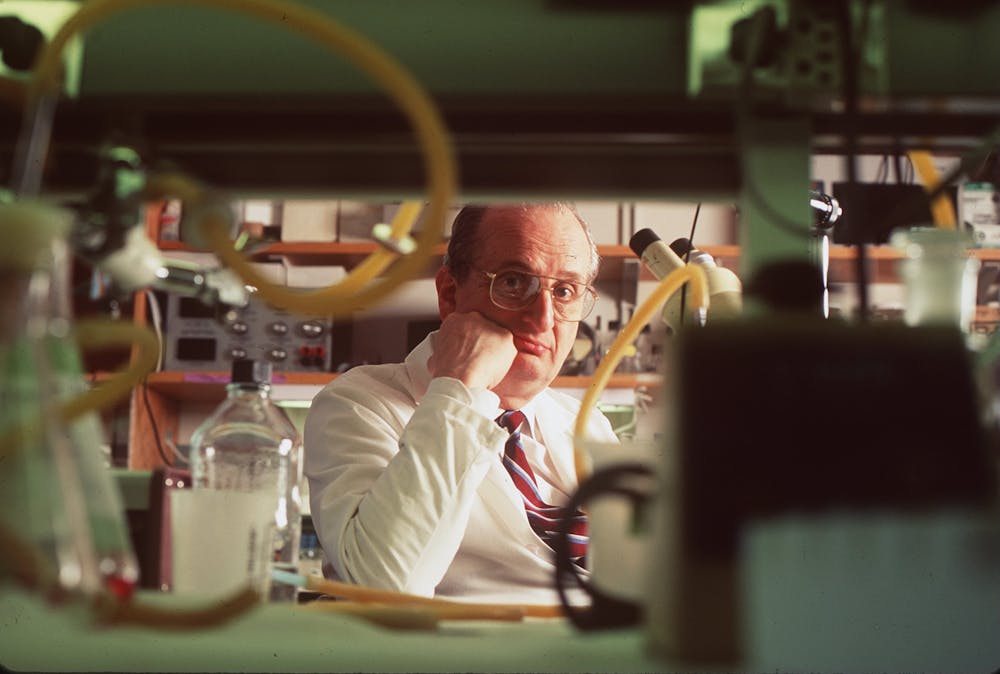
A balding man with glasses wearing a lab coat over a white shirt and tie sits at a lab bench surrounded by test tubes and lab equipment.
Dr. Judah Folkman (1933-2008) explored the role of blood vessels in disease and faced heavy skepticism.
Bill Greene/The Boston Globe via Getty Images

Dr. Folkman’s idea of how tumors grew was actually quite controversial. His theory was that tumors secreted a chemical signal, which he called TAF, tumor angiogenesis factor. And that would cause blood vessels to grow to the tumor. The tumor then could spread through those blood vessels. That’s a process called metastasis, which often kills people.

His theory was that if you could stop blood vessels maybe that would be a new way to stop cancer. To solve this problem we had to deliver large molecules to the body through tiny particles. Nobody before us had done that, and we were told it was impossible.

I spent about two years working in the laboratory, and I found over 200 different ways to get this to not work. Eventually I was able to make little microspheres, or nanospheres. We published our findings in the journal Nature. This was the first time nucleic acids had ever been delivered through tiny particles for any period of time.

What was the process for obtaining the patent?

Folkman and I filed for a patent, but the patent examiner rejected it five years in a row. And all the people at the hospital told me I was wasting a lot of money for the hospital. They said I should give up, but I don’t like to give up.

When we first started doing this, everybody told me it was impossible and that it could never work. So I did what’s called a science citation search, looking back at our 1976 Nature paper. One of the papers I found was really helpful. I had no idea it was even written but I found that five of the top material scientists in the world said that Folkman and I had shown some surprising results that clearly demonstrate that this idea could work.

We showed that to the examiner and he said, well, that’s interesting. He said, I’ll allow the patent if you can get written affidavits from these five people that they really wrote it. So I wrote them and they wrote back and sent the affidavits. We got this really broad patent, and with that patent I got involved in starting companies.

What did this process teach you?

I learned that if you’re not your own champion, nobody else will be. So I got involved in patenting things, and my students were very interested in seeing their work make a difference. That’s what led to a number of different companies, some of which we started and others which we guided, developing many products used today. My story is sort of one person’s example of how you can try to use science to help relieve suffering and prolong life.

[Over 150,000 readers rely on The Conversation’s newsletters to understand the world. Sign up today.]

Robert Langer, Institute Professor, Massachusetts Institute of Technology (MIT)

This article is republished from The Conversation under a Creative Commons license. Read the original article.


ShareTweet
The Conversation

The Conversation

Leave a Reply Cancel reply

Your email address will not be published. Required fields are marked *

Videos

In this episode, the host discusses the significance of large language models (LLMs) in healthcare, their applications, and the challenges they face. The conversation highlights the importance of simplicity in model design and the necessity of integrating patient feedback to enhance the effectiveness of LLMs in clinical settings.

Takeaways
LLMs are becoming integral in healthcare.
They can help determine costs and service options.
Hallucination in LLMs can lead to misinformation.
LLMs can produce inconsistent answers based on input.
Simplicity in LLMs is often more effective than complexity.
Patient behavior should guide LLM development.
Integrating patient feedback is crucial for accuracy.
Pre-training models with patient input enhances relevance.
Healthcare providers must understand LLM limitations.
The best LLMs will focus on patient-centered care.

Chapters

00:00 Introduction to LLMs in Healthcare
05:16 The Importance of Simplicity in LLMs
The Future of LLMs in HealthcareDaily Remedy
YouTube Video U1u-IYdpeEk
Subscribe

AI Regulation and Deployment Is Now a Core Healthcare Issue

Clinical Reads

Ambient Artificial Intelligence Clinical Documentation: Workflow Support with Emerging Governance Risk

Ambient Artificial Intelligence Clinical Documentation: Workflow Support with Emerging Governance Risk

by Daily Remedy
February 1, 2026
0

Health systems are increasingly deploying ambient artificial intelligence tools that listen to clinical encounters and automatically generate draft visit notes. These systems are intended to reduce documentation burden and allow clinicians to focus more directly on patient interaction. At the same time, they raise unresolved questions about patient consent, data handling, factual accuracy, and legal responsibility for machine‑generated records. Recent policy discussions and legal actions suggest that adoption is moving faster than formal oversight frameworks. The practical clinical question is...

Read more

Join Our Newsletter!

Twitter Updates

Tweets by TheDailyRemedy

Popular

  • The Information Epidemic: How Digital Health Misinformation Is Rewiring Clinical Risk

    The Information Epidemic: How Digital Health Misinformation Is Rewiring Clinical Risk

    0 shares
    Share 0 Tweet 0
  • Prevention Is Having a Moment and a Measurement Problem

    0 shares
    Share 0 Tweet 0
  • Health Technology Assessment Is Moving Upstream

    0 shares
    Share 0 Tweet 0
  • Behavioral Health Is Now a Network Phenomenon

    0 shares
    Share 0 Tweet 0
  • Affordability Is the New Clinical Variable

    0 shares
    Share 0 Tweet 0
  • 628 Followers

Daily Remedy

Daily Remedy offers the best in healthcare information and healthcare editorial content. We take pride in consistently delivering only the highest quality of insight and analysis to ensure our audience is well-informed about current healthcare topics - beyond the traditional headlines.

Daily Remedy website services, content, and products are for informational purposes only. We do not provide medical advice, diagnosis, or treatment. All rights reserved.

Important Links

  • Support Us
  • About Us
  • Contact us
  • Privacy Policy
  • Terms and Conditions

Join Our Newsletter!

  • Survey
  • Podcast
  • About Us
  • Contact us

© 2026 Daily Remedy

No Result
View All Result
  • Home
  • Articles
  • Podcasts
  • Surveys
  • Courses
  • About Us
  • Contact us
  • Support Us
  • Official Learner

© 2026 Daily Remedy