













Tuesday, March 10, 2026
ISSN 2765-8767
  • Survey
  • Podcast
  • Write for Us
  • My Account
  • Log In
Daily Remedy
  • Home
  • Articles
  • Podcasts
    The Impact of COVID-19 on Patient Trust

    The Impact of COVID-19 on Patient Trust

    March 3, 2026
    Debunking Myths About GLP-1 Medications

    Debunking Myths About GLP-1 Medications

    February 16, 2026
    The Future of LLMs in Healthcare

    The Future of LLMs in Healthcare

    January 26, 2026
    The Future of Healthcare Consumerism

    The Future of Healthcare Consumerism

    January 22, 2026
    Your Body, Your Health Care: A Conversation with Dr. Jeffrey Singer

    Your Body, Your Health Care: A Conversation with Dr. Jeffrey Singer

    July 1, 2025

    The cost structure of hospitals nearly doubles

    July 1, 2025
  • Surveys

    Surveys

    Perceptions of Viral Wellness Practices on Social Media: A Likert-Scale Survey for Informed Readers

    Perceptions of Viral Wellness Practices on Social Media: A Likert-Scale Survey for Informed Readers

    March 1, 2026
    How Confident Are You in RFK Jr.’s Health Leadership?

    How Confident Are You in RFK Jr.’s Health Leadership?

    February 16, 2026

    Survey Results

    Can you tell when your provider does not trust you?

    Can you tell when your provider does not trust you?

    January 18, 2026
    Do you believe national polls on health issues are accurate

    National health polls: trust in healthcare system accuracy?

    May 8, 2024
    Which health policy issues matter the most to Republican voters in the primaries?

    Which health policy issues matter the most to Republican voters in the primaries?

    May 14, 2024
    How strongly do you believe that you can tell when your provider does not trust you?

    How strongly do you believe that you can tell when your provider does not trust you?

    May 7, 2024
  • Courses
  • About Us
  • Contact us
  • Support Us
  • Official Learner
No Result
View All Result
  • Home
  • Articles
  • Podcasts
    The Impact of COVID-19 on Patient Trust

    The Impact of COVID-19 on Patient Trust

    March 3, 2026
    Debunking Myths About GLP-1 Medications

    Debunking Myths About GLP-1 Medications

    February 16, 2026
    The Future of LLMs in Healthcare

    The Future of LLMs in Healthcare

    January 26, 2026
    The Future of Healthcare Consumerism

    The Future of Healthcare Consumerism

    January 22, 2026
    Your Body, Your Health Care: A Conversation with Dr. Jeffrey Singer

    Your Body, Your Health Care: A Conversation with Dr. Jeffrey Singer

    July 1, 2025

    The cost structure of hospitals nearly doubles

    July 1, 2025
  • Surveys

    Surveys

    Perceptions of Viral Wellness Practices on Social Media: A Likert-Scale Survey for Informed Readers

    Perceptions of Viral Wellness Practices on Social Media: A Likert-Scale Survey for Informed Readers

    March 1, 2026
    How Confident Are You in RFK Jr.’s Health Leadership?

    How Confident Are You in RFK Jr.’s Health Leadership?

    February 16, 2026

    Survey Results

    Can you tell when your provider does not trust you?

    Can you tell when your provider does not trust you?

    January 18, 2026
    Do you believe national polls on health issues are accurate

    National health polls: trust in healthcare system accuracy?

    May 8, 2024
    Which health policy issues matter the most to Republican voters in the primaries?

    Which health policy issues matter the most to Republican voters in the primaries?

    May 14, 2024
    How strongly do you believe that you can tell when your provider does not trust you?

    How strongly do you believe that you can tell when your provider does not trust you?

    May 7, 2024
  • Courses
  • About Us
  • Contact us
  • Support Us
  • Official Learner
No Result
View All Result
Daily Remedy
No Result
View All Result
Home Trends

One in Four Americans are Covered by Medicaid or CHIP

Daily Remedy by Daily Remedy
February 22, 2022
in Trends
0
One in Four Americans are Covered by Medicaid or CHIP

Heather Bednarek, Saint Louis University and Ellen Barnidge, Saint Louis University
CC BY-ND

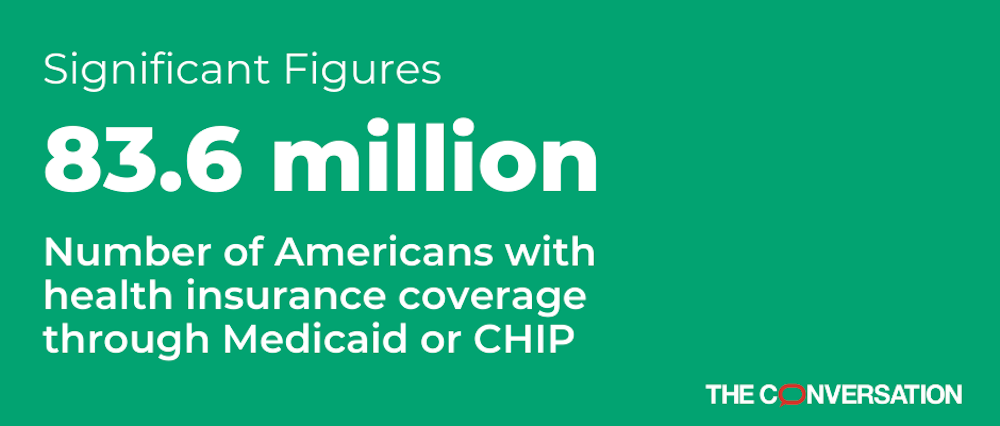
As of July 2021, a total of 83.6 million Americans were insured through either Medicaid or the Children’s Health Insurance Program.

That’s almost 1 in 4 Americans, with 76.7 million insured through Medicaid and 6.9 million through CHIP. Both public health insurance programs are funded jointly by the federal and state governments. Medicaid provides health insurance for low-income people, most of whom are 64 or younger.

CHIP provides health coverage to kids and pregnant women whose families have low incomes but make too much to qualify for Medicaid.

Affordable Care Act’s impact

Before states began to expand Medicaid in 2014 as part of the Affordable Care Act, the program was much smaller, covering around 55 million people in 2013.

So far, 38 states and the District of Columbia have expanded Medicaid access, with financial support from the federal government.

Prior to the ACA, most states were more restrictive about who could enroll in Medicaid, a program launched following the enactment of landmark legislation President Lyndon B. Johnson signed into law in 1965. After the ACA, the federal government began to shoulder more of the program’s costs, footing at least 90% of the bill for new enrollees covered through the program’s expansion.

Today, all adults in Medicaid expansion states who are under 65 with annual incomes less than 138% of the federal poverty line are eligible for Medicaid. In 2022, that means someone who is single without dependents and has an income of $18,754 or less qualifies, as does a family of four earning up to $38,295.

Eligibility rules in nonexpansion states vary widely and exclude more low-income people.

CHIP was signed into law in 1997. Like the Medicaid expansion it was optional, yet it was adopted in all states within three years, by 2000.

Unfortunately, 4.3 million children remain uninsured, many of whom are in poverty, live in a nonexpansion state or a state with stricter income eligibility standards for CHIP.

Even when children are eligible for Medicaid or CHIP, they may not be enrolled in the program due to their parents’ lack of awareness or their state’s lack of outreach.

The pace of Medicaid expansion since 2014 has been far slower than the CHIP rollout. Twelve states have yet to opt in, as of February 2022, though the expansion debate continues.

And yet Medicaid’s sharp enrollment growth has reduced the share of uninsured people.

Fewer uninsured Americans

About 91.4% of Americans had public or private health coverage for at least part of 2020, leaving an estimated 28 million Americans without any health insurance, according to the Census Bureau. In 2013, only 86.7% of the country was insured.

Our state, Missouri, expanded Medicaid on Oct. 1, 2021. The state estimates that as many as 275,000 people are newly eligible, though only about 64,000 enrolled in the first five months. Oklahoma expanded Medicaid in July 2021, enrolling more than 200,000 in its first few months. South Dakota may be next: its voters will decide whether to expand Medicaid in November 2022.

Of the 28.6 million Americans who have enrolled in Medicaid or CHIP since the ACA was rolled out, about 60% obtained coverage prior to the COVID-19 pandemic.

Response to the COVID-19 pandemic

In March 2020, the federal government responded to what it correctly anticipated as the sharp growth of Medicaid and CHIP coverage.

At the time, an unemployment surge was stripping millions of workers of their economic stability, including health insurance coverage. Medicaid enrollments tend to rise during bad economic times, as people become eligible due to lower incomes. The pandemic was no different, particularly in 2020.

What’s different this time is that states, which administer Medicaid and CHIP, haven’t been allowed to kick anyone out of the program during this period – even if they would have lost eligibility due to higher earnings.

This restriction will continue as long as the federal government public health emergency declaration remains in effect. To help states with that increased financial burden, the federal government increased its share of Medicaid payments to states.

In January 2022, the Biden administration renewed the public health emergency for another three months. The emergency declaration is scheduled to expire on April 16.

Soon after this measure expires, millions who have been covered by Medicaid but now make too much money to qualify could lose their eligibility, particularly if they live in states that have not yet expanded Medicaid.

But it’s not clear whether the number of Americans enrolled in these programs will decline sharply. In part, that’s because more people are getting access to Medicaid for the first time due to their states’ participation in its expansion.

[You’re smart and curious about the world. So are The Conversation’s authors and editors. You can read us daily by subscribing to our newsletter.]

Heather Bednarek, Associate Professor of Economics, Saint Louis University and Ellen Barnidge, Associate Professor of Behavioral Science and Health Education; Interim Dean of the College for Public Health and Social Justice, Saint Louis University

This article is republished from The Conversation under a Creative Commons license. Read the original article.


ShareTweet
Daily Remedy

Daily Remedy

Dr. Jay K Joshi serves as the editor-in-chief of Daily Remedy. He is a serial entrepreneur and sought after thought-leader for matters related to healthcare innovation and medical jurisprudence. He has published articles on a variety of healthcare topics in both peer-reviewed journals and trade publications. His legal writings include amicus curiae briefs prepared for prominent federal healthcare cases.

Leave a Reply Cancel reply

Your email address will not be published. Required fields are marked *

Videos

In this episode of the Daily Remedy Podcast, Tiffany Ryder discusses her insights on healthcare messaging, the impact of COVID-19 on patient trust, and the importance of transparency in health policy. She emphasizes the need for clear communication in the face of divisiveness and explores the complexities surrounding the estrogen debate. Additionally, Tiffany highlights positive developments in health policy and the necessity of effectively conveying these changes to the public.

Tiffany Ryder is a political commentator and public health policy thought leader who publishes the Substack newsletter Signal and Noise: https://signalandnoise.online/


Chapters

00:00 Introduction to Healthcare Conversations
02:58 Signal and Noise: Understanding Healthcare Communication
05:56 The Storytelling Problem in Healthcare
08:58 Navigating Political Divisiveness in Health Policy
11:55 The Role of Media in Health Policy
15:03 Bias in Health Reporting
17:56 Estrogen and Health Policy: A Case Study
24:00 Positive Developments in Health Policy
27:03 Looking Ahead: Future of Health Policy
31:49 Communicating Health Policy Effectively
The Impact of COVID-19 on Patient Trust
YouTube Video ujzgl7HDlsw
Subscribe

2027 Medicare Advantage & Part D Advance Notice

Clinical Reads

GLP-1 Drugs Have Moved Past Weight Loss. Medicine Has Not Fully Caught Up.

Glucagon-Like Peptide–Based Therapies and Longevity: Clinical Implications from Emerging Evidence

by Daily Remedy
March 1, 2026
0

Glucagon-like peptide–based therapies are increasingly used for weight management and glycemic control, but their potential impact on long-term survival remains uncertain. The clinical question addressed in this report is whether treatment with glucagon-like peptide receptor agonists is associated with reductions in all-cause mortality and age-related morbidity beyond their established metabolic effects. This question matters because these agents are now prescribed across broad patient populations, including individuals without diabetes, and long-term exposure may influence cardiovascular, oncologic, and neurodegenerative outcomes. Understanding whether...

Read more

Join Our Newsletter!

Twitter Updates

Tweets by TheDailyRemedy

Popular

  • If the Wealthy Live to 120

    If the Wealthy Live to 120

    0 shares
    Share 0 Tweet 0
  • When the Taboo Becomes Therapeutic

    0 shares
    Share 0 Tweet 0
  • When Illness Has No Lab Value

    0 shares
    Share 0 Tweet 0
  • The Curious Case of Dr. Xiulu Ruan

    1 shares
    Share 0 Tweet 0
  • The Second Brain Goes Viral

    0 shares
    Share 0 Tweet 0
  • 628 Followers

Daily Remedy

Daily Remedy offers the best in healthcare information and healthcare editorial content. We take pride in consistently delivering only the highest quality of insight and analysis to ensure our audience is well-informed about current healthcare topics - beyond the traditional headlines.

Daily Remedy website services, content, and products are for informational purposes only. We do not provide medical advice, diagnosis, or treatment. All rights reserved.

Important Links

  • Support Us
  • About Us
  • Contact us
  • Privacy Policy
  • Terms and Conditions

Join Our Newsletter!

  • Survey
  • Podcast
  • About Us
  • Contact us

© 2026 Daily Remedy

No Result
View All Result
  • Home
  • Articles
  • Podcasts
  • Surveys
  • Courses
  • About Us
  • Contact us
  • Support Us
  • Official Learner

© 2026 Daily Remedy