













Monday, May 25, 2026
ISSN 2765-8767
  • Survey
  • Podcast
  • Write for Us
  • My Account
  • Log In
Daily Remedy
  • Home
  • Articles
  • Podcasts
    How NADAC, WAC, and ASP Shape Drug Costs

    How NADAC, WAC, and ASP Shape Drug Costs

    April 20, 2026
    The Hidden Costs Employers Don’t See in Traditional Health Plans

    The Hidden Costs Employers Don’t See in Traditional Health Plans

    March 22, 2026
    The Impact of COVID-19 on Patient Trust

    The Impact of COVID-19 on Patient Trust

    March 3, 2026
    Debunking Myths About GLP-1 Medications

    Debunking Myths About GLP-1 Medications

    February 16, 2026
    The Future of LLMs in Healthcare

    The Future of LLMs in Healthcare

    January 26, 2026
    The Future of Healthcare Consumerism

    The Future of Healthcare Consumerism

    January 22, 2026
  • Surveys

    Surveys

    Public Perception of Peptide Regulation and Compounding Practices

    Public Perception of Peptide Regulation and Compounding Practices

    April 19, 2026
    Understanding of Clinical Evidence in Peptide and Hormone Use

    Understanding of Clinical Evidence in Peptide and Hormone Use

    March 30, 2026

    Survey Results

    Can you tell when your provider does not trust you?

    Can you tell when your provider does not trust you?

    January 18, 2026
    Do you believe national polls on health issues are accurate

    National health polls: trust in healthcare system accuracy?

    May 8, 2024
    Which health policy issues matter the most to Republican voters in the primaries?

    Which health policy issues matter the most to Republican voters in the primaries?

    May 14, 2024
    How strongly do you believe that you can tell when your provider does not trust you?

    How strongly do you believe that you can tell when your provider does not trust you?

    May 7, 2024
  • Courses
  • About Us
  • Contact us
  • Support Us
  • Official Learner
No Result
View All Result
  • Home
  • Articles
  • Podcasts
    How NADAC, WAC, and ASP Shape Drug Costs

    How NADAC, WAC, and ASP Shape Drug Costs

    April 20, 2026
    The Hidden Costs Employers Don’t See in Traditional Health Plans

    The Hidden Costs Employers Don’t See in Traditional Health Plans

    March 22, 2026
    The Impact of COVID-19 on Patient Trust

    The Impact of COVID-19 on Patient Trust

    March 3, 2026
    Debunking Myths About GLP-1 Medications

    Debunking Myths About GLP-1 Medications

    February 16, 2026
    The Future of LLMs in Healthcare

    The Future of LLMs in Healthcare

    January 26, 2026
    The Future of Healthcare Consumerism

    The Future of Healthcare Consumerism

    January 22, 2026
  • Surveys

    Surveys

    Public Perception of Peptide Regulation and Compounding Practices

    Public Perception of Peptide Regulation and Compounding Practices

    April 19, 2026
    Understanding of Clinical Evidence in Peptide and Hormone Use

    Understanding of Clinical Evidence in Peptide and Hormone Use

    March 30, 2026

    Survey Results

    Can you tell when your provider does not trust you?

    Can you tell when your provider does not trust you?

    January 18, 2026
    Do you believe national polls on health issues are accurate

    National health polls: trust in healthcare system accuracy?

    May 8, 2024
    Which health policy issues matter the most to Republican voters in the primaries?

    Which health policy issues matter the most to Republican voters in the primaries?

    May 14, 2024
    How strongly do you believe that you can tell when your provider does not trust you?

    How strongly do you believe that you can tell when your provider does not trust you?

    May 7, 2024
  • Courses
  • About Us
  • Contact us
  • Support Us
  • Official Learner
No Result
View All Result
Daily Remedy
No Result
View All Result
Home Featured

How To Properly Dispose of Medical Waste

Every facility must deal with waste, but healthcare facilities must deal with potentially hazardous waste, which requires special handling. Here are the basics.

Kelly Schoessling by Kelly Schoessling
June 10, 2024
in Featured
0
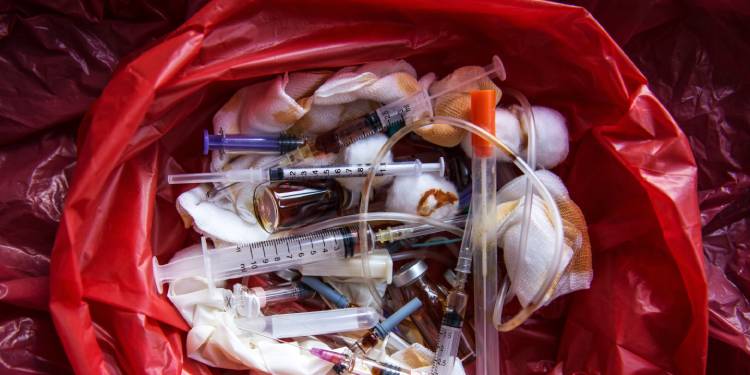
The contents of a bright red hazardous medical waste bag reveal used syringes, bandages, tubes, and ampoules.

Dealing with waste is part of every business, and healthcare facilities are no exception. The problem is that healthcare waste carries the potential danger of infection and contamination. As medicine advances, the amount of trash it generates increases, requiring greater diligence in removal, containment, and disposal. While every healthcare facility should already be following federal and other regulations and standards about medical waste management, it’s worth revisiting a few basics on how to dispose of medical waste properly.

What Is Medical Waste?

Medical waste is any waste created during the performance of healthcare activities. It may be contaminated by blood, other bodily fluids, and infectious materials. Some of the more notable forms of medical waste include:

  • Sharps, like needles, scalpels, and other metal tools that pose the risk of scraping, lacerating, or puncturing the skin
  • Used gloves, gowns, and masks contaminated by bodily fluids
  • Lab waste, including Petri dishes, test tubes, and beakers
  • Pharmaceutical waste, like mediations of all sorts
  • Pathological waste, like organs, tissue samples

Segregation at the Source

Most hospitals have the means to dispose of waste safely, but methods and materials vary according to the facility. One thing that never changes is segregation at the point where waste is created. This means the waste is handled and separated according to specific requirements. Color-coded bins are the most recognizable method of separation and containment. Healthcare professionals and other staff are trained to know what kind of waste goes where in order to avoid contamination and other issues.

  • Red bins hold infectious waste contaminated with bodily fluids.
  • Yellow bins contain pathological waste and sharps.
  • Blue bins hold pharmaceutical waste.

Safe Handling and Storage

Once the waste is separated, it must be handled and stored safely before it’s gotten rid of in one or more of the following ways:

PPE Use

Personal protective equipment (PPE) involves any number of garments or tools one wears while handling medical waste. Latex gloves, face masks, scrubs, and HAZMAT suits are all kinds of PPE.

Sharps Containers

A necessity for syringes, scalpels, and other items, sharps containers are bright red and prevent injuries and transmission of infection.

Secure Storage

Medical waste must be kept in a designated area that is secure, properly ventilated, and far from wherever people work, wander, or congregate. The containers must be sealed and labeled.

Transportation and Disposal

Here’s one last thought on properly disposing of medical waste. Transportation of medical waste must follow protocols established by federal, regional, and local laws and standards. Only licensed transporters can remove and carry medical waste. Establishing a paper trail on the type of waste and quantities is paramount, as is recording the disposal facility’s details. Finally, determine and outline how the waste must be treated. This includes autoclaving, incineration, chemical disinfection, and other methods.

Proper collection and disposal of medical waste is both a legal and ethical obligation. If healthcare professionals follow best practices in separating, handling, storing, and disposing of waste, they can rest assured they’ve protected the health and safety of clients, staff, and the public.


ShareTweet
Kelly Schoessling

Kelly Schoessling

Kelly Schoessling is a contributor to Daily Remedy and a publishing coordinator at Logical Position.

Leave a Reply Cancel reply

Your email address will not be published. Required fields are marked *

Videos

summary

An in-depth exploration of drug pricing, including key databases like NADAC, WAC, and ASP, and how they influence the pharmaceutical supply chain, policy, and patient advocacy. The episode also introduces MedPricer's innovative pricing intelligence platform, offering valuable insights for healthcare professionals, policymakers, and patients.

Chapters

00:00 Understanding Drug Pricing Dynamics
03:52 Exploring the Drug Pricing Database
10:07 Patient Advocacy and Drug Pricing
13:56 Market Intelligence in Drug Pricing
How NADAC, WAC, and ASP Shape Drug CostsDaily Remedy
YouTube Video X-Tfwy7XKEg
Subscribe

Policy Shift in Peptide Regulation

Clinical Reads

FDA Evaluation of Certain Bulk Drug Substances in Compounding: Clinical Interpretation

FDA Evaluation of Certain Bulk Drug Substances in Compounding: Clinical Interpretation

by Daily Remedy
April 19, 2026
0

Clinicians increasingly encounter patients using or requesting peptide-based therapies sourced through compounding pharmacies. The U.S. Food and Drug Administration has identified a subset of bulk drug substances, including certain peptides, that may present significant safety risks when used in compounded formulations. The clinical question is whether these regulatory signals reflect meaningful patient-level risk and how they should influence prescribing behavior. This matters because compounded peptides often sit outside traditional approval pathways, creating uncertainty around quality, dosing consistency, and safety. Understanding...

Read more

Join Our Newsletter!

Twitter Updates

Tweets by TheDailyRemedy

Popular

  • The IRA’s Drug Negotiation Mechanism Meets the Rebate Industrial Complex

    The IRA’s Drug Negotiation Mechanism Meets the Rebate Industrial Complex

    0 shares
    Share 0 Tweet 0
  • Two Platforms, Two Theories of Change in Hospital Pricing

    0 shares
    Share 0 Tweet 0
  • Growth Hormone Secretagogues and the Longevity Trade-Off

    0 shares
    Share 0 Tweet 0
  • The Payer’s Dilemma: Choosing Between Negotiation Intelligence and Market Disclosure

    0 shares
    Share 0 Tweet 0
  • Retatrutide: The Weight Loss Drug Everyone Wants—But Can’t Officially Get

    1 shares
    Share 0 Tweet 0
  • 628 Followers

Daily Remedy

Daily Remedy offers the best in healthcare information and healthcare editorial content. We take pride in consistently delivering only the highest quality of insight and analysis to ensure our audience is well-informed about current healthcare topics - beyond the traditional headlines.

Daily Remedy website services, content, and products are for informational purposes only. We do not provide medical advice, diagnosis, or treatment. All rights reserved.

Important Links

  • Support Us
  • About Us
  • Contact us
  • Privacy Policy
  • Terms and Conditions

Join Our Newsletter!

  • Survey
  • Podcast
  • About Us
  • Contact us

© 2026 Daily Remedy

No Result
View All Result
  • Home
  • Articles
  • Podcasts
  • Surveys
  • Courses
  • About Us
  • Contact us
  • Support Us
  • Official Learner

© 2026 Daily Remedy
