













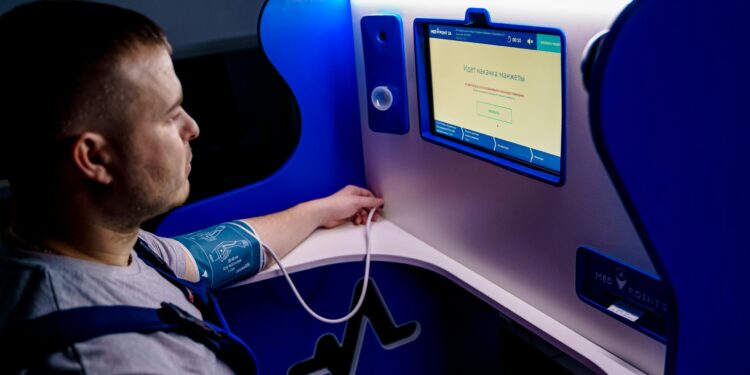
Digital and remote health technologies — particularly AI-enhanced diagnostic tools such as software-assisted stethoscopes, camera-based vital sign systems, and algorithmic auscultation platforms — have moved from pilot projects to active procurement conversations across health systems over the past two weeks. Search and investor attention has clustered around devices that convert bedside signals into structured, machine-readable data streams, often paired with automated interpretation layers. Regulatory clearances and device summaries cataloged in the U.S. Food and Drug Administration device database at https://www.accessdata.fda.gov/scripts/cdrh/cfdocs/cfpmn/pmn.cfm show a steady increase in software‑augmented diagnostic devices entering clinical pathways. The shift is not merely technological. It alters how clinical evidence is produced, who interprets it, and where diagnostic authority resides.
Traditional bedside examination tools produced ephemeral signals. A murmur heard, a rhythm suspected, a crackle appreciated — all filtered through clinician perception and documentation skill. Digital diagnostic devices capture persistent signals. Waveforms are stored. Sound files are replayable. Pattern-recognition models produce probability scores. The exam becomes data, and data invites automation.
AI-enhanced stethoscopes illustrate the transition. These devices convert acoustic signals into digital waveforms and apply trained models to classify murmurs, arrhythmias, and pulmonary findings. Peer-reviewed validation studies indexed through https://pubmed.ncbi.nlm.nih.gov and device performance summaries published in cardiology and digital medicine journals report promising sensitivity and specificity ranges in controlled settings. Controlled settings, however, are not noisy clinics. Signal quality degrades in real environments — clothing interference, patient movement, ambient noise — and model performance follows signal quality.
Remote diagnostic capture expands the use case further. Telehealth platforms increasingly integrate connected exam peripherals — digital otoscopes, handheld ultrasound probes, Bluetooth spirometers — into virtual visits. Regulatory frameworks for software as a medical device and clinical decision support tools, outlined by the FDA at https://www.fda.gov/medical-devices/software-medical-device-samd, attempt to distinguish assistive tools from autonomous diagnostic actors. The boundary is technical and legal at once. Decision support becomes decision influence.
Second-order workflow effects appear quickly. When diagnostic signals are digitized, they become shareable across time and distance. A primary care visit can generate a cardiac sound file reviewed asynchronously by a cardiologist. That improves access while redistributing responsibility. Interpretive liability shifts when multiple clinicians can review the same captured signal. Disagreement becomes auditable rather than anecdotal.
Data permanence changes malpractice dynamics. A traditional auscultation finding is documented as text; a digital auscultation is documented as a file. Plaintiffs’ attorneys prefer files. Objective records increase transparency and retrospective scrutiny simultaneously. Health system legal teams are beginning to model these exposures as digital diagnostics scale.
Reimbursement lags capability. CPT coding frameworks and remote physiologic monitoring codes maintained by the Centers for Medicare & Medicaid Services at https://www.cms.gov do not map cleanly onto all digital diagnostic use cases. Some tools qualify under existing remote monitoring or diagnostic testing codes. Others operate in payment gray zones, funded through bundled visits or value-based contracts. Payment ambiguity slows diffusion more reliably than technical limitation does.
Investors nevertheless see platform potential. Digital diagnostic devices generate longitudinal data streams. Data streams support analytics products, risk stratification tools, and population monitoring services. Hardware margins are modest; data services margins are not. Device companies increasingly describe themselves as data infrastructure firms rather than instrument manufacturers.
Clinical training implications are less discussed and more consequential. When algorithmic interpretation becomes embedded in exam tools, clinician skill acquisition changes. Trainees exposed primarily to AI-interpreted signals may develop weaker raw signal recognition. This is not unprecedented — automated ECG interpretation altered rhythm reading habits — but the scope is broader when multiple exam modalities are augmented simultaneously.
Counterintuitively, digital diagnostic precision can increase referral volume rather than reduce it. Higher sensitivity tools detect more borderline abnormalities. Borderline abnormalities generate follow-up imaging and specialist evaluation. Utilization rises before it stabilizes. Early adopters often underestimate this utilization elasticity.
Equity effects are mixed. Remote diagnostic tools extend specialty-quality signals into rural and underserved settings where expert examiners are scarce. At the same time, device cost, connectivity requirements, and software subscription models can concentrate access in well-capitalized systems. Digital reach expands while digital divides persist.
Evidence hierarchies are also being tested. Device makers publish validation studies, often prospective and well-designed, yet narrower than the clinical diversity encountered in general practice. Health technology assessment groups and payer evidence review committees increasingly demand real-world performance data before granting broad coverage. Real-world data takes time. Market enthusiasm does not.
Cybersecurity and data governance risks accompany diagnostic digitization. Audio files, waveform traces, and physiologic streams are identifiable health data. Device security guidance issued by the FDA and federal cybersecurity agencies at https://www.fda.gov/medical-devices/digital-health-center-excellence/cybersecurity informs manufacturer obligations, but health system integration remains the weak point. Each connected device expands the attack surface.
There is a philosophical shift embedded here as well. The physical exam — long treated as clinical craft — is being partially converted into reproducible measurement. Craft resists standardization; measurement invites it. Medicine gains consistency and loses some interpretive texture. Whether that trade improves outcomes depends on context and implementation quality.
Digital diagnostic tools will not eliminate bedside judgment. They will change what bedside judgment is asked to do. Instead of detecting faint signals, clinicians will increasingly adjudicate algorithmic outputs — deciding when to trust them, when to override them, and when to investigate further.
The exam is not disappearing. It is being versioned.



