













Sunday, February 15, 2026
ISSN 2765-8767
  • Survey
  • Podcast
  • Write for Us
  • My Account
  • Log In
Daily Remedy
  • Home
  • Articles
  • Podcasts
    The Future of LLMs in Healthcare

    The Future of LLMs in Healthcare

    January 26, 2026
    The Future of Healthcare Consumerism

    The Future of Healthcare Consumerism

    January 22, 2026
    Your Body, Your Health Care: A Conversation with Dr. Jeffrey Singer

    Your Body, Your Health Care: A Conversation with Dr. Jeffrey Singer

    July 1, 2025

    The cost structure of hospitals nearly doubles

    July 1, 2025
    Navigating the Medical Licensing Maze

    The Fight Against Healthcare Fraud: Dr. Rafai’s Story

    April 8, 2025
    Navigating the Medical Licensing Maze

    Navigating the Medical Licensing Maze

    April 4, 2025
  • Surveys

    Surveys

    AI in Healthcare Decision-Making

    AI in Healthcare Decision-Making

    February 1, 2026
    Patient Survey: Understanding Healthcare Consumerism

    Patient Survey: Understanding Healthcare Consumerism

    January 18, 2026

    Survey Results

    Can you tell when your provider does not trust you?

    Can you tell when your provider does not trust you?

    January 18, 2026
    Do you believe national polls on health issues are accurate

    National health polls: trust in healthcare system accuracy?

    May 8, 2024
    Which health policy issues matter the most to Republican voters in the primaries?

    Which health policy issues matter the most to Republican voters in the primaries?

    May 14, 2024
    How strongly do you believe that you can tell when your provider does not trust you?

    How strongly do you believe that you can tell when your provider does not trust you?

    May 7, 2024
  • Courses
  • About Us
  • Contact us
  • Support Us
  • Official Learner
No Result
View All Result
  • Home
  • Articles
  • Podcasts
    The Future of LLMs in Healthcare

    The Future of LLMs in Healthcare

    January 26, 2026
    The Future of Healthcare Consumerism

    The Future of Healthcare Consumerism

    January 22, 2026
    Your Body, Your Health Care: A Conversation with Dr. Jeffrey Singer

    Your Body, Your Health Care: A Conversation with Dr. Jeffrey Singer

    July 1, 2025

    The cost structure of hospitals nearly doubles

    July 1, 2025
    Navigating the Medical Licensing Maze

    The Fight Against Healthcare Fraud: Dr. Rafai’s Story

    April 8, 2025
    Navigating the Medical Licensing Maze

    Navigating the Medical Licensing Maze

    April 4, 2025
  • Surveys

    Surveys

    AI in Healthcare Decision-Making

    AI in Healthcare Decision-Making

    February 1, 2026
    Patient Survey: Understanding Healthcare Consumerism

    Patient Survey: Understanding Healthcare Consumerism

    January 18, 2026

    Survey Results

    Can you tell when your provider does not trust you?

    Can you tell when your provider does not trust you?

    January 18, 2026
    Do you believe national polls on health issues are accurate

    National health polls: trust in healthcare system accuracy?

    May 8, 2024
    Which health policy issues matter the most to Republican voters in the primaries?

    Which health policy issues matter the most to Republican voters in the primaries?

    May 14, 2024
    How strongly do you believe that you can tell when your provider does not trust you?

    How strongly do you believe that you can tell when your provider does not trust you?

    May 7, 2024
  • Courses
  • About Us
  • Contact us
  • Support Us
  • Official Learner
No Result
View All Result
Daily Remedy
No Result
View All Result
Home Uncertainty & Complexity

Does Scaring People Work When It Comes To Health Messaging?

Daily Remedy by Daily Remedy
February 17, 2022
in Uncertainty & Complexity
0
Does Scaring People Work When It Comes To Health Messaging

In the recent film “Don’t Look Up,” two astronomers learn that a comet is on track to collide with Earth and destroy human civilization. When they try to sound the alarm, all manner of obstacles get in their way. In the end, well, you’ll have to watch the movie to find out.

The film is fiction, of course, but the situation illuminates one facet of reality: When people try to warn others of impending danger, success is not guaranteed.

Warning messages travel under a variety of names, including fear appeals, threat appeals and risk communication. As a communication scientist who has studied warning messages for 40 years, I’ve thought a lot about the question of when fear appeals are heeded and when they are not – a consideration that has undoubtedly been on the minds of many public health officials throughout the COVID-19 pandemic.

COVID-19: A ‘biological comet’

Fear appeals obviously aren’t limited to comets. Warnings about the unwanted consequences of smoking, texting while driving and drinking while pregnant can be considered fear appeals. So can food recalls, evacuation warnings and messages that encourage vaccination for the flu, polio and COVID-19.

Broad research literature reviews, called meta-analyses, find that fear appeals do work for most people most of the time.

And yet, consider where society finds itself today. For the past two years, people the world over have been told that they are in danger of contracting a potentially deadly disease – a sort of biological comet – and that a variety of health protective behaviors, such as social distancing, masking and vaccination, can save lives. Still, many people forgo social distancing, reject masking recommendations and continue to refuse a vaccine that will protect them. Why?
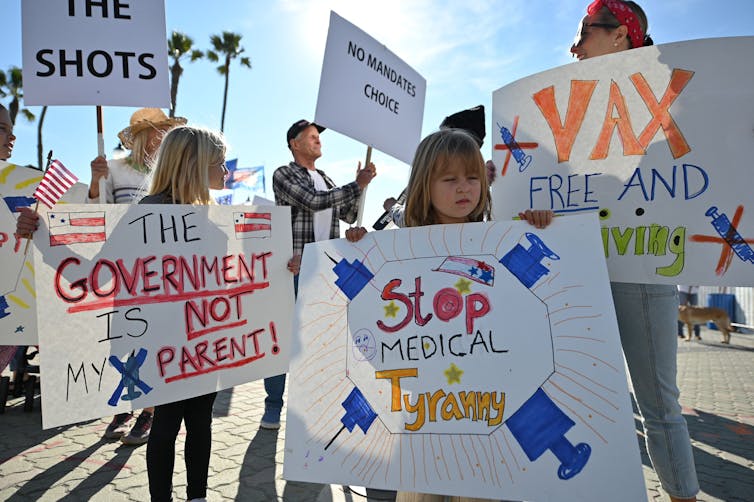
Adults and children hold protest signs while demonstrating against COVID-19 vaccine mandates.
In Huntington Beach, Calif., adults and children alike demonstrated against COVID-19 vaccine mandates for students.
Robyn Beck/AFP via Getty Images

How fear appeals fail – at times

Understanding when fear appeals work and when they don’t requires some knowledge of what they are and how they function. Fear appeals have two distinct parts. The first part describes the danger. The second describes how to mitigate the danger.

If they are well crafted, the first part scares the people receiving the message and the second calms them down. As a person hears or reads a fear appeal from beginning to end, fear looks like an inverted U: It rises and then it falls.

Research I have conducted with my colleagues at Penn State shows that both the escalation and de-escalation of fear must occur for the message to be effective. Without the rise and the fall of fear, the message will fail. So what might interfere with this process?

A great deal hinges on what people believe about the supposed threat. If the problem is not seen as serious, there is no reason to be afraid, no need to pay attention to the recommended solution and no need to protect oneself.

From the earliest days of the COVID-19 pandemic, some message sources downplayed the threat. President Trump, for instance, compared the novel coronavirus to another disease that society has learned to cope with. “This is a flu. This is like a flu,” Trump said. Statements of this sort compromised efforts to convey the true risks of COVID-19.

And even a serious threat must be seen as relevant or it is unlikely to evoke strong emotion. Early in the pandemic, some areas were hit hard by the virus while others experienced relatively low infection rates. People living in those low-caseload areas often had only indirect information about the pandemic, often through social media. And social media contained a great deal of misinformation.

Strikingly, just 12 people were responsible for two-thirds of the misinformation about vaccines on social media platforms such as Twitter and Facebook. Joseph Mercola, an osteopathic physician with 3.6 million followers, notoriously and erroneously stated: “The same number of people died in 2020 that, on average, have died in previous years. This simply wouldn’t be the case if we had a lethal pandemic.” This blanket denial of the virus’s true impact allowed a great many people to conclude that the pandemic wasn’t a problem for them or for anyone else.

Then there’s the question of what can be done about the threat.

Health experts maintain – based on a vast amount of data and scientific evidence – that COVID-19 vaccines are highly effective. When individuals believe the remedy is effective, fear is diminished and the likelihood of action is enhanced. But beliefs about the vaccines’ effectiveness have been weakened by claims that the vaccine is too new and unproven or that its production was rushed.

Last, a key consideration is whether people can actually achieve the solution. Social distancing required pivoting to remote work and school, placing a huge burden on families that fell disproportionately on women. Meanwhile, high-quality masks were initially expensive and challenging to locate in a sea of counterfeits.

Just a year ago, in early 2021, vaccines were unavailable in many locations. And now, after navigating nearly two years of challenges in adapting recommended solutions, there is a real danger that pandemic fatigue will reduce motivation to adhere to safety guidelines.

Undermining the messenger

Fear appeals can also be thwarted in more general ways. For instance, by attributing nefarious motives to the government and public health officials, those who spread misinformation and conspiracy theories can cause others to discount any and all information coming from those sources.

As I noted above, research shows that fear appeals are persuasive for most of the people most of the time. However, the studies underlying that conclusion are primarily experiments in which fear appeals are compared with either some weak message or no message at all. In other words, these comparisons do not at all resemble the reality surrounding COVID-19.

Pro-vaccine messaging is taking place in a highly competitive message environment – one that involves active efforts to undermine public health advocacy. The inconsistent and contradictory messaging produced by health agencies such as the Centers for Disease Control and Prevention has damaged the effectiveness of fear appeals. The fact that scientific knowledge evolves and always possesses a degree of uncertainty explains why health agencies changed – and continue to change – their messaging. Regrettably, this inconsistency also undercuts the impact of health messaging in a public that wants simple, consistent answers.

And just as in “Don’t Look Up,” various groups and individuals have prioritized their own short-term gains over a genuine global danger. Those collective efforts have left large swaths of the population unconcerned or demotivated about a genuine global threat. This helps to explain why the U.S. has many more deaths from COVID-19 than do other wealthy nations. The parallels between cinema and reality are more than a little frightening.

[Like what you’ve read? Want more? Sign up for The Conversation’s daily newsletter.]

James Dillard, Professor of Communication Arts and Sciences, Penn State

This article is republished from The Conversation under a Creative Commons license. Read the original article.


ShareTweet
Daily Remedy

Daily Remedy

Dr. Jay K Joshi serves as the editor-in-chief of Daily Remedy. He is a serial entrepreneur and sought after thought-leader for matters related to healthcare innovation and medical jurisprudence. He has published articles on a variety of healthcare topics in both peer-reviewed journals and trade publications. His legal writings include amicus curiae briefs prepared for prominent federal healthcare cases.

Leave a Reply Cancel reply

Your email address will not be published. Required fields are marked *

Videos

In this episode, the host discusses the significance of large language models (LLMs) in healthcare, their applications, and the challenges they face. The conversation highlights the importance of simplicity in model design and the necessity of integrating patient feedback to enhance the effectiveness of LLMs in clinical settings.

Takeaways
LLMs are becoming integral in healthcare.
They can help determine costs and service options.
Hallucination in LLMs can lead to misinformation.
LLMs can produce inconsistent answers based on input.
Simplicity in LLMs is often more effective than complexity.
Patient behavior should guide LLM development.
Integrating patient feedback is crucial for accuracy.
Pre-training models with patient input enhances relevance.
Healthcare providers must understand LLM limitations.
The best LLMs will focus on patient-centered care.

Chapters

00:00 Introduction to LLMs in Healthcare
05:16 The Importance of Simplicity in LLMs
The Future of LLMs in HealthcareDaily Remedy
YouTube Video U1u-IYdpeEk
Subscribe

2027 Medicare Advantage & Part D Advance Notice

Clinical Reads

BIIB080 in Mild Alzheimer’s Disease: What a Phase 1b Exploratory Clinical Analysis Can—and Cannot—Tell Us

BIIB080 in Mild Alzheimer’s Disease: What a Phase 1b Exploratory Clinical Analysis Can—and Cannot—Tell Us

by Daily Remedy
February 15, 2026
0

Can lowering tau biology translate into a clinically meaningful slowing of decline in people with early symptomatic Alzheimer’s disease? That is the practical question behind BIIB080, an intrathecal antisense therapy designed to reduce production of tau protein by targeting the tau gene transcript. In a phase 1b program originally designed for safety and dosing, investigators later examined cognitive, functional, and global outcomes as exploratory endpoints. The clinical question matters because current disease-modifying options primarily target amyloid, while tau pathology tracks...

Read more

Join Our Newsletter!

Twitter Updates

Tweets by TheDailyRemedy

Popular

  • The Information Epidemic: How Digital Health Misinformation Is Rewiring Clinical Risk

    The Information Epidemic: How Digital Health Misinformation Is Rewiring Clinical Risk

    0 shares
    Share 0 Tweet 0
  • Prevention Is Having a Moment and a Measurement Problem

    0 shares
    Share 0 Tweet 0
  • Child Health Is Now a Platform Issue

    0 shares
    Share 0 Tweet 0
  • Behavioral Health Is Now a Network Phenomenon

    0 shares
    Share 0 Tweet 0
  • The Breach Is the Diagnosis: Cybersecurity Has Become a Clinical Risk Variable

    0 shares
    Share 0 Tweet 0
  • 628 Followers

Daily Remedy

Daily Remedy offers the best in healthcare information and healthcare editorial content. We take pride in consistently delivering only the highest quality of insight and analysis to ensure our audience is well-informed about current healthcare topics - beyond the traditional headlines.

Daily Remedy website services, content, and products are for informational purposes only. We do not provide medical advice, diagnosis, or treatment. All rights reserved.

Important Links

  • Support Us
  • About Us
  • Contact us
  • Privacy Policy
  • Terms and Conditions

Join Our Newsletter!

  • Survey
  • Podcast
  • About Us
  • Contact us

© 2026 Daily Remedy

No Result
View All Result
  • Home
  • Articles
  • Podcasts
  • Surveys
  • Courses
  • About Us
  • Contact us
  • Support Us
  • Official Learner

© 2026 Daily Remedy