






Monday, March 30, 2026
ISSN 2765-8767
  • Home
  • Courses
  • About Us
  • Contact us
  • Support Us
  • Home
  • Courses
  • About Us
  • Contact us
  • Support Us

Sensible Medicine

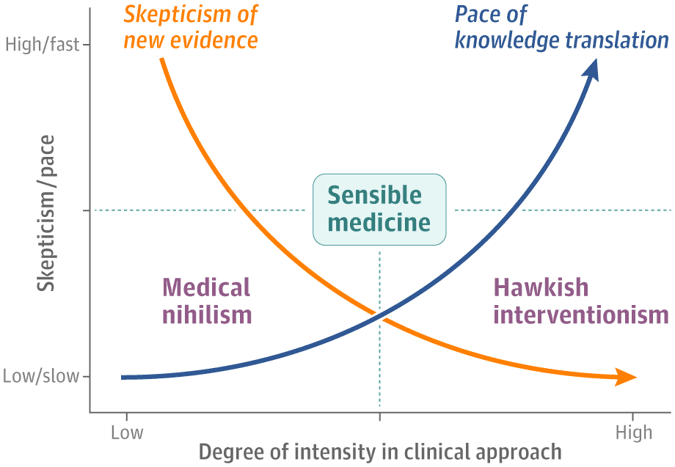
Sensible medicine is an approach to treatment that seeks a balance along the spectrum of the strength of evidence and the pace of knowledge translation. On one hand, a hawkish interventionist has little doubt about the effectiveness of a new treatment and rapidly adopts it into practice. There is a tendency to favor adoption of the new, acceptance of less rigor in research methods and results, and a glance away from subconscious biases. This contrasts with the medical nihilist who is highly skeptical of new evidence and hopes to intervene even less. The medical nihilist is certain of the futility of treatment, ineffectiveness of most medications, and corrupting influence of financial incentives. In the middle is a sensible approach, which acknowledges that some interventions are effective but, perhaps, confidence should be tempered. With sensible medicine, the translation of knowledge to the bedside is appropriately calibrated to the rigor and reasoning of the available evidence and the severity of the outcome to be avoided.


Daily Remedy

Daily Remedy

Dr. Jay K Joshi serves as the editor-in-chief of Daily Remedy. He is a serial entrepreneur and sought after thought-leader for matters related to healthcare innovation and medical jurisprudence. He has published articles on a variety of healthcare topics in both peer-reviewed journals and trade publications. His legal writings include amicus curiae briefs prepared for prominent federal healthcare cases.

Videos

Policy Shift in Peptide Regulation

Semaglutide and the Expansion Problem: When One Trial Becomes a Platform

Semaglutide and the Expansion Problem: When One Trial Becomes a Platform

Semaglutide has moved beyond its original indication and now sits at the center of a widening set of clinical questions: cardiovascular risk, kidney disease progression, and even neurodegeneration. The question is no longer whether the drug lowers glucose or reduces weight—it does—but how far those effects extend across systems, and whether evidence from one population can be translated into another without distortion. Large, well-powered trials have produced consistent signals, yet those signals are now being applied in contexts that were...

Read more

Join Our Newsletter!