












Sunday, January 18, 2026
ISSN 2765-8767
  • Survey
  • Podcast
  • Write for Us
  • My Account
  • Log In
Daily Remedy
  • Home
  • Articles
  • Podcasts
    Your Body, Your Health Care: A Conversation with Dr. Jeffrey Singer

    Your Body, Your Health Care: A Conversation with Dr. Jeffrey Singer

    July 1, 2025

    The cost structure of hospitals nearly doubles

    July 1, 2025
    Navigating the Medical Licensing Maze

    The Fight Against Healthcare Fraud: Dr. Rafai’s Story

    April 8, 2025
    Navigating the Medical Licensing Maze

    Navigating the Medical Licensing Maze

    April 4, 2025
    The Alarming Truth About Health Insurance Denials

    The Alarming Truth About Health Insurance Denials

    February 3, 2025
    Telehealth in Turmoil

    The Importance of NIH Grants

    January 31, 2025
  • Surveys

    Surveys

    Patient Survey: Understanding Healthcare Consumerism

    Patient Survey: Understanding Healthcare Consumerism

    January 18, 2026
    Public Confidence in Proposed Changes to U.S. Vaccine Policy

    Public Confidence in Proposed Changes to U.S. Vaccine Policy

    January 3, 2026

    Survey Results

    Can you tell when your provider does not trust you?

    Can you tell when your provider does not trust you?

    January 18, 2026
    Do you believe national polls on health issues are accurate

    National health polls: trust in healthcare system accuracy?

    May 8, 2024
    Which health policy issues matter the most to Republican voters in the primaries?

    Which health policy issues matter the most to Republican voters in the primaries?

    May 14, 2024
    How strongly do you believe that you can tell when your provider does not trust you?

    How strongly do you believe that you can tell when your provider does not trust you?

    May 7, 2024
  • Courses
  • About Us
  • Contact us
  • Support Us
  • Official Learner
No Result
View All Result
  • Home
  • Articles
  • Podcasts
    Your Body, Your Health Care: A Conversation with Dr. Jeffrey Singer

    Your Body, Your Health Care: A Conversation with Dr. Jeffrey Singer

    July 1, 2025

    The cost structure of hospitals nearly doubles

    July 1, 2025
    Navigating the Medical Licensing Maze

    The Fight Against Healthcare Fraud: Dr. Rafai’s Story

    April 8, 2025
    Navigating the Medical Licensing Maze

    Navigating the Medical Licensing Maze

    April 4, 2025
    The Alarming Truth About Health Insurance Denials

    The Alarming Truth About Health Insurance Denials

    February 3, 2025
    Telehealth in Turmoil

    The Importance of NIH Grants

    January 31, 2025
  • Surveys

    Surveys

    Patient Survey: Understanding Healthcare Consumerism

    Patient Survey: Understanding Healthcare Consumerism

    January 18, 2026
    Public Confidence in Proposed Changes to U.S. Vaccine Policy

    Public Confidence in Proposed Changes to U.S. Vaccine Policy

    January 3, 2026

    Survey Results

    Can you tell when your provider does not trust you?

    Can you tell when your provider does not trust you?

    January 18, 2026
    Do you believe national polls on health issues are accurate

    National health polls: trust in healthcare system accuracy?

    May 8, 2024
    Which health policy issues matter the most to Republican voters in the primaries?

    Which health policy issues matter the most to Republican voters in the primaries?

    May 14, 2024
    How strongly do you believe that you can tell when your provider does not trust you?

    How strongly do you believe that you can tell when your provider does not trust you?

    May 7, 2024
  • Courses
  • About Us
  • Contact us
  • Support Us
  • Official Learner
No Result
View All Result
Daily Remedy
No Result
View All Result
Home Perspectives

The COVID-19 Pandemic Offers an Opportunity to Make a Healthy Shift in Body Ideals

The Conversation by The Conversation
April 3, 2024
in Perspectives
0
The COVID-19 Pandemic Offers an Opportunity to Make a Healthy Shift in Body Ideals

The COVID-19 pandemic offers an opportunity to make a healthy shift in body ideals
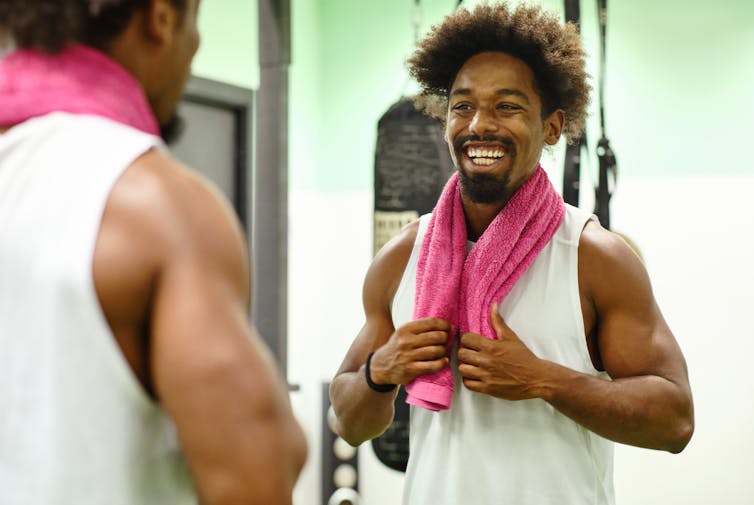
Happy black man
Behavioral science researchers have found that people tend to have more positive body self-images when they appreciate the body for what it can do – not just how it looks.
Tempura/E+ via Getty Images

Janet J. Boseovski, University of North Carolina – Greensboro

The COVID-19 pandemic has changed everyday life for many people in both trivial and profound ways. Embracing pants without a waistband, trying out creative baking – and perhaps spending a great deal of time sitting, whether for virtual meetings or Netflix binges.

For many people, these kinds of behaviors, coupled with the ongoing stressors and limitations of the pandemic, translated to pounds gained and newfound or increased feelings of discomfort about body image.

It may seem untimely to think about addressing weight loss or body image while still dealing with the uncertainties and pressures of the ongoing pandemic. However, science has shown that living through disasters and personal upheavals often causes a shift in life priorities and thinking more about the value of one’s own life. Science also reveals that life disruptions can be a great time to think about, and bring about, habit change.

I’m a developmental psychologist and health coach. I’ve taught university students about cognition and motivation for the past 20 years, as well as about lifelong physical and mental well-being. Behavioral scientists find that when these sorts of upheavals disrupt regular routines, it can become easier than ever before to get rid of unhealthy behaviors and replace them with positive changes in personal habits.

That said, this isn’t another article about how to lose weight. It’s not intended to provoke a knee-jerk reaction like pursuing a Jennifer Lopez rear or Chris Hemsworth-y lats.

Instead, I am inviting people to redefine “the ideal body” by better appreciating the body’s functionality – what it can do – rather than focusing mostly on how it appears.

Celebrities aren’t good role models

According to Merriam-Webster, an ideal is a “standard of perfection, beauty or excellence.”

However, respecting and appreciating one’s body for what it can do, rather than how it looks or compares to cultural ideals, can positively influence body image. For example, behavioral scientists have found that exercising for health, enjoyment and wellness is associated with a positive body image and healthy eating habits, while a more negative body image is associated with exercising for appearance-related reasons.

There are physical benefits as well. For example, putting an emphasis on fitness goals, rather than weight loss, has been shown to enhance longevity. Scientists have also found that exercise can reduce an adult’s risks for a severe case of COVID-19 as well as potentially deadly complications.

On top of all this, as journalist Charles Duhigg reports in his book “The Power of Habit,” experts have found that exercise is a keystone habit that often supports adopting other positive health behaviors, such as better nutrition.

Woman running with dog on a beach road.
To successfully change an old habit for the better, it’s important to create an environment that supports the new goal – such as picking out exercise clothes the night before for an early morning walk or run.
Zing Images/Digital Vision via Getty Images

Appearance and attainability

As a psychologist, I am aware that we are an appearance-oriented culture. I’m not suggesting that people disregard aesthetic goals.

Rather, I’m suggesting that looking to other people to define one’s own body image ideals can be maladaptive. This is especially true when people choose celebrity icons and social media influencers as their ideals. For instance, there’s evidence that comparing one’s own appearance to images of celebrities is associated with both body image dissatisfaction and disordered eating.

Research suggests that the most effective role models are people with whom one identifies or shares some similarities. This makes it easier to set goals that are attainable, rather than focusing on the public images of celebrity icons. Here, too, it is important that the goals are realistic and applicable to people’s own lives. It’s also important that they avoid making appearance comparisons to people that they know, as this can also lead to body dissatisfaction.

Setting attainable goals instead involves focusing on specific behaviors to which one can commit. For example, if someone sets a goal of moving with greater ease, they might plan on going to the gym for 30 minutes three times per week. If the goal is fitting into pre-pandemic clothing, they might eliminate a less-than-healthy snack from the daily eating routine.

These are actions that people can control directly, whereas it is unclear how one would achieve the appearance or weight of a particular celebrity or friend.

A personal example

Clarifying the personal meaning of “ideal body” isn’t just a thought experiment. Understanding one’s values helps in setting goals and then establishing habits in daily life to achieve them.

Using myself as an example: As a 48-year-old, my personal body image ideal involves becoming as strong as possible as I age. I don’t want to feel or look delicate, so my workouts primarily involve resistance training – with some running thrown in for stress relief. These are attainable because I value the benefits of these activities.

To be sure that I will maintain my exercise routines, I schedule them in advance so that I know exactly how I will fit them into my day rather than leaving it up to chance and forgoing them entirely or doing them too close to my bedtime, which interferes with my sleep.

For role models, I look to the behavior of other strong women – such as the women of Girls Gone Strong, an organization that promotes women’s health and strength through fitness – to inspire me to achieve my goals.

Changing the context

Even after figuring out personal body image values and setting attainable goals, it can still be hard to let go of older unhealthy habits. Wendy Wood, a University of California psychologist and foremost expert in this arena, has found that many behaviors are activated automatically by being in a context – a location – that has past associations with that behavior. Further, those associations matter more than a person’s current goals.

[More than 140,000 readers get one of The Conversation’s informative newsletters. Join the list today.]

Say that attaining one’s body image and fitness goals involves taking a brisk walk every morning. Turning that into a habit means avoiding past behaviors – don’t set the coffee maker to make the morning java, turn on the television or check the phone before the walk – as well as adopting new behaviors, such as setting out the right clothes the night before and establishing a route in advance.

How to get started? A fruitful first step might be to ask: In what ways has the pandemic crisis changed my life values, priorities and attitudes? The answers may be a good foundation for successfully making a healthy shift in body ideals.

Janet J. Boseovski, Professor of Psychology, University of North Carolina – Greensboro

This article is republished from The Conversation under a Creative Commons license. Read the original article.


ShareTweet
The Conversation

The Conversation

Leave a Reply Cancel reply

Your email address will not be published. Required fields are marked *

Videos

Summary

In this episode of the Daily Remedy Podcast, the host delves into the evolving landscape of healthcare consumerism as we approach 2026. The discussion highlights how patients are increasingly becoming empowered consumers, driven by the rising costs and complexities of healthcare in America. The host emphasizes that this shift is not merely about convenience but about patients demanding transparency, trust, and agency in their healthcare decisions. With advancements in technology, particularly AI, patients are now equipped to compare prices, switch providers, and even self-diagnose, fundamentally altering the traditional patient-provider dynamic.

The conversation further explores the implications of this shift, noting that patients are seeking predictable pricing and upfront cost estimates, which are becoming essential in their healthcare experience. The host also discusses the role of technology in facilitating this change, enabling a more fluid relationship between patients and healthcare providers. As healthcare consumerism matures, the episode raises critical questions about the future of patient engagement and the collaborative model of care that is emerging, where decision-making is shared rather than dictated by healthcare professionals alone.

Takeaways

Patients are becoming empowered consumers in healthcare.
Healthcare consumerism is maturing into a demand for transparency and trust.
Technology is enabling patients to become strong economic actors.
Patients want predictable pricing and upfront cost estimates.
The shift towards collaborative decision-making is changing the healthcare landscape.

Chapters

00:00 Introduction to Healthcare Consumerism
01:46 The Rise of Patient Empowerment
04:31 Technology's Role in Healthcare Transformation
07:16 The Shift Towards Collaborative Decision-Making
09:44 Conclusion and Future Outlook
Healthcare Consumerism 2026: A New Era of Patient Empowerment
YouTube Video dcz8FQlhAog
Subscribe

Real Food Initiative

Clinical Reads

Analysis of the DHHS “Real Food” Initiative

Analysis of the DHHS “Real Food” Initiative

by Daily Remedy
January 18, 2026
0

EXECUTIVE SUMMARY The Department of Health and Human Services has launched a transformative public health initiative through the RealFood.gov platform, introducing revised Dietary Guidelines for Americans that represent a fundamental departure from decades of nutritional policy. This initiative, branded as "Eat Real Food," repositions whole, minimally processed foods as the cornerstone of American nutrition while explicitly challenging the role of ultra-processed foods in the national diet. The initiative arrives amid a stark public health landscape where 50% of Americans have...

Read more

Twitter Updates

Tweets by DailyRemedy1

Newsletter

Start your Daily Remedy journey

Cultivate your knowledge of current healthcare events and ensure you receive the most accurate, insightful healthcare news and editorials.

*we hate spam as much as you do

Popular

  • National Opioid Settlement Injunction

    National Opioid Settlement Injunction

    1 shares
    Share 0 Tweet 0
  • Modeling Patient Irrationality

    0 shares
    Share 0 Tweet 0
  • My Plight as an Abandoned Pain Patient

    0 shares
    Share 0 Tweet 0
  • Tips for Reducing Patient Anxiety in Your Healthcare Clinic

    0 shares
    Share 0 Tweet 0
  • A Two Headed Monster – State Attorneys General and the Drug Enforcement Agency

    3 shares
    Share 0 Tweet 0
  • 628 Followers

Daily Remedy

Daily Remedy offers the best in healthcare information and healthcare editorial content. We take pride in consistently delivering only the highest quality of insight and analysis to ensure our audience is well-informed about current healthcare topics - beyond the traditional headlines.

Daily Remedy website services, content, and products are for informational purposes only. We do not provide medical advice, diagnosis, or treatment. All rights reserved.

Important Links

  • Support Us
  • About Us
  • Contact us
  • Privacy Policy
  • Terms and Conditions

Newsletter

Start your Daily Remedy journey

Cultivate your knowledge of current healthcare events and ensure you receive the most accurate, insightful healthcare news and editorials.

*we hate spam as much as you do

  • Survey
  • Podcast
  • About Us
  • Contact us

© 2026 Daily Remedy

No Result
View All Result
  • Home
  • Articles
  • Podcasts
  • Surveys
  • Courses
  • About Us
  • Contact us
  • Support Us
  • Official Learner

© 2026 Daily Remedy

Start your Daily Remedy journey

Cultivate your knowledge of current healthcare events and ensure you receive the most accurate, insightful healthcare news and editorials.

*we hate spam as much as you do
