














Tuesday, March 17, 2026
ISSN 2765-8767
  • Survey
  • Podcast
  • Write for Us
  • My Account
  • Log In
Daily Remedy
  • Home
  • Articles
  • Podcasts
    The Impact of COVID-19 on Patient Trust

    The Impact of COVID-19 on Patient Trust

    March 3, 2026
    Debunking Myths About GLP-1 Medications

    Debunking Myths About GLP-1 Medications

    February 16, 2026
    The Future of LLMs in Healthcare

    The Future of LLMs in Healthcare

    January 26, 2026
    The Future of Healthcare Consumerism

    The Future of Healthcare Consumerism

    January 22, 2026
    Your Body, Your Health Care: A Conversation with Dr. Jeffrey Singer

    Your Body, Your Health Care: A Conversation with Dr. Jeffrey Singer

    July 1, 2025

    The cost structure of hospitals nearly doubles

    July 1, 2025
  • Surveys

    Surveys

    Perceptions of Viral Wellness Practices on Social Media: A Likert-Scale Survey for Informed Readers

    Perceptions of Viral Wellness Practices on Social Media: A Likert-Scale Survey for Informed Readers

    March 1, 2026
    How Confident Are You in RFK Jr.’s Health Leadership?

    How Confident Are You in RFK Jr.’s Health Leadership?

    February 16, 2026

    Survey Results

    Can you tell when your provider does not trust you?

    Can you tell when your provider does not trust you?

    January 18, 2026
    Do you believe national polls on health issues are accurate

    National health polls: trust in healthcare system accuracy?

    May 8, 2024
    Which health policy issues matter the most to Republican voters in the primaries?

    Which health policy issues matter the most to Republican voters in the primaries?

    May 14, 2024
    How strongly do you believe that you can tell when your provider does not trust you?

    How strongly do you believe that you can tell when your provider does not trust you?

    May 7, 2024
  • Courses
  • About Us
  • Contact us
  • Support Us
  • Official Learner
No Result
View All Result
  • Home
  • Articles
  • Podcasts
    The Impact of COVID-19 on Patient Trust

    The Impact of COVID-19 on Patient Trust

    March 3, 2026
    Debunking Myths About GLP-1 Medications

    Debunking Myths About GLP-1 Medications

    February 16, 2026
    The Future of LLMs in Healthcare

    The Future of LLMs in Healthcare

    January 26, 2026
    The Future of Healthcare Consumerism

    The Future of Healthcare Consumerism

    January 22, 2026
    Your Body, Your Health Care: A Conversation with Dr. Jeffrey Singer

    Your Body, Your Health Care: A Conversation with Dr. Jeffrey Singer

    July 1, 2025

    The cost structure of hospitals nearly doubles

    July 1, 2025
  • Surveys

    Surveys

    Perceptions of Viral Wellness Practices on Social Media: A Likert-Scale Survey for Informed Readers

    Perceptions of Viral Wellness Practices on Social Media: A Likert-Scale Survey for Informed Readers

    March 1, 2026
    How Confident Are You in RFK Jr.’s Health Leadership?

    How Confident Are You in RFK Jr.’s Health Leadership?

    February 16, 2026

    Survey Results

    Can you tell when your provider does not trust you?

    Can you tell when your provider does not trust you?

    January 18, 2026
    Do you believe national polls on health issues are accurate

    National health polls: trust in healthcare system accuracy?

    May 8, 2024
    Which health policy issues matter the most to Republican voters in the primaries?

    Which health policy issues matter the most to Republican voters in the primaries?

    May 14, 2024
    How strongly do you believe that you can tell when your provider does not trust you?

    How strongly do you believe that you can tell when your provider does not trust you?

    May 7, 2024
  • Courses
  • About Us
  • Contact us
  • Support Us
  • Official Learner
No Result
View All Result
Daily Remedy
No Result
View All Result
Home Contrarian

Gut Microbiome Can Support Weight Loss

Your body already has a built-in weight loss system

Christopher Damman by Christopher Damman
January 22, 2024
in Contrarian
0
Gut Microbiome Can Support Weight Loss

Faruk Tokluoglu

Wegovy, Ozempic and Mounjaro are weight loss and diabetes drugs that have made quite a splash in health news. They target regulatory pathways involved in both obesity and diabetes and are widely considered breakthroughs for weight loss and blood sugar control.

But do these drugs point toward a root cause of metabolic disease? What inspired their development in the first place?

It turns out your body produces natural versions of these drugs – also known as incretin hormones – in your gut. It may not be surprising that nutrients in food help regulate these hormones. But it may intrigue you to know that the trillions of microbes in your gut are key for orchestrating this process.

I am a gastroenterologist at the University of Washington who studies how food and your gut microbiome affect health and disease. Here’s an inside-out perspective on the role natural gut hormones and healthy food play in metabolism and weight loss.

A broken gut

Specialized bacteria in your lower gut take the components of food you can’t digest like fiber and polyphenols – the elements of plants that are removed in many processed foods – and transforms them into molecules that stimulate hormones to control your appetite and metabolism. These include GLP-1, a natural version of Wegovy and Ozempic.

GLP-1 and other hormones like PYY help regulate blood sugar through the pancreas. They also tell your brain that you’ve had enough to eat and your stomach and intestines to slow the movement of food along the digestive tract to allow for digestion. This system even has a name: the colonic brake.
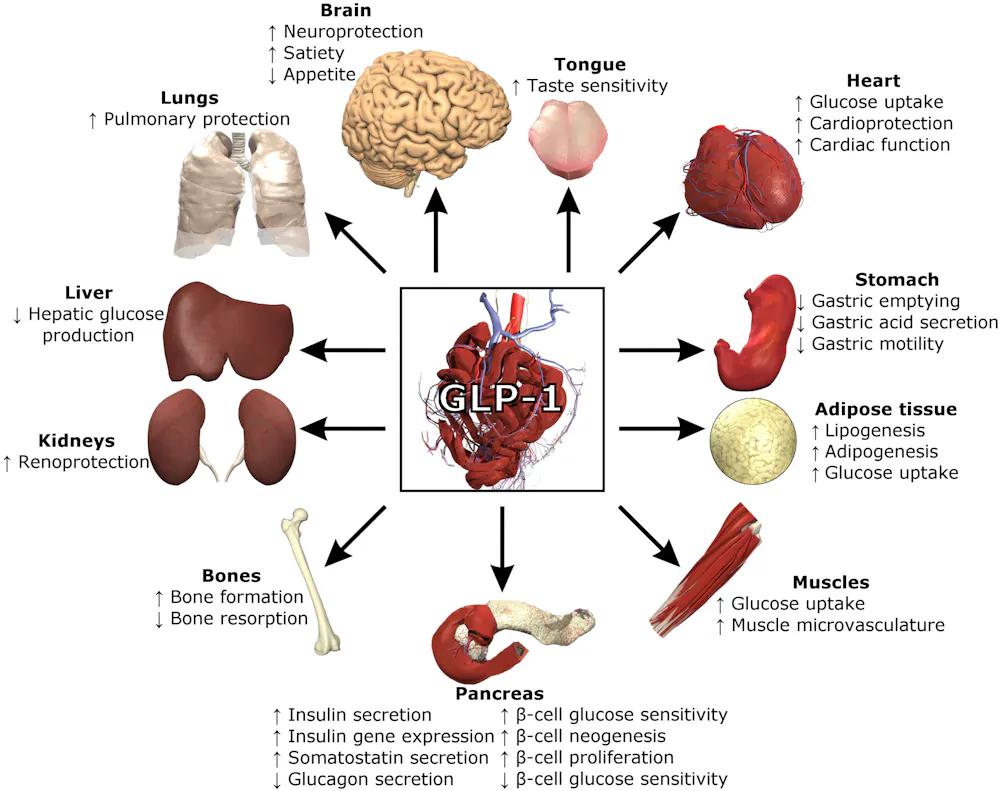
Diagram showing the effects of GLP-1 on various organs of the body
GLP-1 serves many functions in the body.
Lthoms11/Wikimedia Commons, CC BY-SA

Prior to modern processed foods, metabolic regulatory pathways were under the direction of a diverse healthy gut microbiome that used these hormones to naturally regulate your metabolism and appetite. However, food processing, aimed at improving shelf stability and enhancing taste, removes the bioactive molecules like fiber and polyphenols that help regulate this system.

Removal of these key food components and the resulting decrease in gut microbiome diversity may be an important factor contributing to the rise in obesity and diabetes.

A short track to metabolic health

Wegovy and Ozempic reinvigorate the colonic brake downstream of food and microbes with molecules similar to GLP-1. Researchers have demonstrated their effectiveness at weight loss and blood sugar control.

Mounjaro has gone a step further and combined GLP-1 with a second hormone analogue derived from the upper gut called GIP, and studies are showing this combination therapy to be even more effective at promoting weight loss than GLP-1-only therapies like Wegovy and Ozempic.

These drugs complement other measures like gastric bypass surgery that are used in the most extreme cases of metabolic disease. These surgeries may in part work much like Wegovy and Ozempic by bypassing digestion in segments of the gastrointestinal tract and bathing your gut microbes in less digested food. This awakens the microbes to stimulate your gut cells to produce GLP-1 and PYY, effectively regulating appetite and metabolism.

Many patients have seen significant improvements to not only their weight and blood glucose but also reductions in important cardiovascular outcomes like strokes and heart attacks. Medical guidelines support the use of new incretin-based medications like Wegovy, Ozempic and Mounjaro to manage the interrelated metabolic conditions of diabetes, obesity and cardiovascular disease.

Considering the effects incretin-based medications have on the brain and cravings, medical researchers are also evaluating their potential to treat nonmetabolic conditions like alcohol abuse, drug addiction and depression.

A near-magic bullet – for the right folks

Despite the success and prospect of these drugs to help populations that may benefit most from them, current prescribing practices have raised some questions. Should people who are only a little overweight use these drugs? What are the risks of prescribing these drugs to children and adolescents for lifelong weight management?
Close-up of a person's socked feet stepping on a scale
Some people regain weight after stopping incretin-based drugs.
Oleksandra Troian/Moment via Getty Images

While incretin-based therapies seem close to magic bullets, they are not without gastrointestinal side effects like nausea, vomiting, diarrhea and constipation. These symptoms are related to how the drugs work to slow the gastrointestinal tract. Other more severe, but rare, side effects include pancreatitis and irreversible gastroparesis, or inflammation of the pancreas and stomach paralysis.

These drugs can also lead to a loss of healthy lean muscle mass in addition to fat, particularly in the absence of exercise. Significant weight gain after stopping the drugs raises further questions about long-term effects and whether it’s possible to transition back to using only lifestyle measures to manage weight.

All roads lead to lifestyle

Despite our greatest aspirations for quick fixes, it’s very possible that a healthy lifestyle remains the most important way to manage metabolic disease and overall health. This includes regular exercise, stress management, sleep, getting outdoors and a balanced diet.

For the majority of the population who don’t yet have obesity or diabetes, restarting the gut’s built-in appetite and metabolism control by reintroducing whole foods and awaking the gut microbiome may be the best approach to promote healthy metabolism.

Adding minimally processed foods back to your diet, and specifically those replete in fiber and polyphenols like flavonoids and carotenoids, can play an important and complementary role to help address the epidemic of obesity and metabolic disease at one of its deepest roots.

Christopher Damman, Associate Professor of Gastroenterology, School of Medicine, University of Washington

This article is republished from The Conversation under a Creative Commons license. Read the original article.


Source: The Conversation
ShareTweet
Christopher Damman

Christopher Damman

Associate Professor of Gastroenterology, School of Medicine, University of Washington

Leave a Reply Cancel reply

Your email address will not be published. Required fields are marked *

Videos

In this episode of the Daily Remedy Podcast, Tiffany Ryder discusses her insights on healthcare messaging, the impact of COVID-19 on patient trust, and the importance of transparency in health policy. She emphasizes the need for clear communication in the face of divisiveness and explores the complexities surrounding the estrogen debate. Additionally, Tiffany highlights positive developments in health policy and the necessity of effectively conveying these changes to the public.

Tiffany Ryder is a political commentator and public health policy thought leader who publishes the Substack newsletter Signal and Noise: https://signalandnoise.online/


Chapters

00:00 Introduction to Healthcare Conversations
02:58 Signal and Noise: Understanding Healthcare Communication
05:56 The Storytelling Problem in Healthcare
08:58 Navigating Political Divisiveness in Health Policy
11:55 The Role of Media in Health Policy
15:03 Bias in Health Reporting
17:56 Estrogen and Health Policy: A Case Study
24:00 Positive Developments in Health Policy
27:03 Looking Ahead: Future of Health Policy
31:49 Communicating Health Policy Effectively
The Impact of COVID-19 on Patient Trust
YouTube Video ujzgl7HDlsw
Subscribe

Policy Shift in Peptide Regulation

Clinical Reads

GLP-1 Drugs Have Moved Past Weight Loss. Medicine Has Not Fully Caught Up.

Glucagon-Like Peptide–Based Therapies and Longevity: Clinical Implications from Emerging Evidence

by Daily Remedy
March 1, 2026
0

Glucagon-like peptide–based therapies are increasingly used for weight management and glycemic control, but their potential impact on long-term survival remains uncertain. The clinical question addressed in this report is whether treatment with glucagon-like peptide receptor agonists is associated with reductions in all-cause mortality and age-related morbidity beyond their established metabolic effects. This question matters because these agents are now prescribed across broad patient populations, including individuals without diabetes, and long-term exposure may influence cardiovascular, oncologic, and neurodegenerative outcomes. Understanding whether...

Read more

Join Our Newsletter!

Twitter Updates

Tweets by TheDailyRemedy

Popular

  • Rural Healthcare

    Rural Healthcare

    0 shares
    Share 0 Tweet 0
  • Healthcare’s Logistics Push

    0 shares
    Share 0 Tweet 0
  • America’s Medical Civil War

    0 shares
    Share 0 Tweet 0
  • A Call to Action for Pain Patients and Advocates

    1 shares
    Share 0 Tweet 0
  • Invisible Backbone: How International Nurses Day Exposed a Global Care Crisis

    0 shares
    Share 0 Tweet 0
  • 628 Followers

Daily Remedy

Daily Remedy offers the best in healthcare information and healthcare editorial content. We take pride in consistently delivering only the highest quality of insight and analysis to ensure our audience is well-informed about current healthcare topics - beyond the traditional headlines.

Daily Remedy website services, content, and products are for informational purposes only. We do not provide medical advice, diagnosis, or treatment. All rights reserved.

Important Links

  • Support Us
  • About Us
  • Contact us
  • Privacy Policy
  • Terms and Conditions

Join Our Newsletter!

  • Survey
  • Podcast
  • About Us
  • Contact us

© 2026 Daily Remedy

No Result
View All Result
  • Home
  • Articles
  • Podcasts
  • Surveys
  • Courses
  • About Us
  • Contact us
  • Support Us
  • Official Learner

© 2026 Daily Remedy