













Sunday, February 15, 2026
ISSN 2765-8767
  • Home
  • Courses
  • About Us
  • Contact us
  • Support Us
  • Home
  • Courses
  • About Us
  • Contact us
  • Support Us

IHME Extends COVID-19 Projections to February 2021

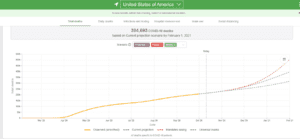
Researchers at the University of Washington’s Institute for Health Metrics and Evaluation (IHME) released new numbers, updating its COVID-19 death toll forecast through Feb. 1, 2021, in the U.S.

The U.S. has seen daily deaths increase slightly to about 750 per day since August, and the newest model shows that number climbing to nearly 2,900 daily by the end of December, bringing the total deaths to about 363,000.

According to Johns Hopkins University, deaths are forecast to total 395,000, an increase of 181,000 from today’s current total of 214,000.

But if mask use is increased to about 95%, overall deaths could drop to 316,000, saving 79,000 lives through Feb. 1.

IHME is forecasting a peak of 2,300 deaths daily in mid-January. But with 95% mask use, that number drops to under 1,400.

IHME is projecting about 2.5 million overall global deaths by Feb. 1, but that number drops to 1.7 million if there is 95% mask use.

And global daily deaths are forecast to peak in mid-January at just over 17,000 per day but could drop to just under 7,000 if mask use is at 95%.

 

Daily Remedy

Daily Remedy

Dr. Jay K Joshi serves as the editor-in-chief of Daily Remedy. He is a serial entrepreneur and sought after thought-leader for matters related to healthcare innovation and medical jurisprudence. He has published articles on a variety of healthcare topics in both peer-reviewed journals and trade publications. His legal writings include amicus curiae briefs prepared for prominent federal healthcare cases.

Videos

2027 Medicare Advantage & Part D Advance Notice

BIIB080 in Mild Alzheimer’s Disease: What a Phase 1b Exploratory Clinical Analysis Can—and Cannot—Tell Us

BIIB080 in Mild Alzheimer’s Disease: What a Phase 1b Exploratory Clinical Analysis Can—and Cannot—Tell Us

Can lowering tau biology translate into a clinically meaningful slowing of decline in people with early symptomatic Alzheimer’s disease? That is the practical question behind BIIB080, an intrathecal antisense therapy designed to reduce production of tau protein by targeting the tau gene transcript. In a phase 1b program originally designed for safety and dosing, investigators later examined cognitive, functional, and global outcomes as exploratory endpoints. The clinical question matters because current disease-modifying options primarily target amyloid, while tau pathology tracks...

Read more

Join Our Newsletter!
