













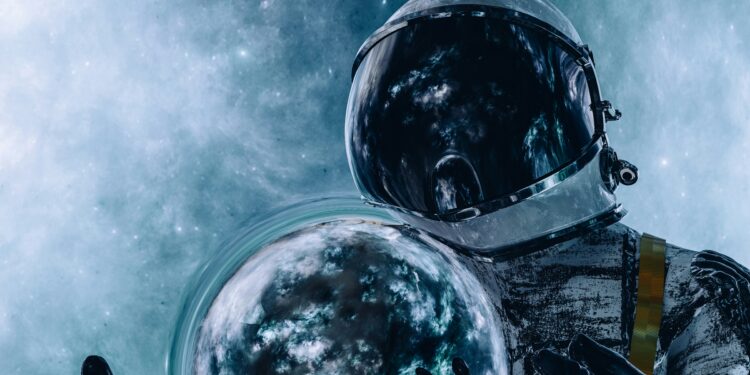
The future of humanity in space begins with an understanding of healthcare in space!
Space has become a very hot topic lately, with politicians raising the specter of nuclear weapons in space, something we’ve known about since the 60s, to ensure the US government can continue to spy on its own citizens and America’s greatest modern rival, China, promising to colonize the Moon. China has indeed put up its own space station after being excluded from the International Space Station (ISS) back in the early 90s. New orbital habitats are being planned so the US can compete, and the American public needs to understand the dangers of living in space. The main issues are zero gravity effects on bone, muscle, and other tissues and radiation damage to our cells and DNA.
The first can be tolerated with exercise and medications or easily ameliorated with artificial gravity systems. But the last, radiation, is the biggest issue. Radiation levels on Earth are usually less than 1 millisievert but can be as high as 2.5 in some areas. The radiation levels on Mars are roughly 100 times higher, at about 250 millisieverts (mSv). The Moon is roughly 500mSv, so twice as high as Mars, and empty space is about 750mSv. Three times that of Mars. That means astronauts on the way to Mars, a nine-month trip, could receive more radiation than they would get after two years on the surface. But can’t we shield ourselves against it? And if not, why not?
Anyone familiar with America’s space program will recognize that this nation went through a coma of innovation due to self-inflicted wounds. The extremely capable but expensive Saturn V was retired in favor of the less capable and even more expensive Space Shuttle. We went from being able to put the 168,000lb, 12,000+ cubic foot Skylab in orbit with a single launch to placing the 32,000lb, 3,700 cubic foot Destiny module into orbit with the Shuttle, so we could start building the International Space Station (ISS) in pieces. Then, the shuttles were grounded, and America depended on the Soviets/Russians to get us to the ISS.
The ISS ended up having a total volume of 1,000 cubic meters and a mass of 410,000 kilograms after forty missions. Thirty-six shuttle flights and four Russian rocket launches. Something the Saturn V could have exceeded with just two more Skylabs. The Soviets built a capable heavy-lift rocket system called Energia, that was able to put 100 metric tonnes into orbit (220,000 pounds), but with the fall of the Soviet Union, the rocket was abandoned, having only been launched twice, and there was no remaining super heavy lift rocket on Earth for three decades.
Once built, the ISS has been a great place to study humanity’s resistance to the space environment, and we’ve learned a lot, some of which will be summarized here. The greatest threat to life in space is, as we stated, radiation. Radiation damage to DNA causes cancer and early senescence. We age faster in a high-radiation environment. There are two main sources of space-based radiation. Solar radiation from the sun, and galactic radiation from outside our solar system, or even our galaxy.
Solar radiation is produced by the sun’s fusion reactions, producing high-speed electrons as well as helium and hydrogen ions. It also produces light in every wavelength, from radio waves through infrared and visible and through ultraviolet, X-rays, and gamma rays. The photons of high-frequency light, from ultraviolet onwards, can cause cancer, with high energy X rays being able to penetrate the thin aluminum skin of our spacecraft while gamma rays can penetrate several meters of lead.
Galactic radiation comes from unimaginable cosmic events, like neutron star collisions, supernova explosions, and black hole formation. These produce particles moving at near light speed that are much heavier than hydrogen or helium, like iron or even uranium, as well as bathing the universe in the light of high energy X-rays and gamma rays. The high-mass, high-speed particles are called Z particles, and they are extremely damaging to human tissue.
An explanation of types of radiation
High-speed electrons are called beta radiation and can be stopped by a few inches of wood or millimeters of aluminum. High-speed helium nuclei, like those from the sun or from the decay of radioactive elements, are called alpha radiation, and, while very deadly if they get inside the human body, like the polonium used to poison some of Putin’s opponents, can be stopped by a sheet of paper. Can’t we just shield ourselves against radiation? We can for some types, but not all.
X-rays and gamma rays are another matter. These take a lot of shielding, and that brings us to another issue: secondary radiation. Secondary radiation is caused by one radiation event triggering more radiation. When gamma or X-ray photons strike matter, like in the Earth’s atmosphere, they interact with the electromagnetic fields of the atoms in that matter and come to a stop. As it does so, however, the energy absorbed can cause the creation of other particles and high-energy photons, including neutrons, X-rays, and gamma rays.
When radiation travels through the human body, it hits important molecules like proteins and DNA. Proteins are produced at a high rate, so these can be replaced with little effort, but the DNA in every cell is a massive database with only two copies. If the radiation damages one of these copies, repair molecules try to correct the damage, but since they don’t know what copy is correct, they sometimes make the wrong repair, creating a cell with dysfunctional DNA.
These cells go on to absorb resources without doing their job, senescent cells, or they start to multiply and absorb lots of resources, starting on their way to cancer. Radiation also damages the cells in the lens of the eyes, causing vision problems and cataracts. There is also a problem with overall damage and inflammation. Studies show that living in space increases our risk of inflammation-related conditions, like cardio and cerebrovascular disease.
The Earth’s atmosphere and magnetic fields protect us from most of this radiation while we are on the surface, with only the most powerful photons and z particles getting through. But once we go to an altitude of 250 miles, where the ISS stays, the atmosphere is too thin to help us, and we need radiation shielding. The ISS uses aluminum, which stops a lot of the solar radiation, and ballistic fabrics like Kevlar, which helps absorb some of the X-rays and gamma rays. Scientists have looked at creating an artificial magnetic field, but right now, we don’t have the electrical power it would take.
We also still need to worry about secondary radiation, which can create the deadliest type of radiation: neutron. Free neutrons only survive a little more than ten minutes before decaying into a proton and electron (with an antineutrino), so they are not really a threat, but neutrons created in secondary radiation reactions are very toxic to humans. This secondary radiation is produced most in metal shielding, like that on the ISS, and least by hydrogen-rich shielding, materials like cryogenic hydrogen, water, and plastics.
Why don’t we just shield our ships and stations with water? It would take about a meter of water to protect us fully from space radiation, bringing the levels down near those we experience on Earth. Each cubic meter of water has a mass of 2,200 lbs. Shielding a small microbus, assuming it’s two meters wide, three meters long, and two meters tall, six foot 8 by ten feet by 6 foot 8, would require a mass of 70 thousand pounds. More than twice what the shuttle could lift. Plastic would be even heavier. So, our astronauts on the ISS tolerate a higher radiation load for the sake of science and exploration. But that won’t work long term.
For a long-term solution, scientists started creating inflatable habitats, using multiple layers of plastics and ballistic fabric, with water shielding pumped into some of the layers. NASA started the research with Transhab, which was canceled and sold off to Bigelow Aerospace, who built the BEAM module that was tested on the ISS before shutting down during the pandemic. Now, several other companies have picked up the baton, including Sierra Space with the LIFE module from the US, and the ESAs Starlab. Starlab is a large, very well-designed orbital habitat that was going to be assembled in space like the ISS.
This changed with the development of the SpaceX Starship. With a payload mass to low Earth orbit capability of over 150 metric tonnes, over 330,000 pounds with one launch, finally beating the Saturn Vs 140 metric tonne limit, Starlab is now planned to go up on one launch, like Skylab. With Starship and other planned super heavy lift rocket systems like New Glenn, we can start building true orbital habitats, capable of housing human beings safely, with artificial gravity systems and sufficient radiation shielding.
The world is experiencing a paradigm shift in what will be possible in space, a renaissance that will finally surpass the accomplishments of our grandparents’ generation and move us out to all the worlds waiting in the solar system. Not just the Moon but Mars, Mercury, Titan, Callisto, and over a hundred others.



