













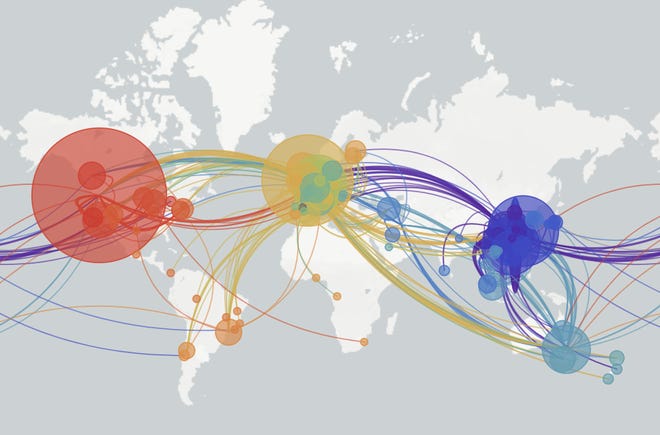
At least eight strains of the coronavirus are making their way around the globe, creating a trail of death and disease that scientists are tracking by their genetic footprints.
While much is unknown, hidden in the virus’s unique microscopic fragments are clues to the origins of its original strain, how it behaves as it mutates and which strains are turning into conflagrations while others are dying out thanks to quarantine measures.
Huddled in once bustling and now almost empty labs, researchers who oversaw dozens of projects are instead focused on one goal: tracking the current strains of the SARS-CoV-2 virus that cause the illness COVID-19.
Labs around the world are turning their sequencing machines, most about the size of a desktop printer, to the task of rapidly sequencing the genomes of virus samples taken from people sick with COVID-19. The information is uploaded to a website called NextStrain.org that shows how the virus is migrating and splitting into similar but new subtypes.
While researchers caution they’re only seeing the tip of the iceberg, the tiny differences between the virus strains suggest shelter-in-place orders are working in some areas and that no one strain of the virus is more deadly than another. They also say it does not appear the strains will grow more lethal as they evolve.
“The virus mutates so slowly that the virus strains are fundamentally very similar to each other,” said Charles Chiu, a professor of medicine and infectious disease at the University of California, San Francisco School of Medicine.
Source: USA Today



