












Monday, January 26, 2026
ISSN 2765-8767
  • Survey
  • Podcast
  • Write for Us
  • My Account
  • Log In
Daily Remedy
  • Home
  • Articles
  • Podcasts
    The Future of LLMs in Healthcare

    The Future of LLMs in Healthcare

    January 26, 2026
    The Future of Healthcare Consumerism

    The Future of Healthcare Consumerism

    January 22, 2026
    Your Body, Your Health Care: A Conversation with Dr. Jeffrey Singer

    Your Body, Your Health Care: A Conversation with Dr. Jeffrey Singer

    July 1, 2025

    The cost structure of hospitals nearly doubles

    July 1, 2025
    Navigating the Medical Licensing Maze

    The Fight Against Healthcare Fraud: Dr. Rafai’s Story

    April 8, 2025
    Navigating the Medical Licensing Maze

    Navigating the Medical Licensing Maze

    April 4, 2025
  • Surveys

    Surveys

    Patient Survey: Understanding Healthcare Consumerism

    Patient Survey: Understanding Healthcare Consumerism

    January 18, 2026
    Public Confidence in Proposed Changes to U.S. Vaccine Policy

    Public Confidence in Proposed Changes to U.S. Vaccine Policy

    January 3, 2026

    Survey Results

    Can you tell when your provider does not trust you?

    Can you tell when your provider does not trust you?

    January 18, 2026
    Do you believe national polls on health issues are accurate

    National health polls: trust in healthcare system accuracy?

    May 8, 2024
    Which health policy issues matter the most to Republican voters in the primaries?

    Which health policy issues matter the most to Republican voters in the primaries?

    May 14, 2024
    How strongly do you believe that you can tell when your provider does not trust you?

    How strongly do you believe that you can tell when your provider does not trust you?

    May 7, 2024
  • Courses
  • About Us
  • Contact us
  • Support Us
  • Official Learner
No Result
View All Result
  • Home
  • Articles
  • Podcasts
    The Future of LLMs in Healthcare

    The Future of LLMs in Healthcare

    January 26, 2026
    The Future of Healthcare Consumerism

    The Future of Healthcare Consumerism

    January 22, 2026
    Your Body, Your Health Care: A Conversation with Dr. Jeffrey Singer

    Your Body, Your Health Care: A Conversation with Dr. Jeffrey Singer

    July 1, 2025

    The cost structure of hospitals nearly doubles

    July 1, 2025
    Navigating the Medical Licensing Maze

    The Fight Against Healthcare Fraud: Dr. Rafai’s Story

    April 8, 2025
    Navigating the Medical Licensing Maze

    Navigating the Medical Licensing Maze

    April 4, 2025
  • Surveys

    Surveys

    Patient Survey: Understanding Healthcare Consumerism

    Patient Survey: Understanding Healthcare Consumerism

    January 18, 2026
    Public Confidence in Proposed Changes to U.S. Vaccine Policy

    Public Confidence in Proposed Changes to U.S. Vaccine Policy

    January 3, 2026

    Survey Results

    Can you tell when your provider does not trust you?

    Can you tell when your provider does not trust you?

    January 18, 2026
    Do you believe national polls on health issues are accurate

    National health polls: trust in healthcare system accuracy?

    May 8, 2024
    Which health policy issues matter the most to Republican voters in the primaries?

    Which health policy issues matter the most to Republican voters in the primaries?

    May 14, 2024
    How strongly do you believe that you can tell when your provider does not trust you?

    How strongly do you believe that you can tell when your provider does not trust you?

    May 7, 2024
  • Courses
  • About Us
  • Contact us
  • Support Us
  • Official Learner
No Result
View All Result
Daily Remedy
No Result
View All Result
Home Perspectives

Some Cancers are Preventable with a Vaccine

Daily Remedy by Daily Remedy
February 24, 2022
in Perspectives
0
Some Cancers are Preventable with a Vaccine

Ronald C. Desrosiers, University of Miami

One-fifth. Nearly 20% of cancers worldwide are caused by a virus.

These viruses don’t cause cancer until long after they initially infect a person. Rather, the viruses teach the cells they take over how to escape the natural biological process of cell death. This strategy sets these altered cells on a path for other genetic changes that can cause full-blown cancer years down the road.

As a microbiologist and researcher of viruses, I seek to understand how viruses affect living cells and the health of the people who are infected. These particular viruses are unique and interesting, both for their effects on patients and because of the potential ways they might be treated or prevented.

The viral landscape

All known viruses can be categorized into one of 22 distinct families. Five of these families are called “persisting,” because once a person is infected, the virus remains in their body for life. One example is the herpes virus that causes chickenpox in children and can reappear later in life as shingles. This ability to survive over the long term helps the virus spread from person to person.

There are seven known viruses that can cause cancer. Five of them are members of persistent virus families. The human papillomavirus, commonly known as HPV and known to cause cervical cancer, is in the papilloma family. The Epstein-Barr virus, which causes Hodgkin lymphomas, and the Kaposi’s sarcoma-associated virus, are both in the herpes family. The human T-lymphotropic virus, which can cause a type of leukemia, is what’s known as a retrovirus. And Merkel cell polyoma virus, which causes Merkel cell carcinoma, is in the polyoma family.

All five of these viruses contain genetic code for one or more proteins that teach cells how to avoid cell death, effectively immortalizing them and promoting cell growth. The cancer cells that develop from these oncogenic viruses all contain their original viruses’ genetic information, even when they appear years after the initial infection. But only a small percentage of people who are infected with one of these five oncogenic viruses ultimately develop the full-blown cancer associated with it.

The other two viruses, hepatitis B, in the hepadna family, and hepatitis C, in the flavi family, are somewhat different. Most people infected with those viruses are able to fight the infection through their own immunity and eliminate the virus.

However, in people who are not able to fight off the infection, long-term infections of these viruses often cause extensive liver damage. These people are at risk of developing a type of liver cancer called hepatocellular carcinoma, because the body’s attempts to repair the damaged liver tissue increase the chance of a cancer-related mutation. The viruses themselves do not teach the liver cells to become immortal or transform themselves, the way the other five oncogenic viruses do to the cells they target.

These viral-induced cancers are serious health threats. Hepatocellular carcinoma, for instance, kills approximately 800,000 people a year, making it the third-deadliest cancer globally. About three-quarters of those killed have had hepatitis virus infections in the past.

HPV is similarly dangerous. The cervical cancer it causes kills some 311,000 people a year worldwide, making it the deadliest cancer in women until recently. That number includes 36,000 women in the U.S. But HPV doesn’t just put women at risk. A similar number of people in the U.S. die each year from anal and throat cancers linked to HPV.
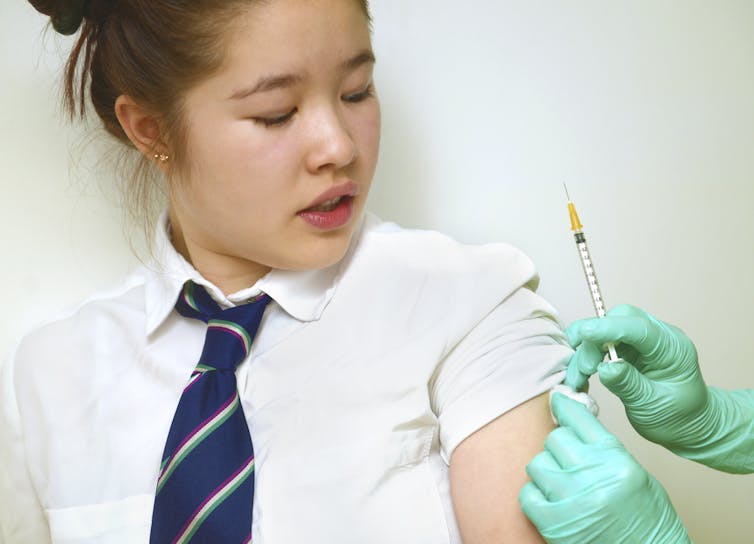
A schoolgirl receives the HPV vaccination.
The HPV vaccine is recommended for all children and adolescents, starting at age 11.
Peter Dazeley/The Image Bank via Getty Images

Reasons for optimism

The first viral vaccine to protect against HPV infection and its associated cancers was approved for use in the U.S. in 2006. It has proved to be highly effective at preventing both HPV infection and the subsequent development of cervical carcinoma.

HPV vaccines are now widely available around the globe. The HPV vaccine is safe, with very mild side effects. It is recommended for children starting at ages 11 to 12, since different individuals become sexually active at different ages. The protective effects of the vaccine last beyond 10 years, and booster shots are available.

Older people – typically up to 26 years of age – can also receive the HPV vaccine. By preventing infection in the first place, the vaccine also prevents the subsequent cancers that may result from a viral infection.

The vaccine for hepatitis B virus has been similarly successful over a longer time period. Introduced in 1986, it was recognized as the first anti-cancer vaccine. Since then, more than a billion people worldwide have received it. The vaccine has been shown to be extremely safe and effective.

Vaccines save lives

The numbers of cancers prevented and lives saved by the vaccines against the hepatitis B virus and human papillomavirus are enormous and indisputable. Yet, as with the resistance to COVID-19 vaccines, vaccine hesitancy is an ongoing problem. In 2019, 46% of adolescents ages 13 to 17 in the U.S. had not received their recommended HPV vaccines. In 2020 in Mississippi, HPV vaccine coverage in adolescents reached a meager 32%.

But the U.S. is better off than some other industrialized nations. In Japan, the current rate of HPV vaccine coverage in adolescents is less than 1% because of false reports of adverse events in 2013. Despite repeated, definitive discrediting of these claims, vaccine uptake in Japan has not rebounded.

Vaccination campaigns have eradicated smallpox and effectively eliminated polio, measles and certain other infectious diseases. Let’s hope that ongoing vaccine efforts can make HPV-induced cancers and hepatitis B virus-induced cancers a thing of the past as well.

Ronald C. Desrosiers, Professor of Pathology, Vice-chair for Research, University of Miami

This article is republished from The Conversation under a Creative Commons license. Read the original article.


ShareTweet
Daily Remedy

Daily Remedy

Dr. Jay K Joshi serves as the editor-in-chief of Daily Remedy. He is a serial entrepreneur and sought after thought-leader for matters related to healthcare innovation and medical jurisprudence. He has published articles on a variety of healthcare topics in both peer-reviewed journals and trade publications. His legal writings include amicus curiae briefs prepared for prominent federal healthcare cases.

Leave a Reply Cancel reply

Your email address will not be published. Required fields are marked *

Videos

In this episode, the host discusses the significance of large language models (LLMs) in healthcare, their applications, and the challenges they face. The conversation highlights the importance of simplicity in model design and the necessity of integrating patient feedback to enhance the effectiveness of LLMs in clinical settings.

Takeaways
LLMs are becoming integral in healthcare.
They can help determine costs and service options.
Hallucination in LLMs can lead to misinformation.
LLMs can produce inconsistent answers based on input.
Simplicity in LLMs is often more effective than complexity.
Patient behavior should guide LLM development.
Integrating patient feedback is crucial for accuracy.
Pre-training models with patient input enhances relevance.
Healthcare providers must understand LLM limitations.
The best LLMs will focus on patient-centered care.

Chapters

00:00 Introduction to LLMs in Healthcare
05:16 The Importance of Simplicity in LLMs
The Future of LLMs in HealthcareDaily Remedy
YouTube Video U1u-IYdpeEk
Subscribe

Large Language Models in Healthcare

Clinical Reads

What the Most-Cited LLM-in-Medicine Papers Reveal—and What They Miss

What the Most-Cited LLM-in-Medicine Papers Reveal—and What They Miss

by Daily Remedy
January 25, 2026
0

In just over two years, papers on large language models (LLMs) in medicine have accumulated nearly fifteen thousand citations, creating an academic canon that is already shaping funding decisions, regulatory conversations, and clinical experimentation. This study dissects the 100 most-cited LLM-in-medicine papers to show who is driving the field, which applications dominate attention, and where the evidence remains dangerously thin. What emerges is a picture of rapid intellectual consolidation—paired with a widening gap between technical promise and clinical reality. The...

Read more

Twitter Updates

Tweets by DailyRemedy1

Newsletter

Start your Daily Remedy journey

Cultivate your knowledge of current healthcare events and ensure you receive the most accurate, insightful healthcare news and editorials.

*we hate spam as much as you do

Popular

  • Why Investors Now Care About Patient Experience

    Why Investors Now Care About Patient Experience

    0 shares
    Share 0 Tweet 0
  • GLP-1 Drugs Have Moved Past Weight Loss. Medicine Has Not Fully Caught Up.

    0 shares
    Share 0 Tweet 0
  • The CDC Consists Mostly of Remote Workers

    0 shares
    Share 0 Tweet 0
  • What Eat Real Food Changes Inside the Exam Room

    0 shares
    Share 0 Tweet 0
  • Opioid Settlements: “Cash Cow”

    0 shares
    Share 0 Tweet 0
  • 628 Followers

Daily Remedy

Daily Remedy offers the best in healthcare information and healthcare editorial content. We take pride in consistently delivering only the highest quality of insight and analysis to ensure our audience is well-informed about current healthcare topics - beyond the traditional headlines.

Daily Remedy website services, content, and products are for informational purposes only. We do not provide medical advice, diagnosis, or treatment. All rights reserved.

Important Links

  • Support Us
  • About Us
  • Contact us
  • Privacy Policy
  • Terms and Conditions

Newsletter

Start your Daily Remedy journey

Cultivate your knowledge of current healthcare events and ensure you receive the most accurate, insightful healthcare news and editorials.

*we hate spam as much as you do

  • Survey
  • Podcast
  • About Us
  • Contact us

© 2026 Daily Remedy

No Result
View All Result
  • Home
  • Articles
  • Podcasts
  • Surveys
  • Courses
  • About Us
  • Contact us
  • Support Us
  • Official Learner

© 2026 Daily Remedy

Start your Daily Remedy journey

Cultivate your knowledge of current healthcare events and ensure you receive the most accurate, insightful healthcare news and editorials.

*we hate spam as much as you do
