













Saturday, February 14, 2026
ISSN 2765-8767
  • Survey
  • Podcast
  • Write for Us
  • My Account
  • Log In
Daily Remedy
  • Home
  • Articles
  • Podcasts
    The Future of LLMs in Healthcare

    The Future of LLMs in Healthcare

    January 26, 2026
    The Future of Healthcare Consumerism

    The Future of Healthcare Consumerism

    January 22, 2026
    Your Body, Your Health Care: A Conversation with Dr. Jeffrey Singer

    Your Body, Your Health Care: A Conversation with Dr. Jeffrey Singer

    July 1, 2025

    The cost structure of hospitals nearly doubles

    July 1, 2025
    Navigating the Medical Licensing Maze

    The Fight Against Healthcare Fraud: Dr. Rafai’s Story

    April 8, 2025
    Navigating the Medical Licensing Maze

    Navigating the Medical Licensing Maze

    April 4, 2025
  • Surveys

    Surveys

    AI in Healthcare Decision-Making

    AI in Healthcare Decision-Making

    February 1, 2026
    Patient Survey: Understanding Healthcare Consumerism

    Patient Survey: Understanding Healthcare Consumerism

    January 18, 2026

    Survey Results

    Can you tell when your provider does not trust you?

    Can you tell when your provider does not trust you?

    January 18, 2026
    Do you believe national polls on health issues are accurate

    National health polls: trust in healthcare system accuracy?

    May 8, 2024
    Which health policy issues matter the most to Republican voters in the primaries?

    Which health policy issues matter the most to Republican voters in the primaries?

    May 14, 2024
    How strongly do you believe that you can tell when your provider does not trust you?

    How strongly do you believe that you can tell when your provider does not trust you?

    May 7, 2024
  • Courses
  • About Us
  • Contact us
  • Support Us
  • Official Learner
No Result
View All Result
  • Home
  • Articles
  • Podcasts
    The Future of LLMs in Healthcare

    The Future of LLMs in Healthcare

    January 26, 2026
    The Future of Healthcare Consumerism

    The Future of Healthcare Consumerism

    January 22, 2026
    Your Body, Your Health Care: A Conversation with Dr. Jeffrey Singer

    Your Body, Your Health Care: A Conversation with Dr. Jeffrey Singer

    July 1, 2025

    The cost structure of hospitals nearly doubles

    July 1, 2025
    Navigating the Medical Licensing Maze

    The Fight Against Healthcare Fraud: Dr. Rafai’s Story

    April 8, 2025
    Navigating the Medical Licensing Maze

    Navigating the Medical Licensing Maze

    April 4, 2025
  • Surveys

    Surveys

    AI in Healthcare Decision-Making

    AI in Healthcare Decision-Making

    February 1, 2026
    Patient Survey: Understanding Healthcare Consumerism

    Patient Survey: Understanding Healthcare Consumerism

    January 18, 2026

    Survey Results

    Can you tell when your provider does not trust you?

    Can you tell when your provider does not trust you?

    January 18, 2026
    Do you believe national polls on health issues are accurate

    National health polls: trust in healthcare system accuracy?

    May 8, 2024
    Which health policy issues matter the most to Republican voters in the primaries?

    Which health policy issues matter the most to Republican voters in the primaries?

    May 14, 2024
    How strongly do you believe that you can tell when your provider does not trust you?

    How strongly do you believe that you can tell when your provider does not trust you?

    May 7, 2024
  • Courses
  • About Us
  • Contact us
  • Support Us
  • Official Learner
No Result
View All Result
Daily Remedy
No Result
View All Result
Home Perspectives

Perceptions of Pain: Survey Results

It's all in your head; that's why it matters.

Daily Remedy by Daily Remedy
January 9, 2023
in Perspectives
0
Perceptions of Pain

Teslariu Mihai

It’s all in your head. That’s what you’re told when what you think is perceived not to matter. Funny how prescient those beliefs become: sometimes what you think is the only thing that matters.

Take the buzz around the CDC opioid prescribing guidelines. They’re a veritable Rorschach test. For some, they’re too lenient. For others, they’re too strict. But mostly they’re a reflection of what people think about opioids for the treatment of acute and chronic pain.

Over the recent weeks, we surveyed readers to glean their thoughts on their care experience when it comes to all things pain related. We asked a series of questions, roughly one per week, with the intent of ascertaining what people thought about their pain management.

The results were predictably unpredictable. Nearly every result contained some degree of selection bias. This is almost impossible to avoid when conducting open sourced online surveys. But we found something more valuable hidden just beneath the numbers themselves, within the bias. By looking at the range of responses rather than the responses themselves, we found an interesting trend in the asymmetry that appeared.

It’s something statisticians call skewness and it’s one of those terms we learn and then quickly forget. But when we analyze the responses by the curves they produce once graphed out, we find important trends in the underlying perception of the respondents. These trends explain why we repeatedly see a disparity between the care patients receive and their perceptions of their pain treatment. Let’s start by comparing the relative frequency of the most common response to each question.

At first blush, the response to the question, “How strongly do you believe that you can tell when your provider does not trust you?”, may prompt a certain level of obvious indifference. However, the most frequent response, ‘very strongly’, came in at 49.33 percent, just under half.

Compare that with the most frequent responses for the following three questions:

  • Do you get tense when discussing opioids?
  • How much of an impact does the DEA have on your clinical care?
  • How much of an impact does the risk of a DEA sanction have on your provider’s decision making?

For these three questions, the most extreme response was also the most frequent, but it was much more frequent than the first question: 70.71 percent, 82.56 percent, and 83.72 percent, respectively, to be exact. The responses indicate a clear bias in the survey design. But the point isn’t that the responses are skewed. Instead, focus on the degree of skewness, which varies for each of these four questions. These variances reveal which perceptions dominate over others.

Note how respondents believe the influence of the DEA has a greater impact on their care than the mutual trust between a provider and a patient. The disparity is over 10 percent, not an insignificant amount. Clearly, the DEA plays a significant role in influencing the patient-physician encounter.

Now look at the question where we asked the degree to which providers and patients share similar beliefs about the DEA. Again, we see a skewing toward the extremes, revealing an inherent survey bias. But the gradual increase toward the upper extreme, 10, shows a clear trend toward sharing similar views: that both the provider and patient share similar views about the DEA.

1

9.30%

2

3.49%

3

3.49%

4

2.33%

5

25.58%

6

3.49%

7

3.49%

8

11.63%

9

11.63%

10

25.58%

Each of the response patterns, when viewed only in reference to the question asked, appears obvious. But when the response patterns are viewed side by side, they expose certain contradictions – that may actually make sense, but only if you consider the adverse effects the DEA has on clinical care.

One question asks whether patients feel tense when discussing opioids with their providers, and skews strongly toward ‘tense’ and ‘very tense’. Another question asks about the degree to which a provider and a patient share similar beliefs about the DEA, which found a strong trend toward the two sharing similar beliefs.

But why would patients feel tense when discussing opioids if the majority of the respondents share similar views as their providers about them?

The contradictory answers expose a certain disingenuousness that appears in patient encounters for nearly all chronic pain patients. Patients and providers both know of the stigmatization chronic pain patients experience. They see it, they acknowledge it, yet they do nothing about it. They taper opioid prescriptions when they know it causes patient harm. They lower doses without any clinical rationale to do so.

Both providers and patients are acutely aware that providers make prescribing decisions to avoid legal liability rather than to do what’s best for the patient clinically. Yet few will admit as much. It’s a shame that it takes a survey to say what most in the medical community will not. Their silence is as extreme as the skews in the distribution curves.

True, these surveys are far from the traditional Likert surveys commonly seen in peer reviewed academic studies. These surveys contain dirty data, as many behavioral economists would label it: responses laced with biases and filled with subjective perceptions unique to each individual. It’s not truly objective. It’s not supposed to be. Yet, it’s a highly accurate gauge of the patient experience.

Sometimes the biases in our heads are the only things that matter. So the next time someone says – it’s all in your head – tell them they’re right, and tell them that’s why it matters.


Full Data – Gathered between September 2022 and December 2022

How strongly do you believe that you can tell when your provider does not trust you?

49.93% very strongly
31.38% somewhat strongly
17.57% unsure
3.77% not quite strongly
3.35% not at all strongly
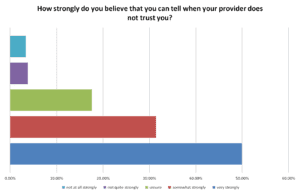
How strongly do you believe that you can tell when your provider does not trust you?
If you present a clinical study to your provider, how confident are you that he or she will discuss it with you?

26.92% not at all confident
26.37% not confident
18.13% unsure
17.03% somewhat confident
11.54% very confident
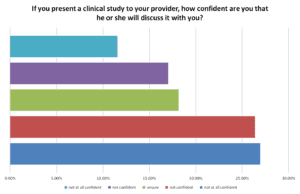
If you present a clinical study to your provider, how confident are you that he or she will discuss it with you?
Do you get tense when discussing opioids?

70.71% extremely tense
24.24% somewhat tense
4.04% a little tense
1.01% not at all tense
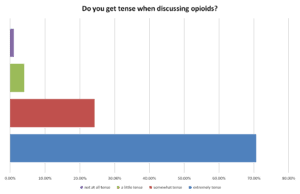
Do you get tense when discussing opioids?
How much of an impact does the DEA have on your clinical care?

82.56% significant impact
11.63% some impact
4.65% slight impact
1.16% no impact
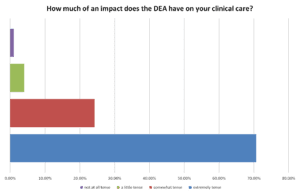
How much of an impact does the DEA have on your clinical care?
How much of an impact does the risk of a DEA sanction have on your provider’s decision making?

83.72% significant impact
9.30% some impact
6.98% slight impact
0% no impact
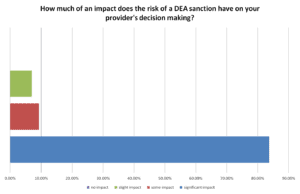
How much of an impact does the risk of a DEA sanction have on your provider's decision making?

To what degree do your provider and you share the same beliefs about the DEA?
1
9.30%
2
3.49%
3
3.49%
4
2.33%
5
25.58%
6
3.49%
7
3.49%
8
11.63%
9
11.63%
10
25.58%
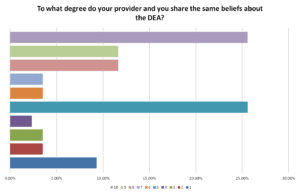

To what degree do your provider and you share the same beliefs about the DEA?

ShareTweet
Daily Remedy

Daily Remedy

Dr. Jay K Joshi serves as the editor-in-chief of Daily Remedy. He is a serial entrepreneur and sought after thought-leader for matters related to healthcare innovation and medical jurisprudence. He has published articles on a variety of healthcare topics in both peer-reviewed journals and trade publications. His legal writings include amicus curiae briefs prepared for prominent federal healthcare cases.

Comments 0

  1. Jrae says:
    3 years ago

    The patient has no rights. The Dr is prepared. When he wants to take ones pain medication away he steers the conversation so any reasoning the sufferer attempts makes him appear as a pleading addict. It’s a one-sided psychological game where the Dr always gets his way. Patient walks into appointment filled with hope of getting relief and leaves feeling like a (guilty) victim, now suffering even more because he has less medication than when he made the appointment. Sad! The patients empathize, they don’t want to see the Dr lose a career he has dedicated so many years of his life to. Sad! Dr’s aren’t honoring the oath they took-it’s akin to having a knife at their throats. So sad!! Think about it, both Dr and patient have their quality of life taken away. Suicides are on the rise on both sides.

    Reply

Leave a Reply Cancel reply

Your email address will not be published. Required fields are marked *

Videos

In this episode, the host discusses the significance of large language models (LLMs) in healthcare, their applications, and the challenges they face. The conversation highlights the importance of simplicity in model design and the necessity of integrating patient feedback to enhance the effectiveness of LLMs in clinical settings.

Takeaways
LLMs are becoming integral in healthcare.
They can help determine costs and service options.
Hallucination in LLMs can lead to misinformation.
LLMs can produce inconsistent answers based on input.
Simplicity in LLMs is often more effective than complexity.
Patient behavior should guide LLM development.
Integrating patient feedback is crucial for accuracy.
Pre-training models with patient input enhances relevance.
Healthcare providers must understand LLM limitations.
The best LLMs will focus on patient-centered care.

Chapters

00:00 Introduction to LLMs in Healthcare
05:16 The Importance of Simplicity in LLMs
The Future of LLMs in HealthcareDaily Remedy
YouTube Video U1u-IYdpeEk
Subscribe

AI Regulation and Deployment Is Now a Core Healthcare Issue

Clinical Reads

Ambient Artificial Intelligence Clinical Documentation: Workflow Support with Emerging Governance Risk

Ambient Artificial Intelligence Clinical Documentation: Workflow Support with Emerging Governance Risk

by Daily Remedy
February 1, 2026
0

Health systems are increasingly deploying ambient artificial intelligence tools that listen to clinical encounters and automatically generate draft visit notes. These systems are intended to reduce documentation burden and allow clinicians to focus more directly on patient interaction. At the same time, they raise unresolved questions about patient consent, data handling, factual accuracy, and legal responsibility for machine‑generated records. Recent policy discussions and legal actions suggest that adoption is moving faster than formal oversight frameworks. The practical clinical question is...

Read more

Join Our Newsletter!

Twitter Updates

Tweets by TheDailyRemedy

Popular

  • The Information Epidemic: How Digital Health Misinformation Is Rewiring Clinical Risk

    The Information Epidemic: How Digital Health Misinformation Is Rewiring Clinical Risk

    0 shares
    Share 0 Tweet 0
  • Prevention Is Having a Moment and a Measurement Problem

    0 shares
    Share 0 Tweet 0
  • Health Technology Assessment Is Moving Upstream

    0 shares
    Share 0 Tweet 0
  • Behavioral Health Is Now a Network Phenomenon

    0 shares
    Share 0 Tweet 0
  • The Breach Is the Diagnosis: Cybersecurity Has Become a Clinical Risk Variable

    0 shares
    Share 0 Tweet 0
  • 628 Followers

Daily Remedy

Daily Remedy offers the best in healthcare information and healthcare editorial content. We take pride in consistently delivering only the highest quality of insight and analysis to ensure our audience is well-informed about current healthcare topics - beyond the traditional headlines.

Daily Remedy website services, content, and products are for informational purposes only. We do not provide medical advice, diagnosis, or treatment. All rights reserved.

Important Links

  • Support Us
  • About Us
  • Contact us
  • Privacy Policy
  • Terms and Conditions

Join Our Newsletter!

  • Survey
  • Podcast
  • About Us
  • Contact us

© 2026 Daily Remedy

No Result
View All Result
  • Home
  • Articles
  • Podcasts
  • Surveys
  • Courses
  • About Us
  • Contact us
  • Support Us
  • Official Learner

© 2026 Daily Remedy
