













Wednesday, February 11, 2026
ISSN 2765-8767
  • Survey
  • Podcast
  • Write for Us
  • My Account
  • Log In
Daily Remedy
  • Home
  • Articles
  • Podcasts
    The Future of LLMs in Healthcare

    The Future of LLMs in Healthcare

    January 26, 2026
    The Future of Healthcare Consumerism

    The Future of Healthcare Consumerism

    January 22, 2026
    Your Body, Your Health Care: A Conversation with Dr. Jeffrey Singer

    Your Body, Your Health Care: A Conversation with Dr. Jeffrey Singer

    July 1, 2025

    The cost structure of hospitals nearly doubles

    July 1, 2025
    Navigating the Medical Licensing Maze

    The Fight Against Healthcare Fraud: Dr. Rafai’s Story

    April 8, 2025
    Navigating the Medical Licensing Maze

    Navigating the Medical Licensing Maze

    April 4, 2025
  • Surveys

    Surveys

    AI in Healthcare Decision-Making

    AI in Healthcare Decision-Making

    February 1, 2026
    Patient Survey: Understanding Healthcare Consumerism

    Patient Survey: Understanding Healthcare Consumerism

    January 18, 2026

    Survey Results

    Can you tell when your provider does not trust you?

    Can you tell when your provider does not trust you?

    January 18, 2026
    Do you believe national polls on health issues are accurate

    National health polls: trust in healthcare system accuracy?

    May 8, 2024
    Which health policy issues matter the most to Republican voters in the primaries?

    Which health policy issues matter the most to Republican voters in the primaries?

    May 14, 2024
    How strongly do you believe that you can tell when your provider does not trust you?

    How strongly do you believe that you can tell when your provider does not trust you?

    May 7, 2024
  • Courses
  • About Us
  • Contact us
  • Support Us
  • Official Learner
No Result
View All Result
  • Home
  • Articles
  • Podcasts
    The Future of LLMs in Healthcare

    The Future of LLMs in Healthcare

    January 26, 2026
    The Future of Healthcare Consumerism

    The Future of Healthcare Consumerism

    January 22, 2026
    Your Body, Your Health Care: A Conversation with Dr. Jeffrey Singer

    Your Body, Your Health Care: A Conversation with Dr. Jeffrey Singer

    July 1, 2025

    The cost structure of hospitals nearly doubles

    July 1, 2025
    Navigating the Medical Licensing Maze

    The Fight Against Healthcare Fraud: Dr. Rafai’s Story

    April 8, 2025
    Navigating the Medical Licensing Maze

    Navigating the Medical Licensing Maze

    April 4, 2025
  • Surveys

    Surveys

    AI in Healthcare Decision-Making

    AI in Healthcare Decision-Making

    February 1, 2026
    Patient Survey: Understanding Healthcare Consumerism

    Patient Survey: Understanding Healthcare Consumerism

    January 18, 2026

    Survey Results

    Can you tell when your provider does not trust you?

    Can you tell when your provider does not trust you?

    January 18, 2026
    Do you believe national polls on health issues are accurate

    National health polls: trust in healthcare system accuracy?

    May 8, 2024
    Which health policy issues matter the most to Republican voters in the primaries?

    Which health policy issues matter the most to Republican voters in the primaries?

    May 14, 2024
    How strongly do you believe that you can tell when your provider does not trust you?

    How strongly do you believe that you can tell when your provider does not trust you?

    May 7, 2024
  • Courses
  • About Us
  • Contact us
  • Support Us
  • Official Learner
No Result
View All Result
Daily Remedy
No Result
View All Result
Home Contrarian

Alzheimer’s Might Not be a Brain Disease

A new theory suggests it’s an autoimmune condition

Donald Weaver by Donald Weaver
September 22, 2022
in Contrarian
0


The pursuit of a cure for Alzheimer’s disease is becoming an increasingly competitive and contentious quest with recent years witnessing several important controversies.

In July 2022, Science magazine reported that a key 2006 research paper, published in the prestigious journal Nature, which identified a subtype of brain protein called beta-amyloid as the cause of Alzheimer’s, may have been based on fabricated data.

One year earlier, in June 2021, the U.S. Food and Drug Administration had approved aducanumab, an antibody-targeting beta-amyloid, as a treatment for Alzheimer’s, even though the data supporting its use were incomplete and contradictory. Some physicians believe aducanumab never should have been approved, while others maintain it should be given a chance.

With millions of people needing an effective treatment, why are researchers still fumbling in this quest for a cure for what is arguably one of the most important diseases confronting humankind?

Escaping the beta-amyloid rut

For years, scientists have been focused on trying to come up with new treatments for Alzheimer’s by preventing the formation of brain-damaging clumps of this mysterious protein called beta-amyloid. In fact, we scientists have arguably got ourselves into a bit of an intellectual rut concentrating almost exclusively on this approach, often neglecting or even ignoring other possible explanations.
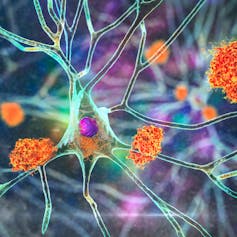
Illustration showing red clusters of amyloid plaques in brain tissue
Studying beta-amyloids as abnormal proteins that cause Alzheimer’s disease has not translated into a useful drug or therapy.
Shutterstock

Regrettably, this dedication to studying the abnormal protein clumps has not translated into a useful drug or therapy. The need for a new “out-of-the-clump” way of thinking about Alzheimer’s is emerging as a top priority in brain science.

My laboratory at the Krembil Brain Institute, part of the University Health Network in Toronto, is devising a new theory of Alzheimer’s disease. Based on our past 30 years of research, we no longer think of Alzheimer’s as primarily a disease of the brain. Rather, we believe that Alzheimer’s is principally a disorder of the immune system within the brain.

The immune system, found in every organ in the body, is a collection of cells and molecules that work in harmony to help repair injuries and protect from foreign invaders. When a person trips and falls, the immune system helps to mend the damaged tissues. When someone experiences a viral or bacterial infection, the immune system helps in the fight against these microbial invaders.

The exact same processes are present in the brain. When there is head trauma, the brain’s immune system kicks into gear to help repair. When bacteria are present in the brain, the immune system is there to fight back.

Alzheimer’s as autoimmune disease

We believe that beta-amyloid is not an abnormally produced protein, but rather is a normally occurring molecule that is part of the brain’s immune system. It is supposed to be there. When brain trauma occurs or when bacteria are present in the brain, beta-amyloid is a key contributor to the brain’s comprehensive immune response. And this is where the problem begins.

Because of striking similarities between the fat molecules that make up both the membranes of bacteria and the membranes of brain cells, beta-amyloid cannot tell the difference between invading bacteria and host brain cells, and mistakenly attacks the very brain cells it is supposed to be protecting.

This leads to a chronic, progressive loss of brain cell function, which ultimately culminates in dementia — all because our body’s immune system cannot differentiate between bacteria and brain cells.
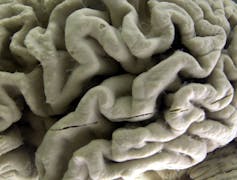
Close-up view of a section of a human brain
A section of a human brain with Alzheimer’s disease displayed at the Museum of Neuroanatomy at the University at Buffalo, in Buffalo, N.Y.
(AP Photo/David Duprey)

When regarded as a misdirected attack by the brain’s immune system on the very organ it is supposed to be defending, Alzheimer’s disease emerges as an autoimmune disease. There are many types of autoimmune diseases, such as rheumatoid arthritis, in which autoantibodies play a crucial role in the development of the disease, and for which steroid-based therapies can be effective. But these therapies will not work against Alzheimer’s disease.

The brain is a very special and distinctive organ, recognized as the most complex structure in the universe. In our model of Alzheimer’s, beta-amyloid helps to protect and bolster our immune system, but unfortunately, it also plays a central role in the autoimmune process that, we believe, may lead to the development of Alzheimer’s.

Though drugs conventionally used in the treatment of autoimmune diseases may not work against Alzheimer’s, we strongly believe that targeting other immune-regulating pathways in the brain will lead us to new and effective treatment approaches for the disease.

Other theories of the disease
A drawing of a brain inside a yellow light bulb, against a green background.
It is gratifying to see new thinking about this age-old disease.
(Pixabay)

In addition to this autoimmune theory of Alzheimer’s, many other new and varied theories are beginning to appear. For example, some scientists believe that Alzheimer’s is a disease of tiny cellular structures called mitochondria — the energy factories in every brain cell. Mitochondria convert oxygen from the air we breathe and glucose from the food we eat into the energy required for remembering and thinking.

Some maintain that it is the end-result of a particular brain infection, with bacteria from the mouth often being suggested as the culprit. Still others suggest that the disease may arise from an abnormal handling of metals within the brain, possibly zinc, copper or iron.

It is gratifying to see new thinking about this age-old disease. Dementia currently affects more than 50 million people worldwide, with a new diagnosis being made every three seconds. Often, people living with Alzheimer’s disease are unable to recognize their own children or even their spouse of more than 50 years.

Alzheimer’s is a public health crisis in need of innovative ideas and fresh directions. For the well-being of the people and families living with dementia, and for the socioeconomic impact on our already stressed health-care system coping with the ever-escalating costs and demands of dementia, we need a better understanding of Alzheimer’s, its causes, and what we can do to treat it and to help the people and families who are living with it.

Donald Weaver, Professor of Chemistry and Director of Krembil Research Institute, University Health Network, University of Toronto

This article is republished from The Conversation under a Creative Commons license. Read the original article.


 

ShareTweet
Donald Weaver

Donald Weaver

Professor of Chemistry and Director of Krembil Research Institute, University Health Network, University of Toronto

Leave a Reply Cancel reply

Your email address will not be published. Required fields are marked *

Videos

In this episode, the host discusses the significance of large language models (LLMs) in healthcare, their applications, and the challenges they face. The conversation highlights the importance of simplicity in model design and the necessity of integrating patient feedback to enhance the effectiveness of LLMs in clinical settings.

Takeaways
LLMs are becoming integral in healthcare.
They can help determine costs and service options.
Hallucination in LLMs can lead to misinformation.
LLMs can produce inconsistent answers based on input.
Simplicity in LLMs is often more effective than complexity.
Patient behavior should guide LLM development.
Integrating patient feedback is crucial for accuracy.
Pre-training models with patient input enhances relevance.
Healthcare providers must understand LLM limitations.
The best LLMs will focus on patient-centered care.

Chapters

00:00 Introduction to LLMs in Healthcare
05:16 The Importance of Simplicity in LLMs
The Future of LLMs in HealthcareDaily Remedy
YouTube Video U1u-IYdpeEk
Subscribe

AI Regulation and Deployment Is Now a Core Healthcare Issue

Clinical Reads

Ambient Artificial Intelligence Clinical Documentation: Workflow Support with Emerging Governance Risk

Ambient Artificial Intelligence Clinical Documentation: Workflow Support with Emerging Governance Risk

by Daily Remedy
February 1, 2026
0

Health systems are increasingly deploying ambient artificial intelligence tools that listen to clinical encounters and automatically generate draft visit notes. These systems are intended to reduce documentation burden and allow clinicians to focus more directly on patient interaction. At the same time, they raise unresolved questions about patient consent, data handling, factual accuracy, and legal responsibility for machine‑generated records. Recent policy discussions and legal actions suggest that adoption is moving faster than formal oversight frameworks. The practical clinical question is...

Read more

Join Our Newsletter!

Twitter Updates

Tweets by TheDailyRemedy

Popular

  • Prevention Is Having a Moment and a Measurement Problem

    Prevention Is Having a Moment and a Measurement Problem

    0 shares
    Share 0 Tweet 0
  • Health Technology Assessment Is Moving Upstream

    0 shares
    Share 0 Tweet 0
  • Behavioral Health Is Now a Network Phenomenon

    0 shares
    Share 0 Tweet 0
  • Have We Cured Sickle Cell Disease?

    2 shares
    Share 0 Tweet 0
  • CDC About Face

    0 shares
    Share 0 Tweet 0
  • 628 Followers

Daily Remedy

Daily Remedy offers the best in healthcare information and healthcare editorial content. We take pride in consistently delivering only the highest quality of insight and analysis to ensure our audience is well-informed about current healthcare topics - beyond the traditional headlines.

Daily Remedy website services, content, and products are for informational purposes only. We do not provide medical advice, diagnosis, or treatment. All rights reserved.

Important Links

  • Support Us
  • About Us
  • Contact us
  • Privacy Policy
  • Terms and Conditions

Join Our Newsletter!

  • Survey
  • Podcast
  • About Us
  • Contact us

© 2026 Daily Remedy

No Result
View All Result
  • Home
  • Articles
  • Podcasts
  • Surveys
  • Courses
  • About Us
  • Contact us
  • Support Us
  • Official Learner

© 2026 Daily Remedy