














Sunday, April 5, 2026
ISSN 2765-8767
  • Survey
  • Podcast
  • Write for Us
  • My Account
  • Log In
Daily Remedy
  • Home
  • Articles
  • Podcasts
    The Hidden Costs Employers Don’t See in Traditional Health Plans

    The Hidden Costs Employers Don’t See in Traditional Health Plans

    March 22, 2026
    The Impact of COVID-19 on Patient Trust

    The Impact of COVID-19 on Patient Trust

    March 3, 2026
    Debunking Myths About GLP-1 Medications

    Debunking Myths About GLP-1 Medications

    February 16, 2026
    The Future of LLMs in Healthcare

    The Future of LLMs in Healthcare

    January 26, 2026
    The Future of Healthcare Consumerism

    The Future of Healthcare Consumerism

    January 22, 2026
    Your Body, Your Health Care: A Conversation with Dr. Jeffrey Singer

    Your Body, Your Health Care: A Conversation with Dr. Jeffrey Singer

    July 1, 2025
  • Surveys

    Surveys

    Understanding of Clinical Evidence in Peptide and Hormone Use

    Understanding of Clinical Evidence in Peptide and Hormone Use

    March 30, 2026
    Public Sentiment on the Future of Peptides and Hormone Therapies in U.S. Medicine

    Public Sentiment on the Future of Peptides and Hormone Therapies in U.S. Medicine

    March 17, 2026

    Survey Results

    Can you tell when your provider does not trust you?

    Can you tell when your provider does not trust you?

    January 18, 2026
    Do you believe national polls on health issues are accurate

    National health polls: trust in healthcare system accuracy?

    May 8, 2024
    Which health policy issues matter the most to Republican voters in the primaries?

    Which health policy issues matter the most to Republican voters in the primaries?

    May 14, 2024
    How strongly do you believe that you can tell when your provider does not trust you?

    How strongly do you believe that you can tell when your provider does not trust you?

    May 7, 2024
  • Courses
  • About Us
  • Contact us
  • Support Us
  • Official Learner
No Result
View All Result
  • Home
  • Articles
  • Podcasts
    The Hidden Costs Employers Don’t See in Traditional Health Plans

    The Hidden Costs Employers Don’t See in Traditional Health Plans

    March 22, 2026
    The Impact of COVID-19 on Patient Trust

    The Impact of COVID-19 on Patient Trust

    March 3, 2026
    Debunking Myths About GLP-1 Medications

    Debunking Myths About GLP-1 Medications

    February 16, 2026
    The Future of LLMs in Healthcare

    The Future of LLMs in Healthcare

    January 26, 2026
    The Future of Healthcare Consumerism

    The Future of Healthcare Consumerism

    January 22, 2026
    Your Body, Your Health Care: A Conversation with Dr. Jeffrey Singer

    Your Body, Your Health Care: A Conversation with Dr. Jeffrey Singer

    July 1, 2025
  • Surveys

    Surveys

    Understanding of Clinical Evidence in Peptide and Hormone Use

    Understanding of Clinical Evidence in Peptide and Hormone Use

    March 30, 2026
    Public Sentiment on the Future of Peptides and Hormone Therapies in U.S. Medicine

    Public Sentiment on the Future of Peptides and Hormone Therapies in U.S. Medicine

    March 17, 2026

    Survey Results

    Can you tell when your provider does not trust you?

    Can you tell when your provider does not trust you?

    January 18, 2026
    Do you believe national polls on health issues are accurate

    National health polls: trust in healthcare system accuracy?

    May 8, 2024
    Which health policy issues matter the most to Republican voters in the primaries?

    Which health policy issues matter the most to Republican voters in the primaries?

    May 14, 2024
    How strongly do you believe that you can tell when your provider does not trust you?

    How strongly do you believe that you can tell when your provider does not trust you?

    May 7, 2024
  • Courses
  • About Us
  • Contact us
  • Support Us
  • Official Learner
No Result
View All Result
Daily Remedy
No Result
View All Result
Home Featured

A Two Headed Monster – State Attorneys General and the Drug Enforcement Agency

A chronic pain patient advocate analyzes the negative affect of the opioid settlements.

Monty Goddard by Monty Goddard
November 12, 2023
in Featured
0
A Two Headed Monster - State Attorneys General and the Drug Enforcement Agency

Getty Images

A two headed monster is attacking the supply of FDA approved pain medications.  One of the heads is Medusa-like, consisting of 41 state Attorneys General.  The other head is our old nemesis, the DEA.

Several months ago, thanks to my associate Patricia A Irving RN, I became interested in the significant negative impact of last year’s 41 state AGs’ “Nation-wide Settlement” with the three major distributors (wholesalers) of controlled substances, McKesson, AmerisourceBergen, and Cardinal Health.  I soon agreed with her concerns after carefully reading all 54 pages of this settlement’s Injunctive Relief which is labeled, “Exhibit  P”.  A fair assessment of the impact of this settlement’s “injunctive relief” requires all 54 pages to be read.  Exhibit P begins on page 478 of the 571 page settlement: Final-Distributor-Settlement-Agreement-3.25.22-Final.pdf.

Pat and I contend this settlement’s injunctive relief, with its mandated “Thresholds” (which the distributors MUST establish and KEEP SECRET from the pharmacies they supply), “Red Flags”, “Onboarding”, “Terminated Customers”, ad infinitum, are resulting in insufficient supply to pharmacies of existing, already manufactured controlled substances, not just opioids.  The injunctive relief is very onerous and intimidating, I believe by design. The entire supply chain is rightfully afraid and therefore being overly cautious/restrictive. The latest government inflicted harm Chronic Pain Patients (CPPs) are now experiencing was the easily foreseeable outcome of this injunctive relief.  Pat Irving had her excellent article on this subject recently published in Pain News Network. The National Opioid Settlement Is Causing Drug Shortages — Pain News Network

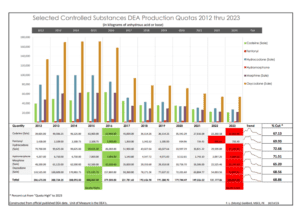
It was my interest in her concern about the settlement’s additional negative impact on the supply chain which prompted my researching the severity of the DEA’s opioid production quota cuts and therefore their negative impact on the supply chain.  Just looking at the numbers did not convey to me the across-the-board magnitude of these progressive cuts. I decided to use an Excel based graph to “show” the 2012 through 2023 DEA manufacturing/production quotas for some common pain medications.  You can see the shocking result in the graphic below.
 

A Two Headed Monster - State Attorneys General and the Drug Enforcement Agency
Monty Goddard

A lesser-known supply shortage issue I recently discovered is the DEA, just this past August 31st, reduced the “inventory allowance” manufacturers were allowed to retain on hand to cover unforeseen supply chain/manufacturing issues was reduced from 50% to 40%, further constricting the efficient supply of opioid medications.  Brace Yourself: DEA’s Final Rule on Quotas Squeezes Inventory Levels and Signals Further Supply Restrictions | Quarles & Brady LLP – JDSupra

I have witnessed on social media the alarming uptick in the number of pain patients finding their pharmacies unable to fill their legitimate prescriptions because the pharmacies are out of stock.  This prompted me to research the ASPH.org Current Drug Shortages – ASHP and the Drugs.com Current Drug Shortages List – Drugs.com shortage databases, both of which list significant shortages of Hydrocodone and both variants of Oxycodone.  (I learned from Pat Anson of PNN News Network, these two databases are essentially one in the same.)  I also viewed the FDA drug shortages database FDA Drug Shortages.  To my surprise, the FDA lists ZERO hydrocodone and oxycodone shortages. This dichotomy is a major problem.  If the FDA does not even acknowledge there is a shortage of these two medicines, the FDA will certainly take no related remedial action, like they recently did in concert with the DEA, to address ADHD medications shortages.  Adderall makers agree to increase production: DEA (msn.com).

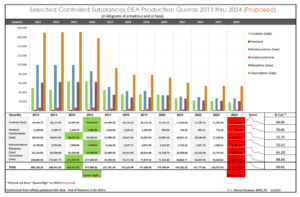
To make matters worse, at a time when production quotas should obviously be increased, the just announced proposed DEA 2024 opioid production quotas cuts do the opposite!  Adding insult to injury, the FDA came to this inexplicable conclusion: “FDA predicts that levels of medical need for schedule II opioids in the United States in calendar year 2024 will decline on average 7.9 percent from calendar year 2023 levels.” Regulations.gov.  While the non-sensical proposed cuts from 2023 appear relatively minor in the macro view, they still cut production quotas of the six medications I graphed as follows: Codeine -8.3%, Fentanyl -7.6%, Hydrocodone -0.3%, Hydromorphone -2.1%, Morphine -4,3%, Oxycodone -0.3%.  See my revised graphic for 2013 through 2024 (Proposed).
A Two Headed Monster - State Attorneys General and the Drug Enforcement Agency
Monty Goddard

We have until Dec 4th to submit professional (avoiding emotions and expletives)  comments on the DEA proposed 2024 production quotas.  Cite the shortages you are already experiencing on pharmacy shelves to support your request that the DEA increase their opioid production quotas, NOT cut them further! Comments can be submitted via this link: Regulations.gov.


ShareTweet
Monty Goddard

Monty Goddard

Mr. Goddard, MSCE PE, is a thirteen years retired, thirty-six plus years civilian employee of the Department of the Navy. He became a pain patient advocate due to his belief that his wife, among others, is unjustly, needlessly suffering with intractable pain.

Comments 0

  1. Louis Ogden says:
    2 years ago

    Great job on the article, Monty! This reduction flies in the face of logic as us baby boomers age.

    Reply
    • Monty Goddard says:
      2 years ago

      Thank you, Louis! These latest proposed reductions definitely do fly in the face of logic!

      Reply
  2. Dora Winterz says:
    2 years ago

    Monty,
    Thank you and Pat for your comprehensive and insightful analysis. Your article shines a much-needed light on the complexities and unintended consequences of the opioid settlements and the DEA’s actions, particularly how they affect chronic pain patients.

    As a chronic pain patient and an activist, I can attest to the real-world impact of these policies. The “injunctive relief” and production quota cuts you describe are not just numbers on a page but represent significant barriers to accessing necessary medications for individuals like me. This has created a dire situation where managing chronic pain becomes a daily struggle, often compounded by the anxiety of uncertain medication availability.

    Your findings about the discrepancy between the FDA’s reporting and actual drug shortages are alarming and reflect a disconnect that urgently needs addressing. The lack of recognition of these shortages by the FDA is a critical oversight, as it hinders the possibility of remedial actions that could alleviate the suffering of thousands, if not more.

    Your call to action for professional commentary on the DEA’s proposed 2024 production quotas is a vital step in advocating for the needs of chronic pain patients. It’s crucial that our voices are heard, and the real experiences of patients are considered in these policy decisions. I hope that more individuals will join in submitting their comments to highlight the urgent need for a more balanced approach that recognizes the legitimate needs of chronic pain patients.

    Once again, thank you for your dedication to this cause and for bringing these critical issues to the forefront. Your work is not only informative but also a beacon of hope for many in the chronic pain community.

    Reply
    • Monty Goddard says:
      2 years ago

      Wow! Thank you Dora!

      Reply
  3. Jessamyn Butler says:
    2 years ago

    Thank you for your incredible article with the graphs, too! I’ll be printing it to add to my collection!
    ANOTHER bad thing about those Settlement monies, at least in PA I know of, now that the state has received its first payout, all of these multimillion “grants” are being handed out to fill gaps in the budgets funding.. NOT being used for anything related to opioids. There are a few “token” recovery houses added to the state, to make it appear that they are helping with that $ 🙄… Only SIX houses.. I’m sure other states are eyeing that Settlement money with greedy eyes, too. A LOT of that $ is going to go straight to the legislators POCKETS!!

    Reply
    • Monty Goddard says:
      2 years ago

      Thank you.

      Reply
  4. Gina says:
    2 years ago

    Thank you for reading all 54 pages and translating it into layman’s terms for all of us to understand. The hardships the DEA has created for everyone in the chain are insane. And since pain patients were never the problem to begin with, what are their actions going to accomplish? Will sanity and common sense ever return?

    Reply
  5. Mark Ibsen MD says:
    2 years ago

    Brilliant article
    Thank you for your contribution!

    Reply

Leave a Reply Cancel reply

Your email address will not be published. Required fields are marked *

Videos

Most employers are unknowingly steering their health plans toward higher costs and reduced control — until they understand how fiduciary missteps and anti-competitive contracts bleed their budgets dry. Katie Talento, a recognized health policy leader, reveals how shifting the network paradigm can save millions by emphasizing independent providers, direct contracting, and innovative tiering models.

Grounded in real-world case studies like Harris Rosen’s community-driven initiative, this episode dives deep into practical strategies to realign incentives—focusing on primary care, specialty care, and transparent vendor relationships. You'll discover how traditional carrier networks are often Trojan horses, locking employers into costly, opaque arrangements that undermine fiduciary duties. Katie breaks down simple yet powerful reforms: owning your data, eliminating conflicts of interest, and outlawing anti-competitive contract clauses.

We explore how a post-network framework—where patients are free to choose providers without restrictive network barriers—can massively reduce costs and improve health outcomes. You'll learn why independent, locally owned providers are vital to rebuilding trust, reducing unnecessary procedures, and reinvesting savings into the community. This conversation offers clarity on the unseen legal landmines employers face and actionable ways to craft health plans built on transparency, independence, and aligned incentives.

Perfect for HR pros, benefits advisors, physicians, and employer leaders committed to transforming healthcare from the ground up. If you’re tired of broken healthcare models draining your budget and frustrating your staff, this episode will empower you to take control by understanding and reshaping the very foundations of employer-sponsored health. Discover the blueprint for smarter, fairer, and more sustainable benefits.

Visit katytalento.com or allbetter.health to connect directly and explore how these innovations can work for your organization. Your path toward a healthier, more cost-effective future starts here.

Chapters

00:00 Introduction to Employer-Sponsored Health Plans
02:50 Understanding ERISA and Fiduciary Responsibilities
06:08 The Misalignment of Clinical and Financial Interests
08:54 Enforcement and Legal Implications for Employers
11:49 Redefining Networks: The Post-Network Framework
25:34 Navigating Healthcare Contracts and Cash Payments
27:31 Understanding Employer Health Plan Structures
28:04 The Role of Benefits Advisors in Health Plans
30:45 Governance and Data Ownership in Health Plans
37:05 Case Study: The Rosen Hotels' Health Model
41:33 Incentivizing Healthy Choices in Healthcare
47:22 Empowering Primary Care and Independent Providers
The Hidden Costs Employers Don’t See in Traditional Health Plans
YouTube Video xhks7YbmBoY
Subscribe

Policy Shift in Peptide Regulation

Clinical Reads

Semaglutide and the Expansion Problem: When One Trial Becomes a Platform

Semaglutide and the Expansion Problem: When One Trial Becomes a Platform

by Daily Remedy
March 30, 2026
0

Semaglutide has moved beyond its original indication and now sits at the center of a widening set of clinical questions: cardiovascular risk, kidney disease progression, and even neurodegeneration. The question is no longer whether the drug lowers glucose or reduces weight—it does—but how far those effects extend across systems, and whether evidence from one population can be translated into another without distortion. Large, well-powered trials have produced consistent signals, yet those signals are now being applied in contexts that were...

Read more

Join Our Newsletter!

Twitter Updates

Tweets by TheDailyRemedy

Popular

  • A Two Headed Monster - State Attorneys General and the Drug Enforcement Agency

    A Two Headed Monster – State Attorneys General and the Drug Enforcement Agency

    3 shares
    Share 0 Tweet 0
  • Neuralink’s Healthcare Ambitions

    1 shares
    Share 0 Tweet 0
  • Rise of Cash Pay Drugs

    1 shares
    Share 0 Tweet 0
  • Emerson Fought the Materialists

    0 shares
    Share 0 Tweet 0
  • What’s Next for the Obesity Industrial Complex

    0 shares
    Share 0 Tweet 0
  • 628 Followers

Daily Remedy

Daily Remedy offers the best in healthcare information and healthcare editorial content. We take pride in consistently delivering only the highest quality of insight and analysis to ensure our audience is well-informed about current healthcare topics - beyond the traditional headlines.

Daily Remedy website services, content, and products are for informational purposes only. We do not provide medical advice, diagnosis, or treatment. All rights reserved.

Important Links

  • Support Us
  • About Us
  • Contact us
  • Privacy Policy
  • Terms and Conditions

Join Our Newsletter!

  • Survey
  • Podcast
  • About Us
  • Contact us

© 2026 Daily Remedy

No Result
View All Result
  • Home
  • Articles
  • Podcasts
  • Surveys
  • Courses
  • About Us
  • Contact us
  • Support Us
  • Official Learner

© 2026 Daily Remedy
