












Sunday, February 15, 2026
ISSN 2765-8767
  • Home
  • Courses
  • About Us
  • Contact us
  • Support Us
  • Home
  • Courses
  • About Us
  • Contact us
  • Support Us

Value Creation in VC Funds

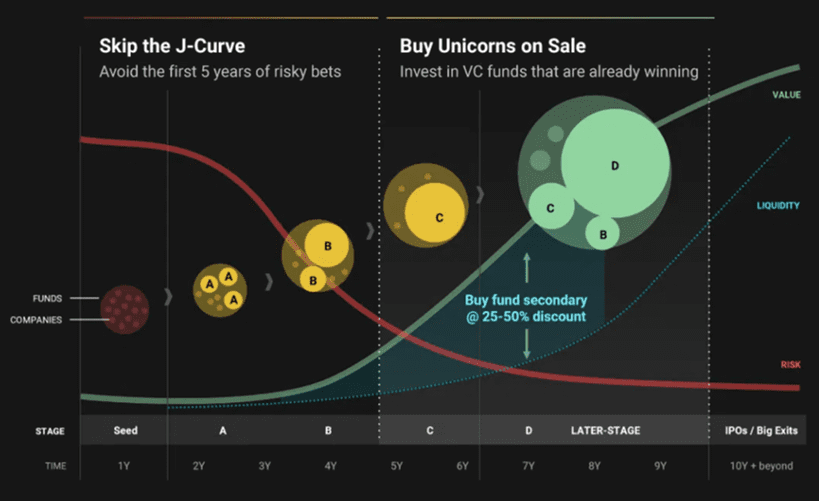
PVC, a sort of funds of funds when it comes to venture capital funds, has beautifully captured a value creation opportunity in venture capital fund investments.

“Because portfolio companies are already established and growing, buyers have a better sense of what they’re getting for their money – they aren’t investing in a “blind pool” of unknown future assets. After five years or more, successful VC funds should have established winners at Series B or C and perhaps even early exits and distributions. Seeing the first few years of performance in the rearview mirror provides insight into how well the fund manager is doing and how well the fund is likely to perform in the future. Again, it’s kind of like checking the score at halftime to see which team is ahead.”

But their model assumes a particular growth pattern underlying the growth of the portfolio startups. Something distinctly not present in the heavily regulated world of healthcare startups. Value creation for healthcare focused funds, therefore, should focus more on the relationship between the regulators and innovators, and draw growth patterns focused more on the dynamics of that relationship than the dynamics of intrinsic portfolio company growth.


Daily Remedy

Daily Remedy

Dr. Jay K Joshi serves as the editor-in-chief of Daily Remedy. He is a serial entrepreneur and sought after thought-leader for matters related to healthcare innovation and medical jurisprudence. He has published articles on a variety of healthcare topics in both peer-reviewed journals and trade publications. His legal writings include amicus curiae briefs prepared for prominent federal healthcare cases.

Videos

2027 Medicare Advantage & Part D Advance Notice

BIIB080 in Mild Alzheimer’s Disease: What a Phase 1b Exploratory Clinical Analysis Can—and Cannot—Tell Us

BIIB080 in Mild Alzheimer’s Disease: What a Phase 1b Exploratory Clinical Analysis Can—and Cannot—Tell Us

Can lowering tau biology translate into a clinically meaningful slowing of decline in people with early symptomatic Alzheimer’s disease? That is the practical question behind BIIB080, an intrathecal antisense therapy designed to reduce production of tau protein by targeting the tau gene transcript. In a phase 1b program originally designed for safety and dosing, investigators later examined cognitive, functional, and global outcomes as exploratory endpoints. The clinical question matters because current disease-modifying options primarily target amyloid, while tau pathology tracks...

Read more

Join Our Newsletter!