













Saturday, February 14, 2026
ISSN 2765-8767
  • Survey
  • Podcast
  • Write for Us
  • My Account
  • Log In
Daily Remedy
  • Home
  • Articles
  • Podcasts
    The Future of LLMs in Healthcare

    The Future of LLMs in Healthcare

    January 26, 2026
    The Future of Healthcare Consumerism

    The Future of Healthcare Consumerism

    January 22, 2026
    Your Body, Your Health Care: A Conversation with Dr. Jeffrey Singer

    Your Body, Your Health Care: A Conversation with Dr. Jeffrey Singer

    July 1, 2025

    The cost structure of hospitals nearly doubles

    July 1, 2025
    Navigating the Medical Licensing Maze

    The Fight Against Healthcare Fraud: Dr. Rafai’s Story

    April 8, 2025
    Navigating the Medical Licensing Maze

    Navigating the Medical Licensing Maze

    April 4, 2025
  • Surveys

    Surveys

    AI in Healthcare Decision-Making

    AI in Healthcare Decision-Making

    February 1, 2026
    Patient Survey: Understanding Healthcare Consumerism

    Patient Survey: Understanding Healthcare Consumerism

    January 18, 2026

    Survey Results

    Can you tell when your provider does not trust you?

    Can you tell when your provider does not trust you?

    January 18, 2026
    Do you believe national polls on health issues are accurate

    National health polls: trust in healthcare system accuracy?

    May 8, 2024
    Which health policy issues matter the most to Republican voters in the primaries?

    Which health policy issues matter the most to Republican voters in the primaries?

    May 14, 2024
    How strongly do you believe that you can tell when your provider does not trust you?

    How strongly do you believe that you can tell when your provider does not trust you?

    May 7, 2024
  • Courses
  • About Us
  • Contact us
  • Support Us
  • Official Learner
No Result
View All Result
  • Home
  • Articles
  • Podcasts
    The Future of LLMs in Healthcare

    The Future of LLMs in Healthcare

    January 26, 2026
    The Future of Healthcare Consumerism

    The Future of Healthcare Consumerism

    January 22, 2026
    Your Body, Your Health Care: A Conversation with Dr. Jeffrey Singer

    Your Body, Your Health Care: A Conversation with Dr. Jeffrey Singer

    July 1, 2025

    The cost structure of hospitals nearly doubles

    July 1, 2025
    Navigating the Medical Licensing Maze

    The Fight Against Healthcare Fraud: Dr. Rafai’s Story

    April 8, 2025
    Navigating the Medical Licensing Maze

    Navigating the Medical Licensing Maze

    April 4, 2025
  • Surveys

    Surveys

    AI in Healthcare Decision-Making

    AI in Healthcare Decision-Making

    February 1, 2026
    Patient Survey: Understanding Healthcare Consumerism

    Patient Survey: Understanding Healthcare Consumerism

    January 18, 2026

    Survey Results

    Can you tell when your provider does not trust you?

    Can you tell when your provider does not trust you?

    January 18, 2026
    Do you believe national polls on health issues are accurate

    National health polls: trust in healthcare system accuracy?

    May 8, 2024
    Which health policy issues matter the most to Republican voters in the primaries?

    Which health policy issues matter the most to Republican voters in the primaries?

    May 14, 2024
    How strongly do you believe that you can tell when your provider does not trust you?

    How strongly do you believe that you can tell when your provider does not trust you?

    May 7, 2024
  • Courses
  • About Us
  • Contact us
  • Support Us
  • Official Learner
No Result
View All Result
Daily Remedy
No Result
View All Result
Home Perspectives

My Friend, Dr. Ruan

The only thing stopping you is your inability to see the power in your voice.

Daily Remedy by Daily Remedy
April 11, 2023
in Perspectives
0
My Friend Dr. Ruan

Eugene Chystiakov

Making friends while adulting – that’s a hard thing to do. Almost as hard as being a physician who was targeted by the DEA while challenging false narratives of the overdose crisis. But somehow I manage both.

In early 2023, two major milestones took place across both fronts. The first being my newfound friendship with Dr. Xiulu Ruan, who was the first physician in decades to successfully challenge a conviction in front of the Supreme Court (Ruan v. United States). The second being the upcoming release of my book, Burden of Pain, the first book written by a physician who was incarcerated as part of the federal government’s misguided efforts to curb opioid overdoses.

Both milestones happened in mid-January. That’s when Dr. Ruan’s associates first reached out to me. Initially, I didn’t know what to make of it. Here was a physician who appeared before the Supreme Court, whose name is forever memorialized in American case law, reaching out to me, thanking me for writing articles and an amicus brief on his behalf.

If I’m being honest, it was a much-needed boost of confidence. I first heard from Dr. Ruan’s associates about a week after I learned that Burden of Pain will be published on May 16th. Most would assume that I would be elated. But I wasn’t. Quite the opposite, I was decidedly nervous. Upon hearing that date from my publishers, all the dedication and focus I put toward crafting a book about my journey through the opioid epidemic transformed into a pervasive sense of insecurity. Imposter syndrome is what some call it. And I was suffering from it in a major way.

But once I heard from Dr. Ruan, those feelings subsided significantly. A writer needs validation from his or her readers, so much so that the relationship between the two influences how a writer writes. Those who receive positive reviews from their readers gain a certain confidence that allows them to express their ideas more boldly and take more risks in their insights, or how those insights are conveyed.

Burden of Pain is the culmination of all that I experienced and learned over years of being targeted and wrongfully convicted by overzealous DEA agents. I learned how manipulative interpretations of the Controlled Substance Act lead to due process violations against physicians. I saw how the federal government perpetuated false narratives in the media to sway public opinion: both about the opioid epidemic at large and of me personally. It’s as bold and risky as a book can be.

Back in early January, I felt overwhelmed at the prospects of sharing Burden of Pain. Who am I to bring forth such novel insights? Flash forward to the present. After months of correspondence with Dr. Ruan, learning from his legal experiences while sharing mine, I realize I am more than qualified. I hope my book does for you what Dr. Ruan did for me: give you the confidence to share your story and to know that your voice matters. This is more important than ever.

The initial wave of opioid settlement funds is being disseminated and states are restricting who gets to provide input in how the funds are being allocated. Ironically enough, the same paternalistic mindset by policy makers that paved the way for the epidemic in the first place is carrying over to how the settlement funds are being distributed.

We need to speak out to our local, state, and federal representatives to let them know where the funds would be most beneficial. Whether that is preventing patients with chronic pain from losing access to care or opening up more treatment facilities, the needs of each community are different. And you are in the best position to know what is needed.

The only thing stopping you is your inability to see the power in your voice, in your story. Much like me a few months ago, too insecure to know the power of my voice. But just as Dr. Ruan gave me the confidence to speak, I hope Burden of Pain gives you the confidence to know your input matters.

You’re far more powerful and knowledgeable than you realize. Only your doubts hold you back.
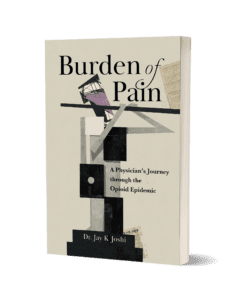
Burden of Pain
Cover of Burden of Pain
ShareTweet
Daily Remedy

Daily Remedy

Dr. Jay K Joshi serves as the editor-in-chief of Daily Remedy. He is a serial entrepreneur and sought after thought-leader for matters related to healthcare innovation and medical jurisprudence. He has published articles on a variety of healthcare topics in both peer-reviewed journals and trade publications. His legal writings include amicus curiae briefs prepared for prominent federal healthcare cases.

Comments 0

  1. Lightning says:
    3 years ago

    An interesting, encouraging, inspiring article. Perhaps somewhat strange, then, that you have (for unknown reasons) censored my previous comment about the actual (moral and socio-political, as opposed to neuro-scientifically or other wise scientifically based) nature of the subjectively declared moral pejorative “addiction”, as well as blocked my email address from subscribing to your newsletter. As you boldly state above, “Only your doubts hold you back”. Indeed.

    The complete text of the hastily censored March 29 2023 comment posted to your Daily-Remedy article follows:

    JKJ: “We are just beginning to understand addiction absent its moralistic façade, in solely medical terms.”

    Your consistently excellent and incisive thinking is a welcome breath of fresh air amidst the deepening throes of dark ages of pain management arising out of scientifically baseless moral crusades against people who use drugs, conducted under the deliberate subterfuge of a faux-medical junk-science mask, engendering and sustaining an entirely socially destructive crucible of abstrusely justified yet perniciously strategic subjective pseudo-psychiatric declarations endlessly waging war upon the human condition in a century-old morally and financially bankrupt inhumane barbaric endless war of intentionally crafted futility – designed to provide fame and monetary wealth for dubiously entitled privileged “moral entrepreneurs” at the expense and the literal demise of sacrificial “pharmakoi”.

    “… the question of addiction … implicates more than simply a scientific theory which forms the basis of a discourse of addiction. At stake in a discourse on addiction is an economy of control (individual and collective) and its history of conquest. … So long as morality factors into the equation, addiction is not simply a scientific concept. … scientific theories of addiction are based on a concept whose religious, State, economic bases rationalize the marginalization of substances … The problem of a moral basis for a scientific concept of addiction is not only that it is a highly uncontrollable variable, … but the prescription of morals are also subject to forms of power that produce social distinctions in order to further colonize social spaces by marginalizing the ‘undesirable’ and promoting the ideal. … the classification of ‘addiction’ followed a desire to eradicate (colonize) a population of people or drugs. Therefore, while there continue to be ongoing clinical researches – in neuroscience, biology, psychology, chemistry, sociology – in search for the perfect theory of addiction, the concept of addiction invariably lies beyond the sciences. … Anyone can believe that there is a nature to such a thing as addiction, but a discourse’s relation to power confers legitimization and truth to the concept. … Whether something is legal or illegal, prohibited or promoted, does not reflect a natural (universal) essence, but rather a power over the body and the word. … social processes delineate the primary nature of drug/user relationship which characterizes addiction [as well as] how forces of colonization re-purpose rituals to serve colonial ideals. … the impositions of morality and higher social forces have made addiction a social tool and a concept irreconcilable with scientific theories.”

    Source: “Addiction: the colonization of rituals”; Matthew Prokopiw, University of Western Ontario (2015):
    https://ir.lib.uwo.ca/etd/3059

    Reply

Leave a Reply Cancel reply

Your email address will not be published. Required fields are marked *

Videos

In this episode, the host discusses the significance of large language models (LLMs) in healthcare, their applications, and the challenges they face. The conversation highlights the importance of simplicity in model design and the necessity of integrating patient feedback to enhance the effectiveness of LLMs in clinical settings.

Takeaways
LLMs are becoming integral in healthcare.
They can help determine costs and service options.
Hallucination in LLMs can lead to misinformation.
LLMs can produce inconsistent answers based on input.
Simplicity in LLMs is often more effective than complexity.
Patient behavior should guide LLM development.
Integrating patient feedback is crucial for accuracy.
Pre-training models with patient input enhances relevance.
Healthcare providers must understand LLM limitations.
The best LLMs will focus on patient-centered care.

Chapters

00:00 Introduction to LLMs in Healthcare
05:16 The Importance of Simplicity in LLMs
The Future of LLMs in HealthcareDaily Remedy
YouTube Video U1u-IYdpeEk
Subscribe

AI Regulation and Deployment Is Now a Core Healthcare Issue

Clinical Reads

Ambient Artificial Intelligence Clinical Documentation: Workflow Support with Emerging Governance Risk

Ambient Artificial Intelligence Clinical Documentation: Workflow Support with Emerging Governance Risk

by Daily Remedy
February 1, 2026
0

Health systems are increasingly deploying ambient artificial intelligence tools that listen to clinical encounters and automatically generate draft visit notes. These systems are intended to reduce documentation burden and allow clinicians to focus more directly on patient interaction. At the same time, they raise unresolved questions about patient consent, data handling, factual accuracy, and legal responsibility for machine‑generated records. Recent policy discussions and legal actions suggest that adoption is moving faster than formal oversight frameworks. The practical clinical question is...

Read more

Join Our Newsletter!

Twitter Updates

Tweets by TheDailyRemedy

Popular

  • The Information Epidemic: How Digital Health Misinformation Is Rewiring Clinical Risk

    The Information Epidemic: How Digital Health Misinformation Is Rewiring Clinical Risk

    0 shares
    Share 0 Tweet 0
  • Prevention Is Having a Moment and a Measurement Problem

    0 shares
    Share 0 Tweet 0
  • Child Health Is Now a Platform Issue

    0 shares
    Share 0 Tweet 0
  • The Breach Is the Diagnosis: Cybersecurity Has Become a Clinical Risk Variable

    0 shares
    Share 0 Tweet 0
  • Health Technology Assessment Is Moving Upstream

    0 shares
    Share 0 Tweet 0
  • 628 Followers

Daily Remedy

Daily Remedy offers the best in healthcare information and healthcare editorial content. We take pride in consistently delivering only the highest quality of insight and analysis to ensure our audience is well-informed about current healthcare topics - beyond the traditional headlines.

Daily Remedy website services, content, and products are for informational purposes only. We do not provide medical advice, diagnosis, or treatment. All rights reserved.

Important Links

  • Support Us
  • About Us
  • Contact us
  • Privacy Policy
  • Terms and Conditions

Join Our Newsletter!

  • Survey
  • Podcast
  • About Us
  • Contact us

© 2026 Daily Remedy

No Result
View All Result
  • Home
  • Articles
  • Podcasts
  • Surveys
  • Courses
  • About Us
  • Contact us
  • Support Us
  • Official Learner

© 2026 Daily Remedy

