












Wednesday, March 4, 2026
ISSN 2765-8767
  • Survey
  • Podcast
  • Write for Us
  • My Account
  • Log In
Daily Remedy
  • Home
  • Articles
  • Podcasts
    The Impact of COVID-19 on Patient Trust

    The Impact of COVID-19 on Patient Trust

    March 3, 2026
    Debunking Myths About GLP-1 Medications

    Debunking Myths About GLP-1 Medications

    February 16, 2026
    The Future of LLMs in Healthcare

    The Future of LLMs in Healthcare

    January 26, 2026
    The Future of Healthcare Consumerism

    The Future of Healthcare Consumerism

    January 22, 2026
    Your Body, Your Health Care: A Conversation with Dr. Jeffrey Singer

    Your Body, Your Health Care: A Conversation with Dr. Jeffrey Singer

    July 1, 2025

    The cost structure of hospitals nearly doubles

    July 1, 2025
  • Surveys

    Surveys

    Perceptions of Viral Wellness Practices on Social Media: A Likert-Scale Survey for Informed Readers

    Perceptions of Viral Wellness Practices on Social Media: A Likert-Scale Survey for Informed Readers

    March 1, 2026
    How Confident Are You in RFK Jr.’s Health Leadership?

    How Confident Are You in RFK Jr.’s Health Leadership?

    February 16, 2026

    Survey Results

    Can you tell when your provider does not trust you?

    Can you tell when your provider does not trust you?

    January 18, 2026
    Do you believe national polls on health issues are accurate

    National health polls: trust in healthcare system accuracy?

    May 8, 2024
    Which health policy issues matter the most to Republican voters in the primaries?

    Which health policy issues matter the most to Republican voters in the primaries?

    May 14, 2024
    How strongly do you believe that you can tell when your provider does not trust you?

    How strongly do you believe that you can tell when your provider does not trust you?

    May 7, 2024
  • Courses
  • About Us
  • Contact us
  • Support Us
  • Official Learner
No Result
View All Result
  • Home
  • Articles
  • Podcasts
    The Impact of COVID-19 on Patient Trust

    The Impact of COVID-19 on Patient Trust

    March 3, 2026
    Debunking Myths About GLP-1 Medications

    Debunking Myths About GLP-1 Medications

    February 16, 2026
    The Future of LLMs in Healthcare

    The Future of LLMs in Healthcare

    January 26, 2026
    The Future of Healthcare Consumerism

    The Future of Healthcare Consumerism

    January 22, 2026
    Your Body, Your Health Care: A Conversation with Dr. Jeffrey Singer

    Your Body, Your Health Care: A Conversation with Dr. Jeffrey Singer

    July 1, 2025

    The cost structure of hospitals nearly doubles

    July 1, 2025
  • Surveys

    Surveys

    Perceptions of Viral Wellness Practices on Social Media: A Likert-Scale Survey for Informed Readers

    Perceptions of Viral Wellness Practices on Social Media: A Likert-Scale Survey for Informed Readers

    March 1, 2026
    How Confident Are You in RFK Jr.’s Health Leadership?

    How Confident Are You in RFK Jr.’s Health Leadership?

    February 16, 2026

    Survey Results

    Can you tell when your provider does not trust you?

    Can you tell when your provider does not trust you?

    January 18, 2026
    Do you believe national polls on health issues are accurate

    National health polls: trust in healthcare system accuracy?

    May 8, 2024
    Which health policy issues matter the most to Republican voters in the primaries?

    Which health policy issues matter the most to Republican voters in the primaries?

    May 14, 2024
    How strongly do you believe that you can tell when your provider does not trust you?

    How strongly do you believe that you can tell when your provider does not trust you?

    May 7, 2024
  • Courses
  • About Us
  • Contact us
  • Support Us
  • Official Learner
No Result
View All Result
Daily Remedy
No Result
View All Result
Home Contrarian

Even Mild Cases of COVID-19 Can Leave a Mark on the Brain

Daily Remedy by Daily Remedy
April 3, 2024
in Contrarian
0
Even Mild Cases of COVID-19 Can Leave a Mark on the Brain

Even mild cases of COVID-19 can leave a mark on the brain, such as reductions in gray matter – a neuroscientist explains emerging research
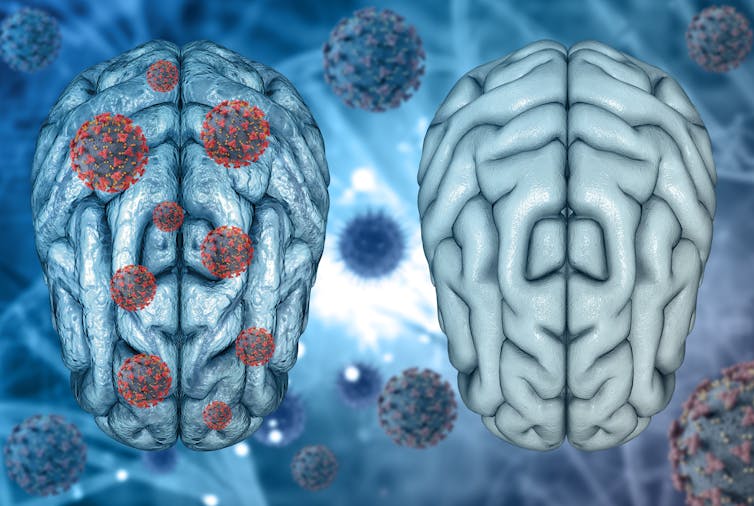
Even Mild Cases of COVID-19 Can Leave a Mark on the Brain
A new brain-imaging study finds that participants who had even mild COVID-19 showed an average reduction in whole brain sizes.
Kirstypargeter/iStock via Getty Images Plus

Jessica Bernard, Texas A&M University

Researchers have been steadily gathering important insights into the effects of COVID-19 on the body and brain. Two years into the pandemic, these findings are raising concerns about the long-term impacts the coronavirus might have on biological processes such as aging.

As a cognitive neuroscientist, I have focused in my past research on understanding how normal brain changes related to aging affect people’s ability to think and move – particularly in middle age and beyond.

But as evidence came in showing that COVID-19 could affect the body and brain for months following infection, my research team shifted some of its focus to better understanding how the illness might influence the natural process of aging. This was motivated in large part by compelling new work from the United Kingdom investigating the impact of COVID-19 on the human brain.

Peering in at the brain’s response to COVID-19

In a large study published in the journal Nature on March 7, 2022, a team of researchers in the UK investigated brain changes in people ages 51 to 81 who had experienced COVID-19. This work provides important new insights about the impact of COVID-19 on the human brain.

In the study, researchers relied on a database called the UK Biobank, which contains brain imaging data from over 45,000 people in the U.K. going back to 2014. This means that there was baseline data and brain imaging of all of those people from before the pandemic.

The research team compared people who had experienced COVID-19 with participants who had not, carefully matching the groups based on age, sex, baseline test date and study location, as well as common risk factors for disease, such as health variables and socioeconomic status.

The team found marked differences in gray matter – or the neurons that process information in the brain – between those who had been infected with COVID-19 and those who had not. Specifically, the thickness of the gray matter tissue in brain regions known as the frontal and temporal lobes was reduced in the COVID-19 group, differing from the typical patterns seen in the people who hadn’t had a COVID-19 infection.

In the general population, it is normal to see some change in gray matter volume or thickness over time as people age. But the changes were more extensive than normal in those who had been infected with COVID-19.

Interestingly, when the researchers separated the individuals who had severe enough illness to require hospitalization, the results were the same as for those who had experienced milder COVID-19. That is, people who had been infected with COVID-19 showed a loss of brain volume even when the disease was not severe enough to require hospitalization.

Finally, researchers also investigated changes in performance on cognitive tasks and found that those who had contracted COVID-19 were slower in processing information than those who had not. This processing ability was correlated with volume in a region of the brain known as the cerebellum, indicating a link between brain tissue volume and cognitive performance in those with COVID-19.

This study is particularly valuable and insightful because of its large sample sizes both before and after illness in the same people, as well as its careful matching with people who had not had COVID-19.

What do these changes in brain volume mean?

Early on in the pandemic, one of the most common reports from those infected with COVID-19 was the loss of sense of taste and smell.
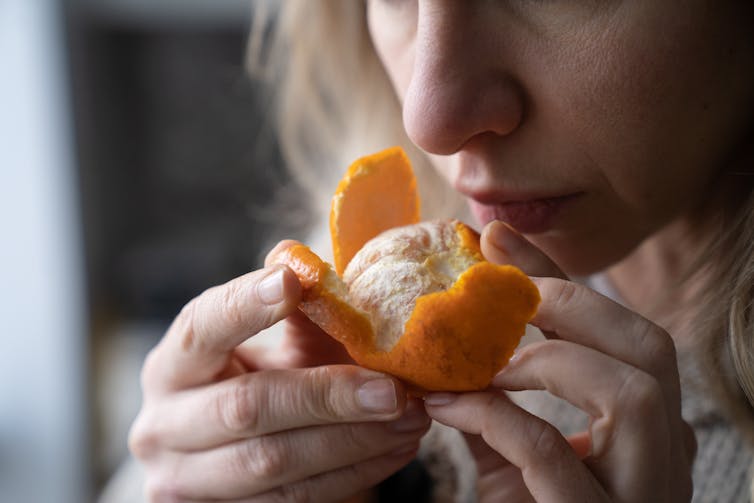
A woman with COVID-19 symptoms tries to sense the smell of a fresh tangerine.
Some people with COVID-19 have experienced either the loss of, or a reduction in, their sense of smell.
Dima Berlin via Getty Images

Strikingly, the brain regions that the U.K. researchers found to be affected by COVID-19 are all linked to the olfactory bulb, a structure near the front of the brain that passes signals about smells from the nose to other brain regions. The olfactory bulb has connections to regions of the temporal lobe. Researchers often talk about the temporal lobe in the context of aging and Alzheimer’s disease, because it is where the hippocampus is located. The hippocampus is likely to play a key role in aging, given its involvement in memory and cognitive processes.

The sense of smell is also important to Alzheimer’s research, as some data has suggested that those at risk for the disease have a reduced sense of smell. While it is too early to draw any conclusions about the long-term impacts of COVID-related effects on the sense of smell, investigating possible connections between COVID-19-related brain changes and memory is of great interest – particularly given the regions implicated and their importance in memory and Alzheimer’s disease.

An overview of how our sense of smell is connected to receptors in the brain.

The study also highlights a potentially important role for the cerebellum, an area of the brain that is involved in cognitive and motor processes; importantly, it too is affected in aging. There is also an emerging line of work implicating the cerebellum in Alzheimer’s disease.

Looking ahead

These new findings bring about important yet unanswered questions: What do these brain changes following COVID-19 mean for the process and pace of aging? Also, does the brain recover from viral infection over time, and to what extent?

These are active and open areas of research we are beginning to tackle in my laboratory in conjunction with our ongoing work investigating brain aging.
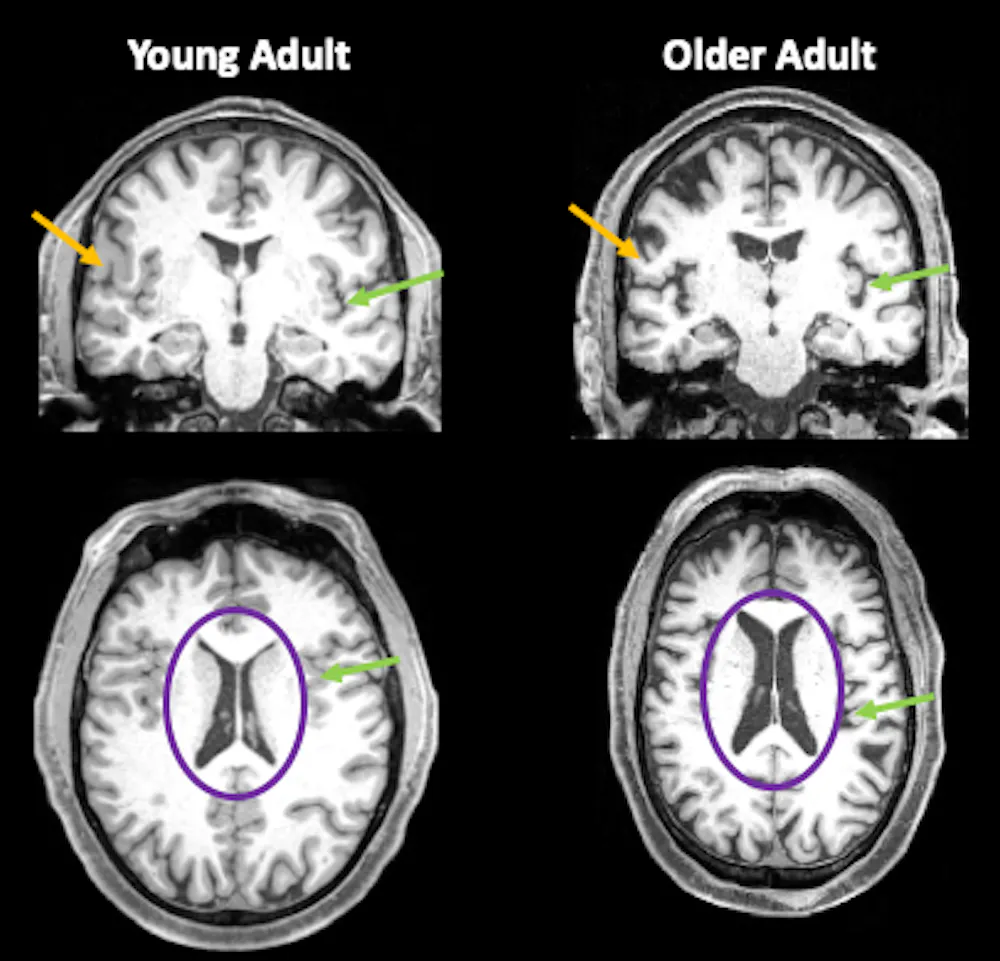
Brain scans from a person in their 30s and a person in their 80s, showing reduced brain volume in the older adult brain
Brain images from a 35-year-old and an 85-year-old. Orange arrows show the thinner gray matter in the older individual. Green arrows point to areas where there is more space filled with cerebrospinal fluid (CSF) due to reduced brain volume. The purple circles highlight the brains’ ventricles, which are filled with CSF. In older adults, these fluid-filled areas are much larger.
Jessica Bernard, CC BY-ND

Our lab’s work demonstrates that as people age, the brain thinks and processes information differently. In addition, we’ve observed changes over time in how people’s bodies move and how people learn new motor skills. Several decades of work have demonstrated that older adults have a harder time processing and manipulating information – such as updating a mental grocery list – but they typically maintain their knowledge of facts and vocabulary. With respect to motor skills, we know that older adults still learn, but they do so more slowly then young adults.

When it comes to brain structure, we typically see a decrease in the size of the brain in adults over age 65. This decrease is not just localized to one area. Differences can be seen across many regions of the brain. There is also typically an increase in cerebrospinal fluid that fills space due to the loss of brain tissue. In addition, white matter, the insulation on axons – long cables that carry electrical impulses between nerve cells – is also less intact in older adults.

Life expectancy has increased in the past decades. The goal is for all to live long and healthy lives, but even in the best-case scenario where one ages without disease or disability, older adulthood brings on changes in how we think and move.

Learning how all of these puzzle pieces fit together will help us unravel the mysteries of aging so that we can help improve quality of life and function for aging individuals. And now, in the context of COVID-19, it will help us understand the degree to which the brain may recover after illness as well.

This is an updated version of an article originally published on Sept. 24, 2021.

Jessica Bernard, Associate Professor, Texas A&M University

This article is republished from The Conversation under a Creative Commons license. Read the original article.


ShareTweet
Daily Remedy

Daily Remedy

Dr. Jay K Joshi serves as the editor-in-chief of Daily Remedy. He is a serial entrepreneur and sought after thought-leader for matters related to healthcare innovation and medical jurisprudence. He has published articles on a variety of healthcare topics in both peer-reviewed journals and trade publications. His legal writings include amicus curiae briefs prepared for prominent federal healthcare cases.

Leave a Reply Cancel reply

Your email address will not be published. Required fields are marked *

Videos

In this episode of the Daily Remedy Podcast, Tiffany Ryder discusses her insights on healthcare messaging, the impact of COVID-19 on patient trust, and the importance of transparency in health policy. She emphasizes the need for clear communication in the face of divisiveness and explores the complexities surrounding the estrogen debate. Additionally, Tiffany highlights positive developments in health policy and the necessity of effectively conveying these changes to the public.

Tiffany Ryder is a political commentator and public health policy thought leader who publishes the Substack newsletter Signal and Noise: https://signalandnoise.online/


Chapters

00:00 Introduction to Healthcare Conversations
02:58 Signal and Noise: Understanding Healthcare Communication
05:56 The Storytelling Problem in Healthcare
08:58 Navigating Political Divisiveness in Health Policy
11:55 The Role of Media in Health Policy
15:03 Bias in Health Reporting
17:56 Estrogen and Health Policy: A Case Study
24:00 Positive Developments in Health Policy
27:03 Looking Ahead: Future of Health Policy
31:49 Communicating Health Policy Effectively
The Impact of COVID-19 on Patient Trust
YouTube Video ujzgl7HDlsw
Subscribe

2027 Medicare Advantage & Part D Advance Notice

Clinical Reads

GLP-1 Drugs Have Moved Past Weight Loss. Medicine Has Not Fully Caught Up.

Glucagon-Like Peptide–Based Therapies and Longevity: Clinical Implications from Emerging Evidence

by Daily Remedy
March 1, 2026
0

Glucagon-like peptide–based therapies are increasingly used for weight management and glycemic control, but their potential impact on long-term survival remains uncertain. The clinical question addressed in this report is whether treatment with glucagon-like peptide receptor agonists is associated with reductions in all-cause mortality and age-related morbidity beyond their established metabolic effects. This question matters because these agents are now prescribed across broad patient populations, including individuals without diabetes, and long-term exposure may influence cardiovascular, oncologic, and neurodegenerative outcomes. Understanding whether...

Read more

Join Our Newsletter!

Twitter Updates

Tweets by TheDailyRemedy

Popular

  • When Prognosis Becomes Probabilistic

    When Prognosis Becomes Probabilistic

    0 shares
    Share 0 Tweet 0
  • Gaming Therapy

    0 shares
    Share 0 Tweet 0
  • When the Algorithm Is Right

    0 shares
    Share 0 Tweet 0
  • The Fasting Correction

    0 shares
    Share 0 Tweet 0
  • Healthcare Trends

    0 shares
    Share 0 Tweet 0
  • 628 Followers

Daily Remedy

Daily Remedy offers the best in healthcare information and healthcare editorial content. We take pride in consistently delivering only the highest quality of insight and analysis to ensure our audience is well-informed about current healthcare topics - beyond the traditional headlines.

Daily Remedy website services, content, and products are for informational purposes only. We do not provide medical advice, diagnosis, or treatment. All rights reserved.

Important Links

  • Support Us
  • About Us
  • Contact us
  • Privacy Policy
  • Terms and Conditions

Join Our Newsletter!

  • Survey
  • Podcast
  • About Us
  • Contact us

© 2026 Daily Remedy

No Result
View All Result
  • Home
  • Articles
  • Podcasts
  • Surveys
  • Courses
  • About Us
  • Contact us
  • Support Us
  • Official Learner

© 2026 Daily Remedy
