












Saturday, April 18, 2026
ISSN 2765-8767
  • Survey
  • Podcast
  • Write for Us
  • My Account
  • Log In
Daily Remedy
  • Home
  • Articles
  • Podcasts
    The Hidden Costs Employers Don’t See in Traditional Health Plans

    The Hidden Costs Employers Don’t See in Traditional Health Plans

    March 22, 2026
    The Impact of COVID-19 on Patient Trust

    The Impact of COVID-19 on Patient Trust

    March 3, 2026
    Debunking Myths About GLP-1 Medications

    Debunking Myths About GLP-1 Medications

    February 16, 2026
    The Future of LLMs in Healthcare

    The Future of LLMs in Healthcare

    January 26, 2026
    The Future of Healthcare Consumerism

    The Future of Healthcare Consumerism

    January 22, 2026
    Your Body, Your Health Care: A Conversation with Dr. Jeffrey Singer

    Your Body, Your Health Care: A Conversation with Dr. Jeffrey Singer

    July 1, 2025
  • Surveys

    Surveys

    Understanding of Clinical Evidence in Peptide and Hormone Use

    Understanding of Clinical Evidence in Peptide and Hormone Use

    March 30, 2026
    Public Sentiment on the Future of Peptides and Hormone Therapies in U.S. Medicine

    Public Sentiment on the Future of Peptides and Hormone Therapies in U.S. Medicine

    March 17, 2026

    Survey Results

    Can you tell when your provider does not trust you?

    Can you tell when your provider does not trust you?

    January 18, 2026
    Do you believe national polls on health issues are accurate

    National health polls: trust in healthcare system accuracy?

    May 8, 2024
    Which health policy issues matter the most to Republican voters in the primaries?

    Which health policy issues matter the most to Republican voters in the primaries?

    May 14, 2024
    How strongly do you believe that you can tell when your provider does not trust you?

    How strongly do you believe that you can tell when your provider does not trust you?

    May 7, 2024
  • Courses
  • About Us
  • Contact us
  • Support Us
  • Official Learner
No Result
View All Result
  • Home
  • Articles
  • Podcasts
    The Hidden Costs Employers Don’t See in Traditional Health Plans

    The Hidden Costs Employers Don’t See in Traditional Health Plans

    March 22, 2026
    The Impact of COVID-19 on Patient Trust

    The Impact of COVID-19 on Patient Trust

    March 3, 2026
    Debunking Myths About GLP-1 Medications

    Debunking Myths About GLP-1 Medications

    February 16, 2026
    The Future of LLMs in Healthcare

    The Future of LLMs in Healthcare

    January 26, 2026
    The Future of Healthcare Consumerism

    The Future of Healthcare Consumerism

    January 22, 2026
    Your Body, Your Health Care: A Conversation with Dr. Jeffrey Singer

    Your Body, Your Health Care: A Conversation with Dr. Jeffrey Singer

    July 1, 2025
  • Surveys

    Surveys

    Understanding of Clinical Evidence in Peptide and Hormone Use

    Understanding of Clinical Evidence in Peptide and Hormone Use

    March 30, 2026
    Public Sentiment on the Future of Peptides and Hormone Therapies in U.S. Medicine

    Public Sentiment on the Future of Peptides and Hormone Therapies in U.S. Medicine

    March 17, 2026

    Survey Results

    Can you tell when your provider does not trust you?

    Can you tell when your provider does not trust you?

    January 18, 2026
    Do you believe national polls on health issues are accurate

    National health polls: trust in healthcare system accuracy?

    May 8, 2024
    Which health policy issues matter the most to Republican voters in the primaries?

    Which health policy issues matter the most to Republican voters in the primaries?

    May 14, 2024
    How strongly do you believe that you can tell when your provider does not trust you?

    How strongly do you believe that you can tell when your provider does not trust you?

    May 7, 2024
  • Courses
  • About Us
  • Contact us
  • Support Us
  • Official Learner
No Result
View All Result
Daily Remedy
No Result
View All Result
Home Financial Markets

The Chronic Disease of Debt

Daily Remedy by Daily Remedy
February 27, 2022
in Financial Markets
0
The Chronic Disease of Debt 2022.03.01

If you owe the bank ten thousand dollars, then you are probably in financial trouble. If you owe the bank a million dollars, then it is the bank that is in trouble. This is the nature of debt – if allowed to grow, the debtor eventually becomes beholden to the indebted.

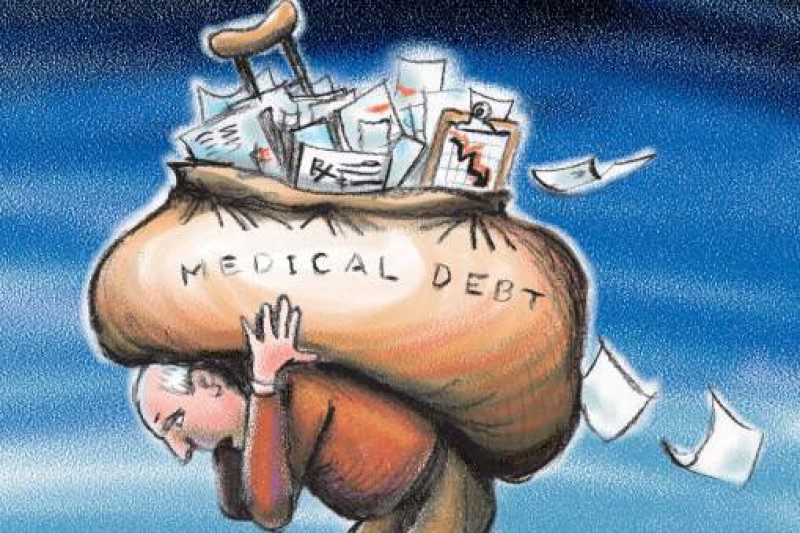
This is the state of healthcare today, beholden to the millions of Americans saddled with medical debt. Over half now carry medical debt, up from 46 percent in 2020, according to survey data from Debt.com, a consumer financial education company. Among those with debt, 75 percent of Americans owe at least $2,000 as of late 2021, driven primarily by diagnostic tests, hospitalizations, and emergency room visits.

“The majority of medical debt is owned by people who don’t have the money to pay for it,” Don Silvestri, CEO of Debt.com, said. And like all forms of debt, those who cannot pay for what is owed find themselves in collections. As a result, about 18 percent of Americans hold medical debt that is in collections, according to 2021 study from the Journal of American Medical Association (JAMA). Researchers in the study found that, between 2009 and 2020, unpaid medical bills became the largest source of debt that Americans owe collections agencies.

Americans are drowning in medical debt, and the problem has grown large enough to where policy makers are calling for fundamental reforms in American healthcare – namely healthcare insurances.

The Commonwealth Fund, a liberal think tank, conducted its own survey of medical debt to ascertain changes in patient behavior in response to it. The survey found that nearly 66 percent of adults under the age of 65 who had medical debt went without needed care. Naturally this would lead to calls for universal healthcare, or at least for expanded Medicaid coverage.

But policy makers in favor of expanded coverage options also take an additional, specious step in thinking. They believe that patients will be more engaged with their providers, or at least make more health-conscious lifestyle decisions, should the powers that be eliminate their medical debt.

Discover Financial Services, makers of the Discover Card, conducted yet another survey of patients with medical debt, and found that 44 percent defer seeing their primary care physician and 39 percent defer purchasing their medications because of existing medical debt.

These surveys and policy implications all lead to one conclusion – medical debt affects patient behavior to where patients are less willing to engage with their healthcare system. It would then follow that to improve healthcare, we should eliminate medical debt. And the easiest way to eliminate it is to expand public health insurance plans.

But debt is not so easily vanquished. Even if we hypothetically write off all the medical debt held by patients, or transfer it to government institutions that administer public health plans like Medicaid or ACA health plans, the debt would remain. Debt is a function of cost, and medical debt is the cost of healthcare – someone or something has to bear it.

When patients bear it, we observe changes in behavior and decry the effects of debt. But we do not give the same consideration to other institutions that may find themselves on the receiving end of medical debt.

We look at medical debt in terms of behavior when it is held by patients, though we only look at it in financial terms when considering other entities that bear it. But debt is best understood in terms of the behavior it elicits among all who carry it.

Hospitals that bear debt use litigious means of extracting payments to reduce their debt. Insurance plans that carry excess bad debt, or debt unlikely to be paid off, restructure their coverage plans either with a higher deductible or with less clinical services included. The combined effects of which result in the same outcome – medical debt is transferred back onto the patient.

Debt in healthcare is not a problem of insurance coverage. It is a feature of the healthcare system, laced within the fabric of how it operates in the United States. It inevitably falls on the patient to bear, no matter how much we jigger with the system.

If we want to solve the problem of medical debt, then we have to think more fundamentally about what costs mean in healthcare. This is hard to do, much less to even conceptualize. And like most difficult issues, we change it into something more palatable. So we look at the issue of medical debt in terms of victims and villains – and place blame where it is most convenient to do so.

Instead, we should reexamine the system itself, study why healthcare costs are what they are. So we can see what we can do about medical debt.

As it currently stands in our modern healthcare system, costs create debt, which gravitates toward the patients. Any attempt to shift debt away from them will simply revert back into the patients’ pocketbook over time.

We cannot reduce debt without altering the calculus of costs. This is a difficult problem. And it is really why the problem of medical debt is difficult to resolve.


ShareTweet
Daily Remedy

Daily Remedy

Dr. Jay K Joshi serves as the editor-in-chief of Daily Remedy. He is a serial entrepreneur and sought after thought-leader for matters related to healthcare innovation and medical jurisprudence. He has published articles on a variety of healthcare topics in both peer-reviewed journals and trade publications. His legal writings include amicus curiae briefs prepared for prominent federal healthcare cases.

Leave a Reply Cancel reply

Your email address will not be published. Required fields are marked *

Videos

Most employers are unknowingly steering their health plans toward higher costs and reduced control — until they understand how fiduciary missteps and anti-competitive contracts bleed their budgets dry. Katie Talento, a recognized health policy leader, reveals how shifting the network paradigm can save millions by emphasizing independent providers, direct contracting, and innovative tiering models.

Grounded in real-world case studies like Harris Rosen’s community-driven initiative, this episode dives deep into practical strategies to realign incentives—focusing on primary care, specialty care, and transparent vendor relationships. You'll discover how traditional carrier networks are often Trojan horses, locking employers into costly, opaque arrangements that undermine fiduciary duties. Katie breaks down simple yet powerful reforms: owning your data, eliminating conflicts of interest, and outlawing anti-competitive contract clauses.

We explore how a post-network framework—where patients are free to choose providers without restrictive network barriers—can massively reduce costs and improve health outcomes. You'll learn why independent, locally owned providers are vital to rebuilding trust, reducing unnecessary procedures, and reinvesting savings into the community. This conversation offers clarity on the unseen legal landmines employers face and actionable ways to craft health plans built on transparency, independence, and aligned incentives.

Perfect for HR pros, benefits advisors, physicians, and employer leaders committed to transforming healthcare from the ground up. If you’re tired of broken healthcare models draining your budget and frustrating your staff, this episode will empower you to take control by understanding and reshaping the very foundations of employer-sponsored health. Discover the blueprint for smarter, fairer, and more sustainable benefits.

Visit katytalento.com or allbetter.health to connect directly and explore how these innovations can work for your organization. Your path toward a healthier, more cost-effective future starts here.

Chapters

00:00 Introduction to Employer-Sponsored Health Plans
02:50 Understanding ERISA and Fiduciary Responsibilities
06:08 The Misalignment of Clinical and Financial Interests
08:54 Enforcement and Legal Implications for Employers
11:49 Redefining Networks: The Post-Network Framework
25:34 Navigating Healthcare Contracts and Cash Payments
27:31 Understanding Employer Health Plan Structures
28:04 The Role of Benefits Advisors in Health Plans
30:45 Governance and Data Ownership in Health Plans
37:05 Case Study: The Rosen Hotels' Health Model
41:33 Incentivizing Healthy Choices in Healthcare
47:22 Empowering Primary Care and Independent Providers
The Hidden Costs Employers Don’t See in Traditional Health Plans
YouTube Video xhks7YbmBoY
Subscribe

Policy Shift in Peptide Regulation

Clinical Reads

Semaglutide and the Expansion Problem: When One Trial Becomes a Platform

Semaglutide and the Expansion Problem: When One Trial Becomes a Platform

by Daily Remedy
March 30, 2026
0

Semaglutide has moved beyond its original indication and now sits at the center of a widening set of clinical questions: cardiovascular risk, kidney disease progression, and even neurodegeneration. The question is no longer whether the drug lowers glucose or reduces weight—it does—but how far those effects extend across systems, and whether evidence from one population can be translated into another without distortion. Large, well-powered trials have produced consistent signals, yet those signals are now being applied in contexts that were...

Read more

Join Our Newsletter!

Twitter Updates

Tweets by TheDailyRemedy

Popular

  • Lonely During the Holidays? You're Not Alone.

    Lonely During the Holidays? You’re Not Alone.

    3 shares
    Share 0 Tweet 0
  • They Rarely Ask for Pain Pills Now

    1 shares
    Share 0 Tweet 0
  • The “Old” Days of Medical Practice

    0 shares
    Share 0 Tweet 0
  • Normalizing Healthcare Policy Polarizations

    0 shares
    Share 0 Tweet 0
  • Combating Vaccine Revisionism: A Stand for Science and Public Trust

    1 shares
    Share 0 Tweet 0
  • 628 Followers

Daily Remedy

Daily Remedy offers the best in healthcare information and healthcare editorial content. We take pride in consistently delivering only the highest quality of insight and analysis to ensure our audience is well-informed about current healthcare topics - beyond the traditional headlines.

Daily Remedy website services, content, and products are for informational purposes only. We do not provide medical advice, diagnosis, or treatment. All rights reserved.

Important Links

  • Support Us
  • About Us
  • Contact us
  • Privacy Policy
  • Terms and Conditions

Join Our Newsletter!

  • Survey
  • Podcast
  • About Us
  • Contact us

© 2026 Daily Remedy

No Result
View All Result
  • Home
  • Articles
  • Podcasts
  • Surveys
  • Courses
  • About Us
  • Contact us
  • Support Us
  • Official Learner

© 2026 Daily Remedy
