













Monday, February 9, 2026
ISSN 2765-8767
  • Survey
  • Podcast
  • Write for Us
  • My Account
  • Log In
Daily Remedy
  • Home
  • Articles
  • Podcasts
    The Future of LLMs in Healthcare

    The Future of LLMs in Healthcare

    January 26, 2026
    The Future of Healthcare Consumerism

    The Future of Healthcare Consumerism

    January 22, 2026
    Your Body, Your Health Care: A Conversation with Dr. Jeffrey Singer

    Your Body, Your Health Care: A Conversation with Dr. Jeffrey Singer

    July 1, 2025

    The cost structure of hospitals nearly doubles

    July 1, 2025
    Navigating the Medical Licensing Maze

    The Fight Against Healthcare Fraud: Dr. Rafai’s Story

    April 8, 2025
    Navigating the Medical Licensing Maze

    Navigating the Medical Licensing Maze

    April 4, 2025
  • Surveys

    Surveys

    AI in Healthcare Decision-Making

    AI in Healthcare Decision-Making

    February 1, 2026
    Patient Survey: Understanding Healthcare Consumerism

    Patient Survey: Understanding Healthcare Consumerism

    January 18, 2026

    Survey Results

    Can you tell when your provider does not trust you?

    Can you tell when your provider does not trust you?

    January 18, 2026
    Do you believe national polls on health issues are accurate

    National health polls: trust in healthcare system accuracy?

    May 8, 2024
    Which health policy issues matter the most to Republican voters in the primaries?

    Which health policy issues matter the most to Republican voters in the primaries?

    May 14, 2024
    How strongly do you believe that you can tell when your provider does not trust you?

    How strongly do you believe that you can tell when your provider does not trust you?

    May 7, 2024
  • Courses
  • About Us
  • Contact us
  • Support Us
  • Official Learner
No Result
View All Result
  • Home
  • Articles
  • Podcasts
    The Future of LLMs in Healthcare

    The Future of LLMs in Healthcare

    January 26, 2026
    The Future of Healthcare Consumerism

    The Future of Healthcare Consumerism

    January 22, 2026
    Your Body, Your Health Care: A Conversation with Dr. Jeffrey Singer

    Your Body, Your Health Care: A Conversation with Dr. Jeffrey Singer

    July 1, 2025

    The cost structure of hospitals nearly doubles

    July 1, 2025
    Navigating the Medical Licensing Maze

    The Fight Against Healthcare Fraud: Dr. Rafai’s Story

    April 8, 2025
    Navigating the Medical Licensing Maze

    Navigating the Medical Licensing Maze

    April 4, 2025
  • Surveys

    Surveys

    AI in Healthcare Decision-Making

    AI in Healthcare Decision-Making

    February 1, 2026
    Patient Survey: Understanding Healthcare Consumerism

    Patient Survey: Understanding Healthcare Consumerism

    January 18, 2026

    Survey Results

    Can you tell when your provider does not trust you?

    Can you tell when your provider does not trust you?

    January 18, 2026
    Do you believe national polls on health issues are accurate

    National health polls: trust in healthcare system accuracy?

    May 8, 2024
    Which health policy issues matter the most to Republican voters in the primaries?

    Which health policy issues matter the most to Republican voters in the primaries?

    May 14, 2024
    How strongly do you believe that you can tell when your provider does not trust you?

    How strongly do you believe that you can tell when your provider does not trust you?

    May 7, 2024
  • Courses
  • About Us
  • Contact us
  • Support Us
  • Official Learner
No Result
View All Result
Daily Remedy
No Result
View All Result
Home Innovations & Investing

Can Delta-8 THC Provide Some of the Benefits of Pot?

Daily Remedy by Daily Remedy
April 3, 2024
in Innovations & Investing
0
Can Delta-8 THC Provide Some of the Benefits of Pot?

Can delta-8 THC provide some of the benefits of pot – with less paranoia and anxiety?

Can Delta-8 THC Provide Some of the Benefits of Pot?
Hemp plants growing on a farm in Colorado.
krblokhin/Getty Images

Daniel J. Kruger, University of Michigan and Jessica S. Kruger, University at Buffalo

Over the past year, you may have seen something called delta-8 THC or “delta 8” appear in convenience stores and pharmacies alongside CBD gummies, oils and lotions.

Delta-8 THC is a hemp-derived compound that’s closely related to delta-9 THC – what’s commonly called THC and is the psychoactive component of cannabis that’s responsible for the high that users feel.

Like garden variety marijuana, delta-8 THC can be vaped or eaten. However, it’s rarely smoked. Anecdotally, its fans swear by its benefits – that it helps with relaxation and pain relief without intense highs that can veer into anxiety or paranoia.

Yet there’s been a dearth of research on this compound. As public health scholars, we decided to conduct the first survey of delta-8 THC users to find out who was using it, why they were using it and what sort of effects it had.

The latest cannabinoid to storm the market

The 2018 Agriculture Improvement Act – also known as the farm bill – legalized the sale of hemp-derived compounds. The widely available CBD is a hemp-derived compound.

Delta-8 THC is another. It’s an isomer, or chemical analog, of THC. The difference is in the position of a double bond in the carbon ring, which makes delta-8 THC have a lower affinity for the CB1 receptor of the endocannabinoid system in our brains. For this reason, it may be less potent than THC and cause a less-intense high.
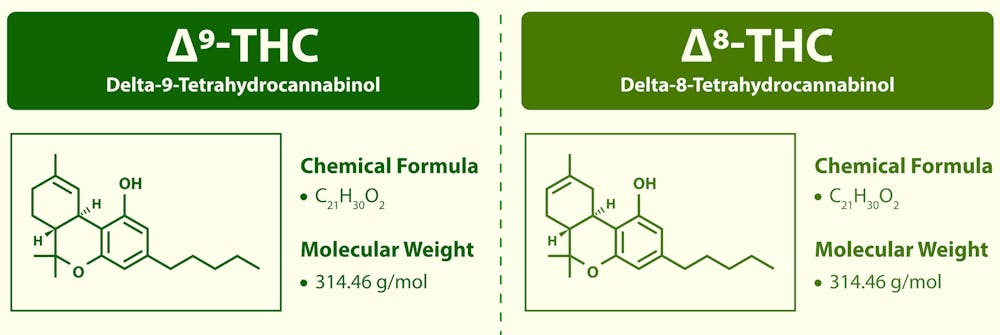
Two charts depicting the chemical structures of delta-8 THC and delta-9 THC.
The chemical structures of delta-9 THC – what’s commonly called THC – and delta-8 THC are strikingly similar; the only difference being the position of a double bond in the carbon ring.
About time/Getty Images

Natural concentrations of delta-8 THC in cannabis are too low for it to be effectively smoked in raw bud or flower. It needs to be extracted from large amounts of plant material, transformed from another cannabinoid like CBD, or synthesized chemically. The Drug Enforcement Administration considers artificially
synthesized delta-8 THC illegal
.

Nonetheless, delta-8 THC products have become one of the fastest-growing sectors of the hemp industry. They seem to be especially popular in areas where THC products remain illegal or medical access is very difficult.

There is little research on this component of cannabis. One study from 1973 found that the effects of delta-8 THC mimicked those of THC, but weren’t as intense. Another, published in 1995, suggested that delta-8 THC could be used as a therapeutic treatment for the adverse effects of chemotherapy.

These studies, however, enrolled only a dozen individuals, and few policymakers seem to even be aware of their existence. While delta-8 THC can be bought in convenience stores and hemp shops in many states, over a dozen U.S. states have blocked the sale of delta-8 THC products due to a lack of research on its psychoactive effects and concerns over contamination with heavy metals and other toxic substances.

Clearing the smoke with science

In our study, we collected data via an online survey that was completed by more than 500 participants across 38 states.

Most of our participants consumed delta-8 THC through concentrates that were either eaten as edibles and tinctures or smoked by vaping – methods of ingestion that may be safer than smoking. About half said they used delta-8 THC to treat a health or medical condition, and almost one-third of participants said they exclusively used delta-8 THC to treat a health condition – they didn’t use it just for fun. Common conditions treated were anxiety or panic attacks, chronic pain, depression or bipolar disorder, and stress – afflictions that people also treat with delta-9 THC.

As we expected, participants thought that delta-8 THC had effects that were somewhat less intense compared with THC.

What’s remarkable, though, is how the profiles of their experiences differ.

Compared with THC, delta-8 THC appears to provide similar levels of relaxation and pain relief. While it seems to cause slightly lower levels of euphoria, it also seems to produce fewer cognitive distortions such as an altered sense of time, short-term memory issues and difficulty concentrating. Participants were also much less likely to experience distressing mental states such as anxiety and paranoia. Many participants remarked how they could use delta-8 THC and still be productive, whereas they tended to use THC products recreationally, given its more potent, mind-altering effects.

Most participants reduced or stopped using pharmaceutical drugs, as well as THC products, because they were using delta-8 THC to treat their conditions. They considered delta-8 THC better than pharmaceutical drugs in terms of adverse side effects, addictiveness, withdrawal symptoms, effectiveness, safety, availability and cost.

[Get the best of The Conversation, every weekend. Sign up for our weekly newsletter.]

However, participants weren’t confident that their primary care doctor could integrate medical cannabis into their course of treatment. For this reason, many hadn’t disclosed their use of delta-8 THC as a substitute for pharmaceutical drugs to their doctors.

These patterns demonstrate the need for more research and better education for health care providers on cannabis and its derivatives; there continues to be a disconnect between those who use cannabis to self-medicate and the mainstream health care system.

More to be done

Our findings are just the start. We hope that they’ll spur more sophisticated research, such as double-blind randomized controlled trials that explore its treatment potential for specific conditions. And we still don’t know if some of the effects reported by our participants, both beneficial and harmful, were due to contaminants or expectations – a placebo effect.

Yet even though delta-8 THC products may provide much of the experiential and therapeutic benefits, with lower risks and fewer adverse effects, some states have outright banned delta-8 THC sales. Since many of those same states permit the recreational sale of cannabis and other hemp products, this seems a bit paradoxical.

Criminalizing substances with high consumer demand like delta-8 THC can create a black market and produce even more concerns for consumer safety, as there’s no mechanism for the regulation and protection of consumers.

Cannabis laws remain a patchwork of policies and regulations. With more and more Americans having access to cannabis for medicinal and recreational purposes, we believe it behooves policymakers to advocate for further study of this promising alternative.

Daniel J. Kruger, Research Assistant Professor, University of Michigan and Jessica S. Kruger, Clinical Assistant Professor of Community Health and Health Behavior, University at Buffalo

This article is republished from The Conversation under a Creative Commons license. Read the original article.


ShareTweet
Daily Remedy

Daily Remedy

Dr. Jay K Joshi serves as the editor-in-chief of Daily Remedy. He is a serial entrepreneur and sought after thought-leader for matters related to healthcare innovation and medical jurisprudence. He has published articles on a variety of healthcare topics in both peer-reviewed journals and trade publications. His legal writings include amicus curiae briefs prepared for prominent federal healthcare cases.

Leave a Reply Cancel reply

Your email address will not be published. Required fields are marked *

Videos

In this episode, the host discusses the significance of large language models (LLMs) in healthcare, their applications, and the challenges they face. The conversation highlights the importance of simplicity in model design and the necessity of integrating patient feedback to enhance the effectiveness of LLMs in clinical settings.

Takeaways
LLMs are becoming integral in healthcare.
They can help determine costs and service options.
Hallucination in LLMs can lead to misinformation.
LLMs can produce inconsistent answers based on input.
Simplicity in LLMs is often more effective than complexity.
Patient behavior should guide LLM development.
Integrating patient feedback is crucial for accuracy.
Pre-training models with patient input enhances relevance.
Healthcare providers must understand LLM limitations.
The best LLMs will focus on patient-centered care.

Chapters

00:00 Introduction to LLMs in Healthcare
05:16 The Importance of Simplicity in LLMs
The Future of LLMs in HealthcareDaily Remedy
YouTube Video U1u-IYdpeEk
Subscribe

AI Regulation and Deployment Is Now a Core Healthcare Issue

Clinical Reads

Ambient Artificial Intelligence Clinical Documentation: Workflow Support with Emerging Governance Risk

Ambient Artificial Intelligence Clinical Documentation: Workflow Support with Emerging Governance Risk

by Daily Remedy
February 1, 2026
0

Health systems are increasingly deploying ambient artificial intelligence tools that listen to clinical encounters and automatically generate draft visit notes. These systems are intended to reduce documentation burden and allow clinicians to focus more directly on patient interaction. At the same time, they raise unresolved questions about patient consent, data handling, factual accuracy, and legal responsibility for machine‑generated records. Recent policy discussions and legal actions suggest that adoption is moving faster than formal oversight frameworks. The practical clinical question is...

Read more

Join Our Newsletter!

Twitter Updates

Tweets by TheDailyRemedy

Popular

  • Powerful Phrases to Tell Patients

    Powerful Phrases to Tell Patients

    0 shares
    Share 0 Tweet 0
  • Positions Currently in High Demand in the Medical Field

    0 shares
    Share 0 Tweet 0
  • The Future of Healthcare Law

    0 shares
    Share 0 Tweet 0
  • Bird Flu’s Cattle Calling

    1 shares
    Share 0 Tweet 0
  • A Comment on the CDC’s Commentary

    0 shares
    Share 0 Tweet 0
  • 628 Followers

Daily Remedy

Daily Remedy offers the best in healthcare information and healthcare editorial content. We take pride in consistently delivering only the highest quality of insight and analysis to ensure our audience is well-informed about current healthcare topics - beyond the traditional headlines.

Daily Remedy website services, content, and products are for informational purposes only. We do not provide medical advice, diagnosis, or treatment. All rights reserved.

Important Links

  • Support Us
  • About Us
  • Contact us
  • Privacy Policy
  • Terms and Conditions

Join Our Newsletter!

  • Survey
  • Podcast
  • About Us
  • Contact us

© 2026 Daily Remedy

No Result
View All Result
  • Home
  • Articles
  • Podcasts
  • Surveys
  • Courses
  • About Us
  • Contact us
  • Support Us
  • Official Learner

© 2026 Daily Remedy
