













Thursday, April 2, 2026
ISSN 2765-8767
  • Survey
  • Podcast
  • Write for Us
  • My Account
  • Log In
Daily Remedy
  • Home
  • Articles
  • Podcasts
    The Hidden Costs Employers Don’t See in Traditional Health Plans

    The Hidden Costs Employers Don’t See in Traditional Health Plans

    March 22, 2026
    The Impact of COVID-19 on Patient Trust

    The Impact of COVID-19 on Patient Trust

    March 3, 2026
    Debunking Myths About GLP-1 Medications

    Debunking Myths About GLP-1 Medications

    February 16, 2026
    The Future of LLMs in Healthcare

    The Future of LLMs in Healthcare

    January 26, 2026
    The Future of Healthcare Consumerism

    The Future of Healthcare Consumerism

    January 22, 2026
    Your Body, Your Health Care: A Conversation with Dr. Jeffrey Singer

    Your Body, Your Health Care: A Conversation with Dr. Jeffrey Singer

    July 1, 2025
  • Surveys

    Surveys

    Understanding of Clinical Evidence in Peptide and Hormone Use

    Understanding of Clinical Evidence in Peptide and Hormone Use

    March 30, 2026
    Public Sentiment on the Future of Peptides and Hormone Therapies in U.S. Medicine

    Public Sentiment on the Future of Peptides and Hormone Therapies in U.S. Medicine

    March 17, 2026

    Survey Results

    Can you tell when your provider does not trust you?

    Can you tell when your provider does not trust you?

    January 18, 2026
    Do you believe national polls on health issues are accurate

    National health polls: trust in healthcare system accuracy?

    May 8, 2024
    Which health policy issues matter the most to Republican voters in the primaries?

    Which health policy issues matter the most to Republican voters in the primaries?

    May 14, 2024
    How strongly do you believe that you can tell when your provider does not trust you?

    How strongly do you believe that you can tell when your provider does not trust you?

    May 7, 2024
  • Courses
  • About Us
  • Contact us
  • Support Us
  • Official Learner
No Result
View All Result
  • Home
  • Articles
  • Podcasts
    The Hidden Costs Employers Don’t See in Traditional Health Plans

    The Hidden Costs Employers Don’t See in Traditional Health Plans

    March 22, 2026
    The Impact of COVID-19 on Patient Trust

    The Impact of COVID-19 on Patient Trust

    March 3, 2026
    Debunking Myths About GLP-1 Medications

    Debunking Myths About GLP-1 Medications

    February 16, 2026
    The Future of LLMs in Healthcare

    The Future of LLMs in Healthcare

    January 26, 2026
    The Future of Healthcare Consumerism

    The Future of Healthcare Consumerism

    January 22, 2026
    Your Body, Your Health Care: A Conversation with Dr. Jeffrey Singer

    Your Body, Your Health Care: A Conversation with Dr. Jeffrey Singer

    July 1, 2025
  • Surveys

    Surveys

    Understanding of Clinical Evidence in Peptide and Hormone Use

    Understanding of Clinical Evidence in Peptide and Hormone Use

    March 30, 2026
    Public Sentiment on the Future of Peptides and Hormone Therapies in U.S. Medicine

    Public Sentiment on the Future of Peptides and Hormone Therapies in U.S. Medicine

    March 17, 2026

    Survey Results

    Can you tell when your provider does not trust you?

    Can you tell when your provider does not trust you?

    January 18, 2026
    Do you believe national polls on health issues are accurate

    National health polls: trust in healthcare system accuracy?

    May 8, 2024
    Which health policy issues matter the most to Republican voters in the primaries?

    Which health policy issues matter the most to Republican voters in the primaries?

    May 14, 2024
    How strongly do you believe that you can tell when your provider does not trust you?

    How strongly do you believe that you can tell when your provider does not trust you?

    May 7, 2024
  • Courses
  • About Us
  • Contact us
  • Support Us
  • Official Learner
No Result
View All Result
Daily Remedy
No Result
View All Result
Home Uncertainty & Complexity

Trust Comes When You Admit What You Do Not Know – Lessons From Child Development Research

Daily Remedy by Daily Remedy
March 28, 2024
in Uncertainty & Complexity
0
Trust Comes When You Admit What You Do Not Know – Lessons From Child Development Research
Child & father
Kids figure out who’s trustworthy as they learn about the world.
Sandro Di Carlo Darsa/PhotoAlto Agency RF Collections via Getty Images

Tamar Kushnir, Duke University; David Sobel, Brown University, and Mark Sabbagh, Queen’s University, Ontario

Consider the following situation: Two experts give you advice about whether you should eat or avoid the fat in common cooking oils.

One of them tells you confidently that there are “good” or “bad” fats, so you can eat some oils and not others. The other is more hesitant, saying the science is mixed and it depends on the individual and the situation, so probably just best to avoid them all until more evidence is available, or see your doctor to find out what is best for you.

Whose advice do you follow?

Neither one of these experts is factually incorrect. But the confident source likely has some additional appeal. Research suggests that people are more likely to follow advice delivered with confidence and to reject advice delivered with hesitancy or uncertainty.

During the pandemic, public health officials have seemed to operate on this assumption – that confidence conveys expertise, leadership and authority and is necessary to get people to trust you. But public health recommendations about COVID-19 are complicated by the rapidly changing scientific understanding of the disease and its spread. Each time there’s new information, some of the old knowledge becomes obsolete and is replaced.

Over the course of the pandemic, Pew Research Center polling has found that the percentage of Americans who feel confused and less confident in public health officials’ recommendations because of changing guidelines has grown.
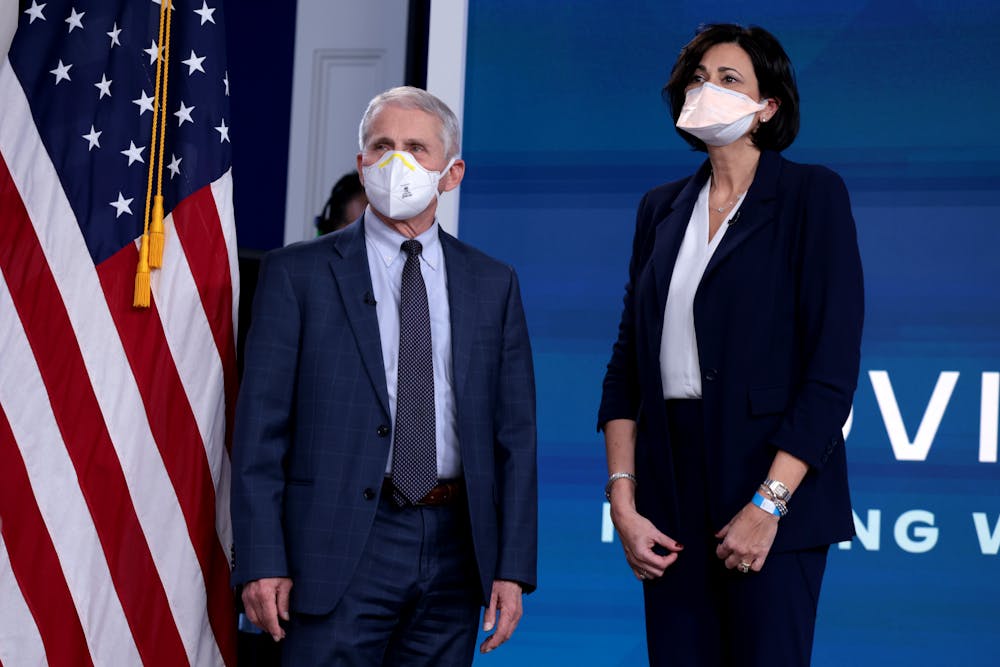
masked man and woman stand with American flag
Anthony Fauci, chief medical adviser to the president, and Centers for Disease Control and Prevention Director Rochelle Walensky have needed to update advice as the pandemic continues.
Anna Moneymaker via Getty Images

In a landscape of constantly changing science, is communicating with total confidence the best way to win public trust? Maybe not. Our research suggests that, in many cases, people trust those who are willing to say “I don’t know.”

We are psychological scientists who study the emergence, in childhood, of what is termed “epistemic trust” – which is trusting that someone is a knowledgeable and reliable source of information. Infants learn to trust their caregivers for other reasons – attachment bonds are formed based on love and consistent care.

But, from the time children are 3 or 4 years old, they also begin to trust people based on what they claim to know. In other words, from early in life our minds separate the love-and-care kind of trust from the sort of trust you need to get reliable, accurate information that helps you learn about the world. These are the origins of adult trust in experts – and in science.

Observing trust in the lab

The setup of our lab studies with kids is similar to our starting example above: Kids meet people and learn facts from them. One person sounds confident and the other sounds uncertain. The children in our studies are still in preschool, so we use simple “lessons” appropriate to the age group, often involving teaching children new made-up vocabulary words. We’re able to vary things about the “teachers” and see how children respond differently.

For instance, in the lab we find that children’s brain activity and learning are responsive to differences in tone between confidence and uncertainty. If you teach a 4-year-old a new word with confidence, they will learn it in one shot. But if you say “hmm, I’m not sure, I think this is called a …,” something changes.

Electrical activity in the brain shows that children both remember the event and learn the word when someone teaches with confidence. When someone communicates uncertainty, they remember the event but don’t learn the word.

If a speaker says they are unsure, it can actually help a listener separate memory of a specific thing they heard from facts they think must be widely known.

Effects of acknowledging uncertainty

In addition to forming accurate impressions in your memory, communicated uncertainty also helps you learn about cases that are uncertain by their nature. Disease transmission is one of these cases.

Our research shows that even 5-year-old children learn about uncertain data better from someone who expresses that uncertainty outright than someone who is confident that things will always work the same way.

In this study, kids saw cause-and-effect relations – objects turned on a music machine. Some objects (black ones) always made it go, others (yellow ones) never made it go, and still others made it go sometimes. For instance, red objects were 66% effective, and white objects were 33% effective.

One group of kids heard a contrast between red and white objects communicated with too much certainty: “Red ones make it go and white ones do not.” Later, kids in this group were confused when they had to distinguish these uncertain causes from more certain black and yellow ones.

Another group of kids heard the contrast communicated with uncertainty: “Maybe the red ones sometimes make it go, and the white ones sometimes do not.” Kids in this group were not confused. They learned that these objects were effective only sometimes, and they could distinguish them from objects that were always or never effective.

close-up of woman listening to young boy
Children become skeptical of adults who are mixed up but confident.
Catherine Falls Commercial/Moment via Getty Images

Overconfidence undermines trust

The studies above show that appropriately communicated uncertainty can influence trust in the short term. But pandemic communication is complicated mainly because no one can predict what information will change in the future. What is better in the long term – admitting what you don’t know, or being confident about information that might change?

[Research into coronavirus and other news from science Subscribe to The Conversation’s new science newsletter.]

In a recent study, we showed that over the long term, when you have a chance of being wrong, too much confidence carries risk. One group of 4-year-olds saw an adult who admitted not knowing the names for common objects: a ball, a book, a cup. Another group saw an adult who claimed to know what the objects were called but got them all wrong – for example, calling a ball “a shoe.”

When the adult admitted ignorance, 4-year-olds were willing to keep learning all sorts of things from them, even more words. But when the adult was confident and inaccurate, she lost all credibility. Even when children knew she could help them find a hidden toy, they wouldn’t trust her to tell them where it was.

Safeguarding trust by saying ‘I don’t know’

The lesson from our research is that speaking with confidence about information that will likely change is a bigger threat to earning trust than expressing uncertainty. When health officials confidently enact a policy at one time, and then confidently enact a different, even contradictory, policy later on, they are acting like the “unreliable informants” in our studies.

Public health communication can have two goals. One is to get people to act fast and follow best practices based on what’s known now. A second is to gain the sustained, long-term trust of the public so that when fast action is needed, people have faith that they are doing the right thing by following guidelines. Rhetoric that is designed to convey certainty in hopes of earning widespread compliance may be counterproductive if it risks mortgaging the long-term trust of the public.

While we recognize the difficulty of communicating in uncertain times, and doing so to an increasingly polarized public, we think it’s important to heed the lessons from the earliest psychology of trust.

The good news is that, based on our research, we believe the human mind doesn’t balk at hearing communicated uncertainty – quite the opposite. Our minds and brains are made to handle the occasional “I think so,” “I’m not sure” or “I don’t know.” In fact, our ability to do this emerges early in child development and is a cornerstone of our ability to learn from others.

Tamar Kushnir, Professor of Psychology and Neuroscience, Duke University; David Sobel, Professor of Cognitive, Linguistic & Psychological Sciences, Brown University, and Mark Sabbagh, Professor of Psychology, Queen’s University, Ontario

This article is republished from The Conversation under a Creative Commons license. Read the original article.


ShareTweet
Daily Remedy

Daily Remedy

Dr. Jay K Joshi serves as the editor-in-chief of Daily Remedy. He is a serial entrepreneur and sought after thought-leader for matters related to healthcare innovation and medical jurisprudence. He has published articles on a variety of healthcare topics in both peer-reviewed journals and trade publications. His legal writings include amicus curiae briefs prepared for prominent federal healthcare cases.

Leave a Reply Cancel reply

Your email address will not be published. Required fields are marked *

Videos

Most employers are unknowingly steering their health plans toward higher costs and reduced control — until they understand how fiduciary missteps and anti-competitive contracts bleed their budgets dry. Katie Talento, a recognized health policy leader, reveals how shifting the network paradigm can save millions by emphasizing independent providers, direct contracting, and innovative tiering models.

Grounded in real-world case studies like Harris Rosen’s community-driven initiative, this episode dives deep into practical strategies to realign incentives—focusing on primary care, specialty care, and transparent vendor relationships. You'll discover how traditional carrier networks are often Trojan horses, locking employers into costly, opaque arrangements that undermine fiduciary duties. Katie breaks down simple yet powerful reforms: owning your data, eliminating conflicts of interest, and outlawing anti-competitive contract clauses.

We explore how a post-network framework—where patients are free to choose providers without restrictive network barriers—can massively reduce costs and improve health outcomes. You'll learn why independent, locally owned providers are vital to rebuilding trust, reducing unnecessary procedures, and reinvesting savings into the community. This conversation offers clarity on the unseen legal landmines employers face and actionable ways to craft health plans built on transparency, independence, and aligned incentives.

Perfect for HR pros, benefits advisors, physicians, and employer leaders committed to transforming healthcare from the ground up. If you’re tired of broken healthcare models draining your budget and frustrating your staff, this episode will empower you to take control by understanding and reshaping the very foundations of employer-sponsored health. Discover the blueprint for smarter, fairer, and more sustainable benefits.

Visit katytalento.com or allbetter.health to connect directly and explore how these innovations can work for your organization. Your path toward a healthier, more cost-effective future starts here.

Chapters

00:00 Introduction to Employer-Sponsored Health Plans
02:50 Understanding ERISA and Fiduciary Responsibilities
06:08 The Misalignment of Clinical and Financial Interests
08:54 Enforcement and Legal Implications for Employers
11:49 Redefining Networks: The Post-Network Framework
25:34 Navigating Healthcare Contracts and Cash Payments
27:31 Understanding Employer Health Plan Structures
28:04 The Role of Benefits Advisors in Health Plans
30:45 Governance and Data Ownership in Health Plans
37:05 Case Study: The Rosen Hotels' Health Model
41:33 Incentivizing Healthy Choices in Healthcare
47:22 Empowering Primary Care and Independent Providers
The Hidden Costs Employers Don’t See in Traditional Health Plans
YouTube Video xhks7YbmBoY
Subscribe

Policy Shift in Peptide Regulation

Clinical Reads

Semaglutide and the Expansion Problem: When One Trial Becomes a Platform

Semaglutide and the Expansion Problem: When One Trial Becomes a Platform

by Daily Remedy
March 30, 2026
0

Semaglutide has moved beyond its original indication and now sits at the center of a widening set of clinical questions: cardiovascular risk, kidney disease progression, and even neurodegeneration. The question is no longer whether the drug lowers glucose or reduces weight—it does—but how far those effects extend across systems, and whether evidence from one population can be translated into another without distortion. Large, well-powered trials have produced consistent signals, yet those signals are now being applied in contexts that were...

Read more

Join Our Newsletter!

Twitter Updates

Tweets by TheDailyRemedy

Popular

  • The Performance of Rest

    The Performance of Rest

    0 shares
    Share 0 Tweet 0
  • Neuralink’s Healthcare Ambitions

    1 shares
    Share 0 Tweet 0
  • Financial Toxicity

    0 shares
    Share 0 Tweet 0
  • When the Family Doctor Can’t Communicate

    1 shares
    Share 0 Tweet 0
  • Innocent Physician Still Punished

    0 shares
    Share 0 Tweet 0
  • 628 Followers

Daily Remedy

Daily Remedy offers the best in healthcare information and healthcare editorial content. We take pride in consistently delivering only the highest quality of insight and analysis to ensure our audience is well-informed about current healthcare topics - beyond the traditional headlines.

Daily Remedy website services, content, and products are for informational purposes only. We do not provide medical advice, diagnosis, or treatment. All rights reserved.

Important Links

  • Support Us
  • About Us
  • Contact us
  • Privacy Policy
  • Terms and Conditions

Join Our Newsletter!

  • Survey
  • Podcast
  • About Us
  • Contact us

© 2026 Daily Remedy

No Result
View All Result
  • Home
  • Articles
  • Podcasts
  • Surveys
  • Courses
  • About Us
  • Contact us
  • Support Us
  • Official Learner

© 2026 Daily Remedy